Llama 4 Scout Extends Context to 10 Million Tokens — The Largest Open-Source Context Window That Still Resets Between Conversations


Meta just redefined what open-source AI can hold in memory — temporarily. Llama 4 Scout, the latest in Meta's open-weight model family, ships with a 10 million token context window — the largest ever in an open-source model. Built on a mixture-of-experts architecture with 17B active parameters from 109B total, Llama 4 Scout processes entire codebases, legal document archives, and research paper collections in a single pass. Its sibling, Llama 4 Maverick, targets creative and multilingual workloads with 400B total parameters.
The developer community is building furiously. Llama 4 Scout's open-weight license means anyone can deploy 10M-token context locally, fine-tune for domain-specific tasks, or build agentic systems that ingest massive input in one go. The MoE architecture keeps inference costs practical despite the enormous context capacity.
But a 10 million token window is still a window. When the conversation ends, 10 million tokens of processed understanding vanish exactly as quickly as 4,000 tokens did in GPT-3.
Llama 4 Scout: What Everyone's Getting Right (And Missing)
The Llama 4 Scout release addresses a genuine bottleneck. Developers building retrieval systems, code analysis tools, and document processing pipelines have fought context limits for years. Chunking strategies, retrieval-augmented generation, sliding windows — all are workarounds for insufficient context. Ten million tokens eliminates most of those workarounds for within-session tasks.
The open-weight model also democratizes long-context AI. Proprietary models with similar capacity cost significantly more per token. Llama 4 Scout lets startups, researchers, and enterprises deploy massive-context inference on their own infrastructure.
What the celebration misses: a larger context window solves the input problem but not the continuity problem. An agent that processes your entire 10M-token codebase today develops deep structural understanding — and loses it entirely when the session closes. Tomorrow's session must re-process those same 10 million tokens from scratch.
What Llama 4 Scout Does With Memory Today
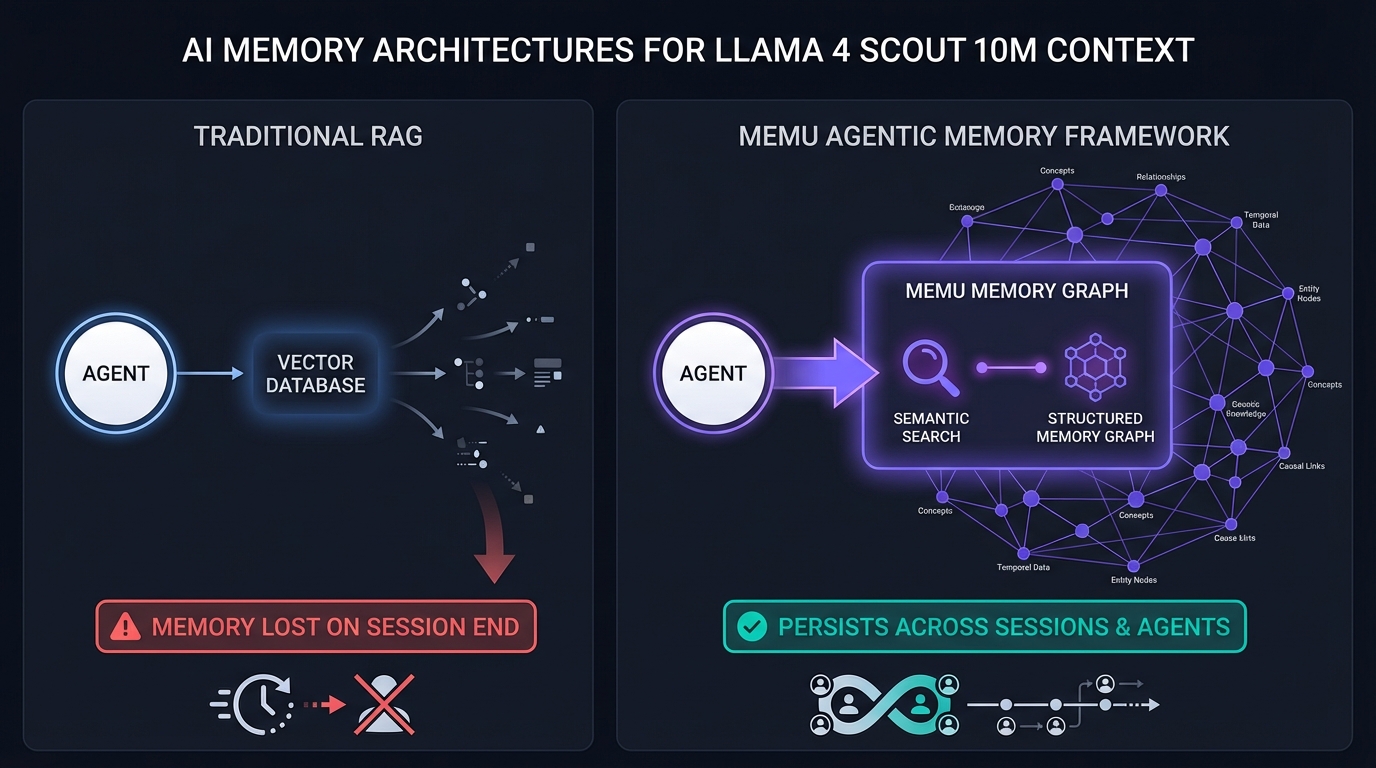
Within a session, Llama 4 Scout's attention mechanism processes the full 10M-token context with impressive coherence. The MoE architecture routes different aspects of the input to specialized expert networks, maintaining quality across the vast context span. Early benchmarks show strong performance on needle-in-haystack retrieval tasks even at maximum context length.
Llama 4 Maverick complements this with a focus on generation quality for creative and conversational workloads, though with a smaller context window. Together, the Llama 4 family covers both breadth (Scout) and depth (Maverick) of language understanding.
Neither model retains session context after the conversation ends. This matches every other LLM in production — context windows are ephemeral by architectural design. The 10M tokens processed by Llama 4 Scout exist only in GPU memory during inference. The model itself doesn't learn or retain information from your specific session.
The MemU Agentic Memory Framework: Persistence Beyond the Context Window
The MemU Agentic Memory Framework decouples memory from context windows entirely. Instead of re-processing millions of tokens every session, MemU captures the knowledge extracted from those tokens — relationships, patterns, decisions, insights — into persistent, structured memory.
Imagine a legal team processing a 10M-token contract archive with Llama 4 Scout. Session one identifies cross-references, conflicting clauses, and risk patterns across hundreds of documents. Without the MemU Agentic Memory Framework, session two must re-ingest and re-analyze the same archive. With MemU, session two retrieves the structured knowledge — which clauses conflict, which parties have overlapping obligations, which risk patterns were identified — in milliseconds, and focuses on new questions.
Three capabilities make this work:
- Knowledge extraction and persistence: The MemU Agentic Memory Framework captures not just raw text but structured relationships — entity connections, temporal sequences, causal patterns — from the agent's analysis.
- Context-efficient retrieval: Instead of feeding 10M tokens into every session, MemU retrieves the specific knowledge relevant to the current query. This reduces context consumption by orders of magnitude while preserving analytical continuity.
- Cross-session accumulation: Each session's discoveries add to the memory graph. The 10th session on the same document corpus has exponentially richer context than the 1st, without re-processing a single token.
A 10M token context window lets you process everything at once. The MemU Agentic Memory Framework lets you remember what you found — permanently.
Head-to-Head: Ephemeral Context vs. Persistent Memory
Llama 4 Scout alone: Process up to 10 million tokens per session with state-of-the-art MoE inference. Exceptional for single-pass analysis of massive documents. But every session starts from zero — the same 10M tokens must be re-ingested every time, with the same compute cost and latency.
Llama 4 Scout + MemU Agentic Memory Framework: First session processes the full context and extracts knowledge into persistent memory. Subsequent sessions retrieve relevant knowledge in sub-100ms, consuming a fraction of the context window. The agent builds cumulative understanding across sessions rather than repeating analysis.
The same limitation applies to Gemini's 2M token window and Claude's 1M token context — larger windows improve single-session capacity but don't solve cross-session continuity. The MemU Agentic Memory Framework works with any model, any context size.
Empowering Llama 4 Scout: Better Together
MemU doesn't compete with Llama 4 Scout's context window — it extends its value beyond a single session.
- Codebase analysis at scale: Llama 4 Scout ingests your entire codebase in one pass. MemU remembers the architectural patterns, dependency relationships, and technical debt identified — so the next coding session starts with accumulated understanding, not a fresh parse.
- Research synthesis: Process hundreds of papers with Llama 4 Scout's massive context. The MemU Agentic Memory Framework retains cross-paper connections, contradictions, and synthesis insights across research sessions.
- Multi-model workflows: Use Llama 4 Scout for heavy ingestion and Maverick for generation — with MemU providing shared memory across both models and all sessions.
Get Started with MemU
Llama 4 Scout's 10M token context window is a genuine breakthrough for open-source AI. The MemU Agentic Memory Framework ensures that breakthrough compounds over time instead of resetting with every session. A drop-in API integrates with any Llama 4 deployment — cloud or local.
Visit memu.pro to explore the Agentic Memory Framework API, or check out the open-source repository on GitHub to start building persistent memory into your Llama 4 workflows today.
Tags: Llama 4 Scout, Llama 4 Maverick, open-source AI, agentic memory, context window, MemU AI, LLM memory, mixture of experts