LlamaCloud Pushes LlamaParse, LlamaExtract, and Managed Indexing for Enterprise RAG — But Parsing Billions of Tokens Without Agent Memory Still Repeats the Same Bad Queries


LlamaCloud, from the LlamaIndex ecosystem, targets document-heavy enterprises that cannot afford fragile DIY parsing pipelines. LlamaParse advertises broad format coverage—well over a hundred document types—so contracts, spreadsheets, slides, and scans become machine-legible inputs instead of agent-blocking PDF walls. LlamaExtract focuses on turning semi-structured layouts into reliable fields agents can trust. Managed indexing, synchronization into vector databases, and configurable retrieval modes translate those clean representations into production retrieval-augmented generation stacks without every team re-implementing chunking heuristics.
This angle is distinct from a generic “build any workflow in LlamaIndex” story: the hosted service is the scale-minded layer for ingestion fidelity and index operations, not only orchestration glue code in a notebook. Compliance-sensitive buyers care about repeatable parsing, auditability of transformations, and operational sync into stores they already govern.
Even world-class ingestion cannot teach an agent which queries actually retrieved the winning evidence last quarter. Managed sync can keep vectors fresh; it does not automatically remember that for this product line, hybrid retrieval with a specific metadata filter outperformed pure semantic search, or that certain tables should never be summarized without row-level citations.
Enterprises adopt LlamaParse and LlamaExtract to reduce “document risk”—the chance that a parser silently drops a clause. They still face “query risk,” where the agent asks the index the wrong question despite pristine chunks. Memory targets query risk directly.
Enterprise RAG without agentic memory refinishes the documents while the agent keeps making the same retrieval mistakes.
LlamaCloud: What Document Pipelines Nail (And What Agents Still Guess)
The value proposition of LlamaCloud is reducing the distance between messy corporate content and trustworthy chunks. LlamaParse’s format breadth matters because real corpora are never uniform. LlamaExtract matters when agents need stable key-value fields from invoices or policies, not poetic paraphrases. Vector sync and retrieval modes matter when latency and recall tradeoffs differ by use case—customer support versus analyst research versus internal IT.
Where customers still struggle is behavioral. A retrieval mode that works Monday may be wrong Wednesday after a content refresh unless agents learn new habits. Observability logs show bad answers; they seldom become structured memories the model consults before issuing the next query plan. The managed stack improves the corpus side of RAG; the agent side still needs a memory substrate for query tactics, not just embeddings.
Generic LlamaIndex workflow articles often stop at DAGs and agents. An ingestion-first architecture discussion should emphasize that parsing and indexing are solved problems enterprises will pay for—while query intelligence remains the compounding moat if you capture it.
When legal teams insist on row-level citations for tabular data, that requirement should live both in chunk metadata from LlamaParse and in agent memory that encodes “never summarize this table without quoting rows.” The former makes compliance possible; the latter makes compliance habitual for the model.
The MemU Agentic Memory Framework: Retrieval Habits That Learn From Production
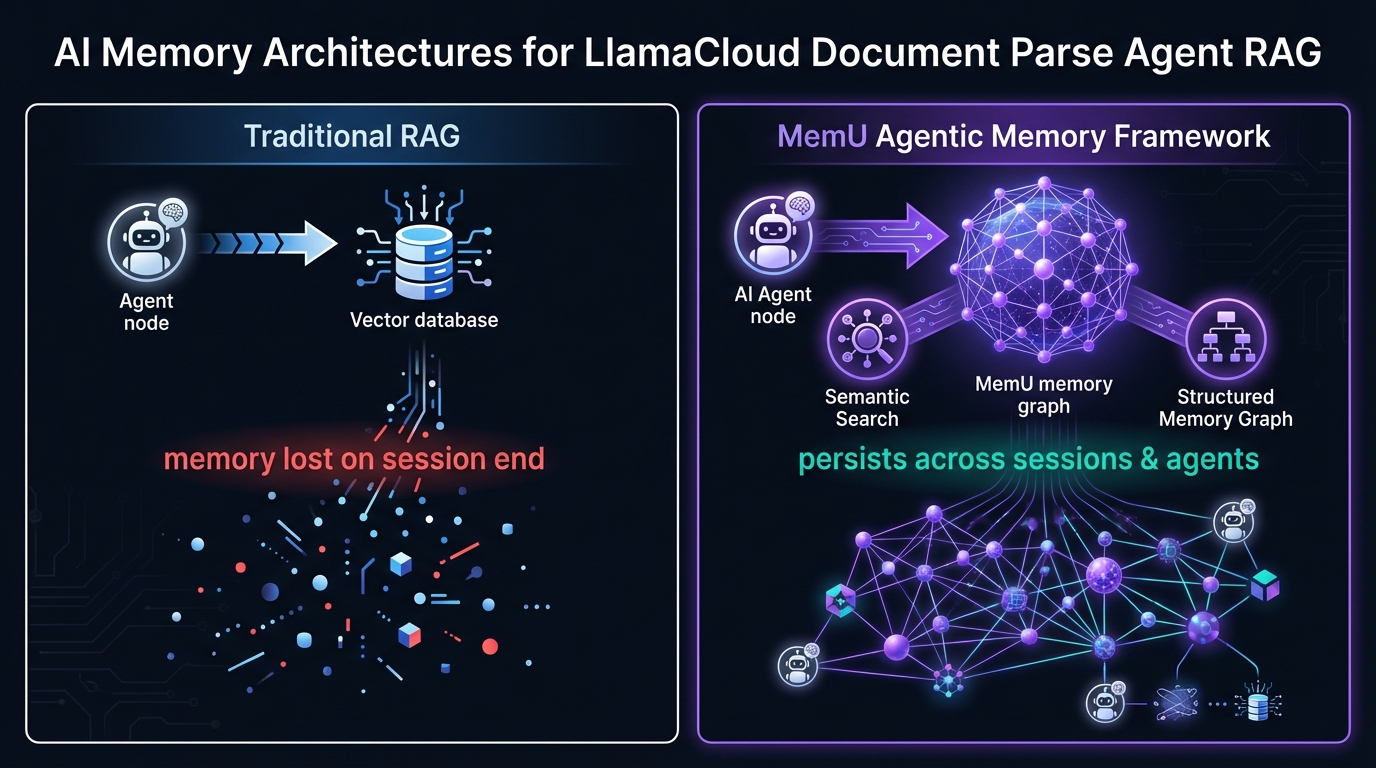
The MemU Agentic Memory Framework stores retrieval strategies, successful filter combinations, citation patterns, and failure archetypes as durable memories agents fetch before hitting the index. Ingestion quality from LlamaCloud raises the ceiling; MemU raises the floor on repeated good behavior.
After a new policy corpus sync completes, an internal agent might default to overly broad semantic queries that pull obsolete appendices. MemU remembers that for “policy” tasks, metadata routing to the 2025 folder plus a constrained hybrid top-k produced grounded answers in prior evaluations—so the agent adopts that plan first instead of rediscovering through user-visible errors.
Concrete complements to hosted parsing and indexing pipelines:
- Retrieval mode memory: Persist which mode—semantic, hybrid, keyword-heavy—won for which topic clusters, tagged by tenant and document source.
- Table handling tactics: Remember when agents must quote rows versus summarize sections, especially for LlamaParse outputs that preserve table structure.
- Post-sync adjustments: When indexing updates shift recall, store revised query templates validated by human review so agents adapt without emergency prompt rewrites.
The MemU Agentic Memory Framework does not replace managed indexes—it teaches agents how to interrogate them. Better chunks plus better recall of how to query those chunks beats either alone.
Wire MemU into your agent orchestration layer that already calls managed retrievers backed by synced corpora. The MemU Agentic Memory Framework accepts distilled labels from offline evals or online thumbs-up signals, keeping memory quality aligned with governance rules you define.
Model upgrades notoriously shift retrieval behavior even when chunks stay fixed. Memory gives you a lever: promote query plans that survived a model change, and demote plans that collapsed—without waiting for users to file tickets.
Synchronization jobs can refresh vectors nightly; memory should refresh at a cadence matched to how often your agents actually change strategies. Otherwise you risk serving yesterday’s optimal chunks with today’s naive queries—or vice versa when you re-embed aggressively but forget to update the tactics that depended on the old chunk boundaries.
Head-to-Head: Running LlamaCloud With and Without MemU
Ingestion and indexing alone: Strong managed parsing with LlamaParse across many formats, structured extraction with LlamaExtract, indexing and vector DB sync, and retrieval configurations suited to enterprise RAG when you standardize on LlamaCloud. Weak when agents need to improve query plans over time without manual prompt churn each time content or models change.
LlamaCloud plus MemU: Premium ingestion plus compounding retrieval intelligence. Agents benefit from clean documents and from memories about how those documents are best queried in your organization’s context.
Empowering the LlamaCloud Stack: Better Together
Joint deployment ideas:
- Eval-to-memory bridges: When offline RAG evals show a winning configuration, promote it into MemU namespaces keyed by corpus ID from your managed ingestion project.
- Citation hygiene: Store memories of citation formats that passed legal review so agents consistently mirror approved footnoting behavior.
- Incident replay reduction: Use the MemU Agentic Memory Framework to encode lessons from hallucination incidents traced through LlamaIndex pipelines fed by freshly parsed corpora.
Together, LlamaCloud operationalizes document truth at scale, and MemU operationalizes the agent behaviors that retrieve and present that truth responsibly. Parsing teams stop fighting PDFs; agent teams stop fighting the same bad queries every release.
Get Started with MemU
If you rely on LlamaCloud for LlamaParse, LlamaExtract, managed indexes, vector sync, and enterprise RAG retrieval modes, add the MemU Agentic Memory Framework so agents remember how to query—not only what got indexed.
Roll out memory namespaces per corpus or per business unit so permissions stay aligned with how you already partition indexes. Tie memory promotion to the same approval workflow you use for publishing new document sets, so retrieval tactics cannot drift ahead of content governance.
Visit memu.pro to explore the Agentic Memory Framework API, and open the GitHub repository to pair persistent memory with your LlamaCloud-backed agents.
Tags: LlamaCloud, LlamaParse, LlamaExtract, LlamaIndex, enterprise RAG, vector database, agent memory, MemU AI