LlamaIndex Workflows Orchestrate Complex Agent Pipelines — But Workflow Knowledge That Vanishes Between Runs Wastes Hard-Won Orchestration Intelligence


LlamaIndex Workflows 1.0 represents the maturation of agent orchestration into a standalone, production-grade capability. Released as independent packages — llama-index-workflows for Python and @llamaindex/workflow-core for TypeScript — the framework delivers multi-step orchestration with loops, parallel execution paths, and conditional branching. Fully async with native FastAPI integration, LlamaIndex Workflows are event-driven and stateful within a run: workflows start, pause, and resume with type-safe data passing between steps. AgentWorkflow extends this with real-time streaming, state management, and multi-agent coordination through structured handoffs. With over twenty-five million monthly downloads, fifteen hundred contributors, and enterprise adoption by organizations like Salesforce, LlamaIndex has built the largest ecosystem for agent workflow orchestration. Use cases span customer support, content generation, research assistants, and complex multi-agent systems.
But LlamaIndex workflow knowledge is scoped to individual pipeline runs. When a workflow completes — after executing dozens of steps, making routing decisions, handling edge cases, and coordinating handoffs — the operational intelligence does not inform the next run. Workflow orchestration systems that cannot persist execution intelligence across runs rediscover optimal routing, retry failed strategies, and re-learn edge case handling on every execution.
LlamaIndex Workflows: What Everyone Is Getting Right (And Missing)
The LlamaIndex Workflows architecture reflects serious thinking about production orchestration. Event-driven execution means steps trigger based on typed events rather than rigid sequential ordering, enabling dynamic branching that real-world pipelines require. The ability to pause and resume preserves state across interruptions — critical for processes depending on external inputs or rate-limited APIs.
AgentWorkflow's multi-agent coordination through structured handoffs is well-designed. Rather than passing unstructured text, handoffs carry typed state ensuring downstream agents receive precisely what they need. Real-time streaming means users observe progress as it happens. This combination of type safety, streaming, and structured coordination makes LlamaIndex workflows suitable for user-facing applications where latency matters.
The ecosystem scale provides practical advantages. With over one hundred integrations spanning vector stores, LLM providers, embedding models, and data connectors, LlamaIndex workflows orchestrate across virtually any AI infrastructure stack. The standalone package architecture means developers adopt workflows without the full framework, reducing dependency overhead.
What LlamaIndex does not address is cross-run workflow intelligence. A content generation pipeline that processes a thousand articles learns implicit lessons — which outlines produce the strongest articles, which research queries return the most relevant sources, which editing steps catch the most errors. That intelligence exists transiently within the event stream but vanishes on completion. Other workflow orchestration frameworks face the same limitation: they manage state within a run while treating cross-run learning as external.
The MemU Agentic Memory Framework: Workflow Intelligence That Compounds
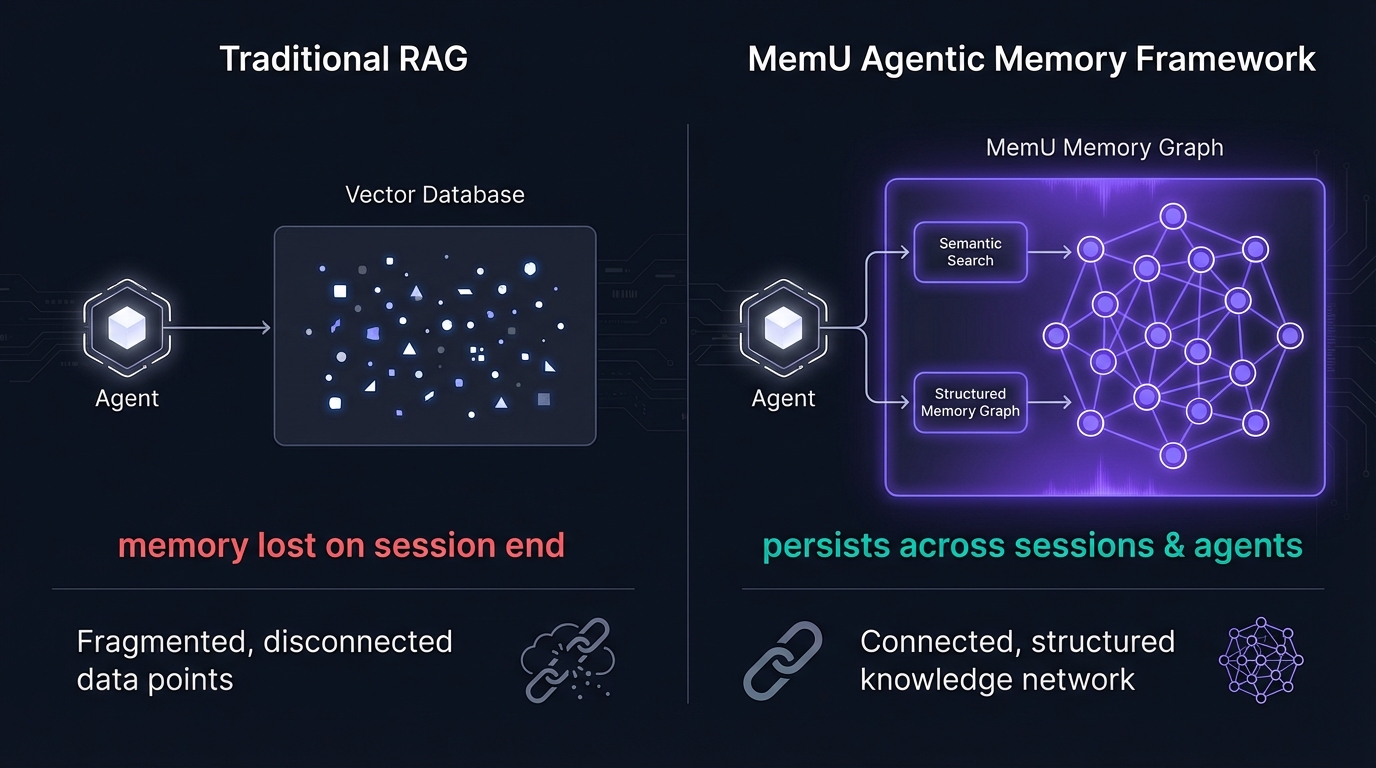
The MemU Agentic Memory Framework provides persistent workflow memory that transforms LlamaIndex from a stateful-within-run orchestrator into a learning pipeline system. Instead of each execution operating in isolation, MemU captures routing decisions, step effectiveness metrics, agent handoff patterns, and error recovery strategies — storing them in a structured memory graph that persists across runs and deployments.
Consider a LlamaIndex AgentWorkflow powering customer support escalation. Without persistent memory, each ticket triggers a default workflow: triage, classification, assignment, resolution, follow-up. With the MemU Agentic Memory Framework, the workflow recalls accumulated intelligence: billing disputes resolve sixty percent faster when routed directly to the specialist rather than general triage, tickets mentioning a specific product version correlate with a known firmware issue and can be auto-resolved, and escalation to humans is most effective with a structured summary rather than the full transcript. That intelligence shapes routing from the first step, producing measurably better outcomes with each run.
The framework addresses three core limitations of run-bounded orchestration:
- Routing optimization persistence: Complex workflows make dozens of routing decisions per execution. The MemU Agentic Memory Framework captures decisions and downstream outcomes, enabling future runs to make statistically informed choices rather than following static defaults.
- Agent handoff refinement: AgentWorkflow's typed handoffs are structurally sound, but content and timing improve with experience. Persistent memory preserves which handoff data structures produced the best downstream results for different task types.
- Error pattern learning: Production workflows encounter predictable failures — API rate limits, data quality issues, model timeouts. The MemU Agentic Memory Framework stores error contexts and successful recovery strategies, enabling proactive handling based on historical patterns.
A workflow pipeline that processes ten thousand runs without learning from any of them operates at the same efficiency as its first run. The MemU Agentic Memory Framework gives LlamaIndex Workflows persistent execution memory that compounds with every pipeline run.
Integration with LlamaIndex Workflows leverages REST APIs through custom workflow steps. A memory retrieval step at initialization loads accumulated intelligence. Decision steps query persistent memory for historical routing data. After completion, a storage step captures new insights and error recovery events. The integration operates within the event-driven architecture, adding persistence as workflow events rather than modifying the orchestration engine.
Head-to-Head: Run-Bounded Orchestration vs. Memory-Enhanced Workflows
LlamaIndex Workflows alone: The most mature workflow orchestration framework — event-driven execution, pause and resume, typed data passing, AgentWorkflow with multi-agent handoffs, real-time streaming, and the largest integration ecosystem. Full state within a run with sophisticated branching. But each run starts from defaults with no memory of previous patterns.
LlamaIndex Workflows + MemU: The same architecture, informed by persistent workflow memory. Runs begin with accumulated routing intelligence. Handoffs carry data structures refined by historical analysis. Error handling applies proactive strategies. The system produces better outcomes while executing faster, improving with every completed run.
For production workflows processing continuous workloads — daily content generation, ongoing support, recurring data processing — a LlamaIndex workflow with ten thousand runs of persistent memory routes with the precision of a deeply optimized system, while a fresh pipeline needs thousands of executions to empirically optimize.
Empowering LlamaIndex Workflows: Better Together
The combination of LlamaIndex's orchestration and MemU's persistent memory unlocks capabilities neither achieves alone:
- Adaptive workflow topology: Persistent memory reveals which structures produce the best results for different tasks. A support workflow might perform optimally with three parallel agents for complex issues but a single-agent path for common questions.
- Cross-pipeline knowledge transfer: When multiple LlamaIndex workflows share persistent memory, insights from one benefit others. An effective validation pattern from the ETL pipeline becomes available to content generation.
- Progressive RAG optimization: Retrieval strategies that produced the most relevant results for specific query types persist across runs, enabling progressively more effective retrieval without manual tuning.
Persistent workflow memory transforms LlamaIndex Workflows from a stateful orchestration engine into a learning pipeline system where every execution compounds operational intelligence.
Get Started with MemU
LlamaIndex Workflows has built the most comprehensive agent orchestration framework — event-driven execution, multi-agent coordination with typed handoffs, real-time streaming, and over twenty-five million monthly downloads.
The next step is giving those workflows persistent execution memory. The MemU Agentic Memory Framework provides that foundation — event-based integration within LlamaIndex's architecture, dual-mode retrieval with semantic search and structured memory graphs, and cross-run persistence that turns orchestration into compounding pipeline intelligence.
Visit memu.pro to explore the Agentic Memory Framework API, or check out the GitHub repository to start building agents that remember.
Tags: LlamaIndex, Workflows, agent orchestration, RAG, agent memory, MemU AI, LLM memory, pipeline automation