Lyzr Hits $250M Valuation With Accenture-Backed Agent Orchestration — But Orchestrated Agents Without Shared Memory Orchestrate in Isolation


Lyzr closed a $14.5 million Series A+ round in March 2026, reaching a $250 million valuation with strategic backing from Accenture and existing investors. The company builds an enterprise-grade agent orchestration platform that provides SDKs for constructing autonomous agents, coordinating multi-agent workflows, and enforcing governance guardrails across complex enterprise environments. For organizations deploying dozens or hundreds of AI agents across departments, the platform offers the orchestration backbone that keeps agent fleets coordinated, compliant, and productive at enterprise scale.
But orchestration without shared memory means each orchestration cycle begins from scratch. Agents that are perfectly coordinated in the moment but carry no memory of previous orchestration outcomes are condemned to repeat the same coordination patterns without ever improving from experience.
Agent Orchestration: What Everyone's Getting Right (And Missing)
Lyzr gets the orchestration layer right. Providing SDKs that allow enterprises to build, deploy, and coordinate autonomous agents with built-in guardrails addresses a critical enterprise infrastructure need. Without proper orchestration, multi-agent deployments devolve into operational chaos — agents duplicating work, conflicting with each other's outputs, and operating without governance oversight. The platform ensures enterprise AI agents work as coordinated teams rather than isolated units, with the security controls and compliance enforcement that large-scale deployments demand.
What agent orchestration platforms have not fully solved is persistent shared memory across orchestration cycles. The platform coordinates agents brilliantly within the current execution window; but when the next orchestration cycle begins, the accumulated insights from previous runs — which agent combinations performed best, which workflows encountered bottlenecks, which data sources proved most valuable for specific tasks — are not automatically available to inform the new cycle. Enterprise AI agents orchestrated without shared memory repeat the same coordination patterns indefinitely without learning from outcomes.
Other agent orchestration platforms — CrewAI, LangGraph, AutoGen, Microsoft Semantic Kernel — share this same architectural gap. They manage the mechanics of coordination effectively; none of them provide persistent memory that spans orchestration lifecycles and accumulates institutional intelligence over time.
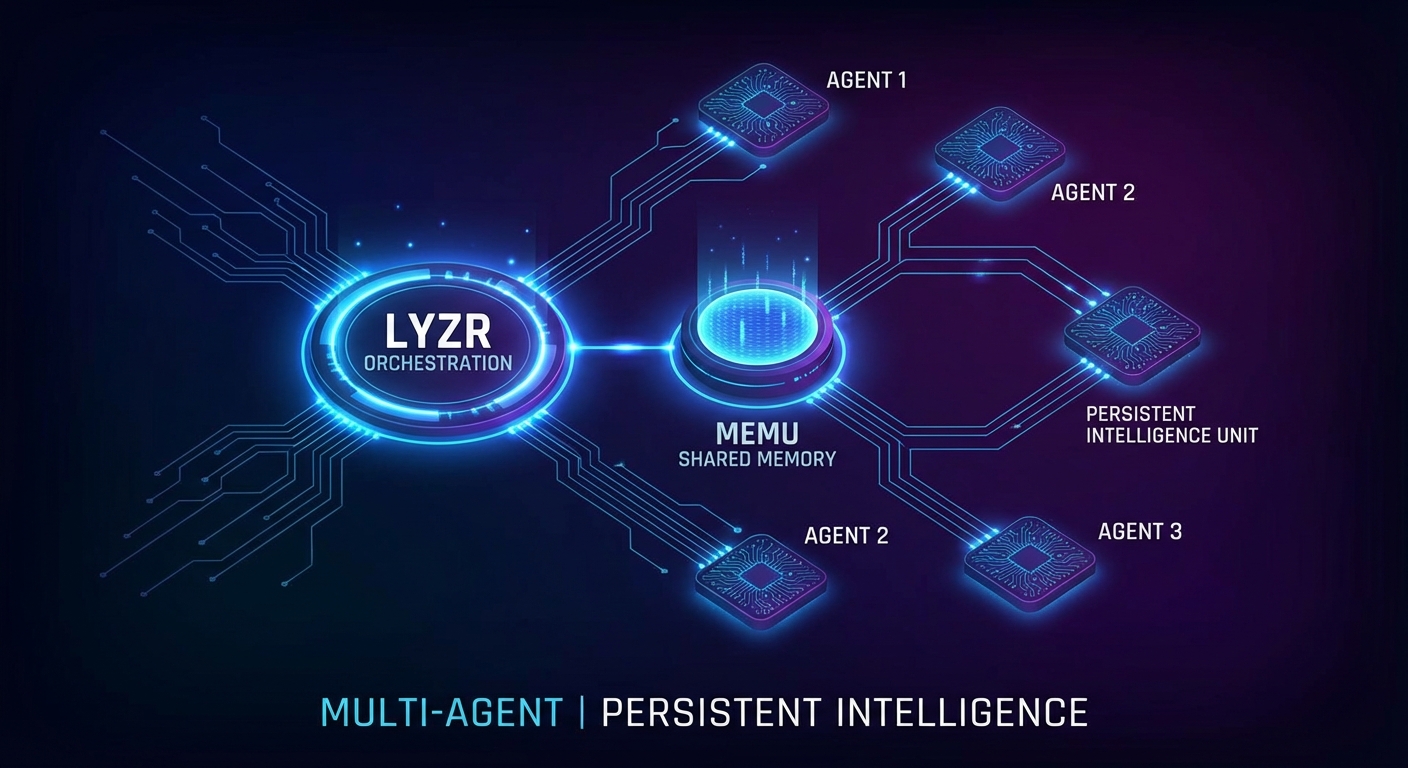
The MemU Agentic Memory Framework: Persistent Memory for Agent Orchestration
The MemU Agentic Memory Framework adds the missing memory layer. Where Lyzr manages real-time agent orchestration and governance enforcement, MemU manages the institutional knowledge that those orchestration cycles produce across weeks and months of continuous enterprise operation.
Consider an enterprise deploying Lyzr to orchestrate a fleet of enterprise AI agents handling customer onboarding. One agent verifies identity documents, another checks regulatory compliance requirements, a third provisions account access and permissions, and a fourth sends personalized welcome communications. With the MemU Agentic Memory Framework integrated, each agent in the fleet accesses shared persistent memory: the compliance agent knows that this customer type typically requires additional KYC documentation based on patterns from thousands of previous onboardings, the provisioning agent recalls that similar enterprise accounts need specific access configurations that differ from standard setups, and the communication agent remembers which welcome sequences produced the highest engagement rates for this particular customer segment.
The MemU Agentic Memory Framework provides:
- Shared agent memory: All agents in an orchestrated workflow read from and write to a persistent memory layer. Knowledge discovered by one agent becomes immediately available to every other agent in the fleet — not locked inside individual agent context windows that vanish after execution.
- Cross-cycle persistence: Memory survives across orchestration runs indefinitely. The insights from today's orchestration cycle inform tomorrow's execution automatically, creating agent systems that measurably improve with every cycle rather than resetting to baseline.
- Orchestration intelligence: Which agent combinations produce optimal results, which workflows encounter friction points, and which task assignments maximize throughput — all stored as retrievable operational memory that the orchestration layer can query before assigning work.
Agent orchestration without shared memory is coordination without institutional knowledge. The MemU Agentic Memory Framework gives orchestrated enterprise AI agents the persistent context that transforms mechanical coordination into adaptive enterprise intelligence that compounds over every execution cycle.
Memory retrieval operates at sub-100ms latency across tens of thousands of entries, ensuring shared memory never becomes a performance bottleneck in the high-throughput orchestration pipelines that enterprise clients require for production workloads.
Head-to-Head: MemU vs. Agent Orchestration Alternatives
Lyzr alone: Enterprise AI agents are orchestrated with SDKs, guardrails, and multi-agent coordination capabilities in real-time. Each orchestration cycle executes efficiently with well-defined agent roles, clear governance boundaries, and structured handoffs. But when the cycle completes, the coordination intelligence — what worked, what failed, what could be optimized for next time — exists only in execution logs, not in accessible shared agent memory that future cycles can query.
Lyzr + MemU Agentic Memory Framework: Every orchestration cycle reads from and writes to persistent shared memory. The platform recalls that a specific three-agent workflow for invoice processing reduced error rates by 40% compared to the original five-agent design and automatically applies the optimized configuration. It remembers that a particular agent combination causes resource contention during peak business hours and avoids that pairing. It knows which data preprocessing steps eliminated downstream failures for specific document types and applies those transformations proactively.
Enterprise learning at scale: With MemU, the agent orchestration platform accumulates enterprise intelligence across thousands of orchestration cycles. Each run makes the system measurably smarter than the previous one. Without persistent shared memory, even the most sophisticated orchestration framework operates at the same intelligence level on day one thousand as it did on day one — technically coordinated but institutionally empty.
Empowering Agent Orchestration: Better Together
MemU does not replace Lyzr — it makes enterprise AI agents dramatically more capable across every orchestration scenario:
- Workflow optimization: The platform orchestrates multi-agent workflows with precision; MemU provides historical performance data across thousands of previous runs that identifies optimal agent configurations, task assignments, and execution sequences for each unique workflow type.
- Guardrail intelligence: The platform enforces compliance guardrails in real-time; MemU remembers which specific edge cases triggered guardrail violations in previous cycles, enabling preemptive compliance enforcement rather than reactive violation handling after the fact.
- Cross-department intelligence: When agent orchestration spans sales, support, and operations simultaneously, MemU ensures that customer intelligence gathered by one department's agents is immediately available to all others — eliminating the information silos that plague enterprise AI deployments and cause inconsistent customer experiences.
- Continuous improvement: Each orchestration cycle with MemU produces structured improvement data. Agent coordination evolves from static workflow execution into a self-improving system where every single run contributes to the organization's institutional knowledge base.
Get Started with MemU
Add persistent shared memory to your agent orchestration platform in minutes. The MemU Agentic Memory Framework works alongside Lyzr or any orchestration framework — one API, zero vendor lock-in, immediate shared intelligence across your entire agent fleet. Whether you are orchestrating enterprise agent deployments with platform SDKs or building custom multi-agent systems from scratch, MemU provides the persistent memory layer that transforms isolated orchestration cycles into continuously learning enterprise intelligence.
Visit memu.pro to explore the Agentic Memory Framework API, or check out the GitHub repository to start building agents that remember.