Manus AI Completes 50-Step Tasks Autonomously — But Every New Task Starts Without Any Prior Experience

Manus AI is the general-purpose autonomous agent that broke the internet. Developed by Monica.im's team and launched in early 2026, Manus AI executes complex, multi-step tasks end-to-end — from researching competitors to building travel itineraries to generating complete project plans — all without human intervention. It topped the GAIA benchmark, outperforming OpenAI's Deep Research and other agentic systems. The AI community hasn't stopped talking about Manus AI since.
What makes Manus AI remarkable is its ability to chain dozens of actions: browsing the web, writing code, managing files, querying databases, and synthesizing results into polished deliverables. It doesn't just answer questions — it completes work. A single prompt can trigger a 50-step workflow that would take a human analyst hours.
But here's the structural gap everyone overlooks: Manus AI treats every task as its first. The agent that spent 45 minutes deeply researching your industry yesterday has zero recollection of that work today.
Manus AI: What Everyone's Getting Right (And Missing)
The excitement around Manus AI is justified. Autonomous task completion represents a genuine leap from chatbot-style AI. Instead of producing text that humans must act on, Manus AI produces outcomes — finished research reports, populated spreadsheets, deployed code. The GAIA benchmark results confirm that this isn't demo-ware; Manus AI handles real-world complexity better than any competing system tested.
The community is right to celebrate autonomous execution. But execution without accumulated experience means every task starts from the same baseline. The agent that learned your company's competitive landscape, your preferred analysis frameworks, and your industry's nuances during Monday's deep research applies none of that context to Wednesday's follow-up task.
This isn't a shortcoming unique to Manus AI. Autonomous agents across the industry — from OpenAI's Deep Research to Anthropic's computer use — share the same architectural constraint: session-scoped intelligence that dissolves on completion.
What Manus AI Does With Memory Today
Within a single task execution, Manus AI maintains impressive coherence. It tracks intermediate results, manages file state, and coordinates multi-step workflows through an internal sandbox environment. The agent reasons about dependencies between steps and adjusts its approach based on intermediate findings.
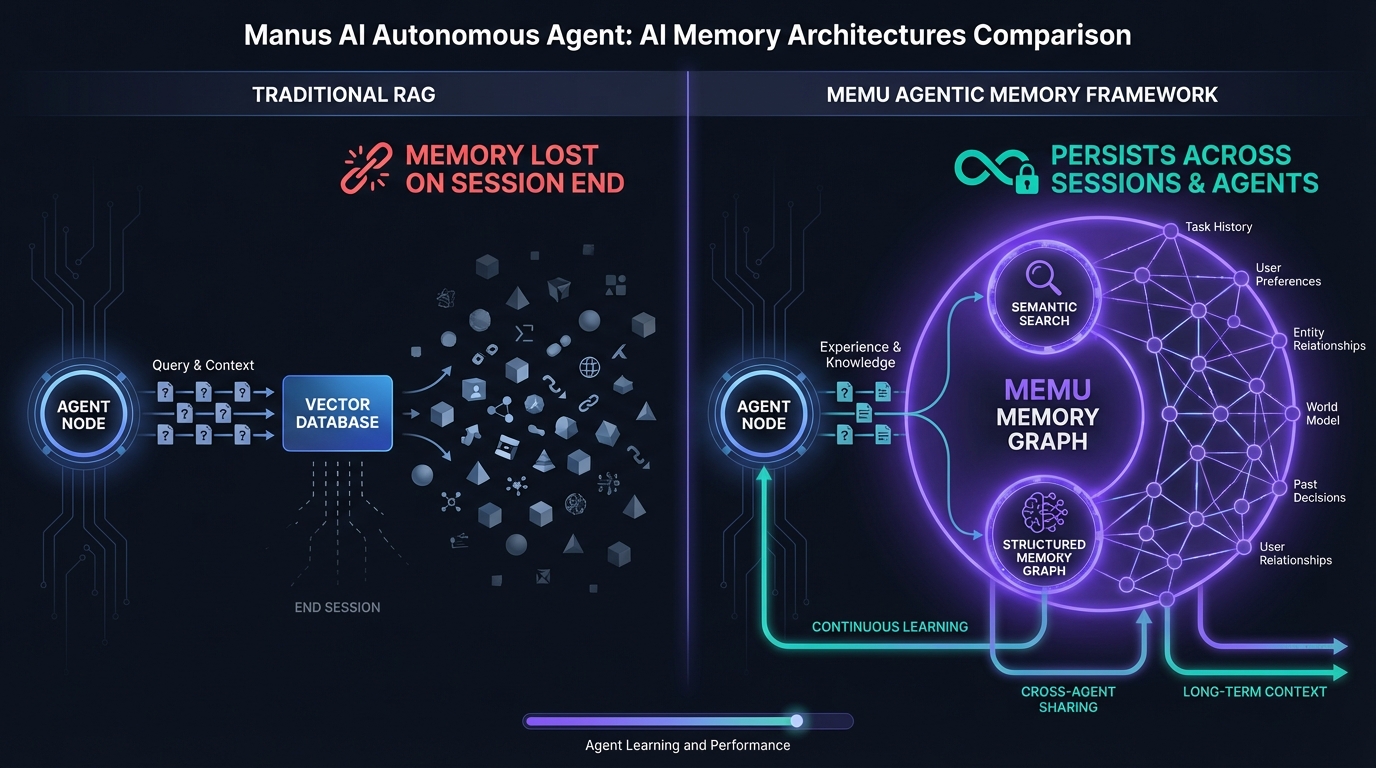
But this coherence is task-scoped. When the task completes, the sandbox resets. The browsing history, the code written, the research synthesized — all exist only in the final output artifact. The agent's understanding of what it discovered, which approaches worked, and which dead ends to avoid doesn't persist.
The 50th task you give Manus AI has the same starting context as the 1st — your prompt and nothing more. Deep Research from OpenAI and Claude's computer use feature operate under the same constraint. This is a category-wide architectural limitation, not a vendor-specific gap.
The MemU Agentic Memory Framework: Autonomous Agents That Accumulate Expertise
The MemU Agentic Memory Framework provides the persistent experience layer that transforms autonomous agents from capable executors into progressively expert systems. Rather than resetting after every task, MemU captures the agent's discoveries, successful strategies, and domain knowledge into structured, retrievable memory.
Consider a product team using Manus AI for weekly competitive analysis. Week 1, the agent spends 40 minutes discovering key competitors, their pricing models, and market positioning. Week 2, the same analysis repeats — same competitors rediscovered, same pricing pages re-scraped. With the MemU Agentic Memory Framework, Week 2's agent retrieves Week 1's competitive landscape instantly and focuses entirely on what changed.
The architecture enhances autonomous agents through three mechanisms:
- Task memory persistence: Discoveries, research findings, and intermediate insights from completed tasks persist as structured knowledge — not just output artifacts, but the reasoning and context behind them.
- Cross-task learning: Patterns that emerge across multiple tasks — which data sources are reliable, which approaches fail for specific domains, which output formats the user prefers — accumulate into agent expertise.
- Dual-mode retrieval: The MemU Agentic Memory Framework combines semantic search with a structured memory graph. The agent retrieves both conceptually similar past experiences and explicitly connected knowledge relationships.
MemU transforms autonomous agents from stateless executors into systems that get measurably better at your specific work over time.
Head-to-Head: Stateless Autonomy vs. Memory-Enhanced Autonomy
Manus AI alone: Exceptional multi-step task execution with web browsing, code generation, and file management. Each task benefits from the model's training knowledge but starts with zero task-specific experience. The 100th competitive analysis takes as long as the 1st.
Manus AI + MemU Agentic Memory Framework: Same autonomous execution plus persistent task memory. Previous research informs current tasks. The agent recalls which sources were valuable, which analysis frameworks produced the best results, and what domain-specific knowledge it accumulated. Sub-100ms memory retrieval adds negligible latency to task execution.
Deep Research and similar systems face the same limitation — sophisticated single-session research that cannot reference its own previous findings. The MemU Agentic Memory Framework is model-agnostic and integrates with any autonomous agent through a simple API.
Empowering Manus AI: Better Together
MemU doesn't replace Manus AI's autonomous execution — it provides the memory infrastructure that makes each execution more informed than the last.
- Recurring research workflows: Manus AI alone re-discovers context every session. With MemU, the agent builds cumulative domain knowledge — each research task starts from the last one's conclusions, not from scratch.
- Multi-user team intelligence: When different team members assign tasks to Manus AI, their collective discoveries feed into shared memory. One analyst's Monday breakthrough accelerates another analyst's Thursday task.
- Preference learning: Output format preferences, preferred data sources, analysis depth expectations — these accumulate in the MemU Agentic Memory Framework so the agent progressively adapts to how your team actually works.
Get Started with MemU
Manus AI represents the frontier of autonomous task completion. The MemU Agentic Memory Framework ensures that frontier capability compounds with every task. Integration requires a single API endpoint — the agent stores memories on task completion and retrieves relevant context at task start.
Visit memu.pro to explore the Agentic Memory Framework API, or check out the open-source repository on GitHub to start building persistent memory into your autonomous agent workflows today.
Tags: Manus AI, autonomous agents, agentic memory, AI task automation, MemU AI, general-purpose AI agent, persistent agent memory