Mastra Brings TypeScript-Native AI Agent Development to Production — But Agent Intelligence That Resets With Every Deployment Limits Long-Term Value


Mastra is the TypeScript-native AI agent framework built by the team behind Gatsby. It delivers an all-in-one platform covering agents, workflows, RAG pipelines, memory, tools, MCP integration, and built-in evaluations — all designed for the TypeScript ecosystem that powers modern web development. The developer studio enables iterating and visualizing agent behavior in real time. Built-in observability traces calls and token usage. Guardrails protect against prompt injection attacks. The framework integrates seamlessly with Next.js, Express, Hono, and SvelteKit, and developers can scaffold projects instantly with npm create mastra@latest. Released under the Apache 2.0 license with over twenty-two thousand GitHub stars, Mastra uses Zod-validated schemas for type-safe structured outputs and has been adopted by teams at Replit, Fireworks, and Medusa for internal copilots, customer assistants, data analysis pipelines, and DevOps automation.
But TypeScript-native agent intelligence has the same limitation as every other framework: it does not persist across application deployments. An agent that learns optimal workflow routing, refines RAG retrieval strategies, and develops effective tool selection patterns loses all of that operational intelligence when the application redeploys. Agent sophistication resets to baseline with every deployment cycle, discarding the accumulated knowledge that made previous sessions effective.
Mastra: What Everyone Is Getting Right (And Missing)
The framework's approach to design is notably developer-friendly. By building natively in TypeScript rather than wrapping Python libraries, Mastra eliminates the impedance mismatch that frontend and full-stack teams face when integrating AI agents into web applications. Zod-validated schemas mean agent outputs conform to expected types at compile time, catching integration errors before they reach production. The developer studio provides the kind of visual iteration experience that accelerates agent development from weeks to days.
The all-in-one architecture reduces operational complexity significantly. Instead of stitching together separate tools for agents, workflows, RAG, and evaluations, the platform delivers a cohesive system where components share context and configuration. Framework-level integrations with Next.js and SvelteKit mean agents deploy alongside existing web applications without infrastructure overhead. Built-in evaluations provide quality feedback loops that most frameworks leave to third-party tools. MCP integration positions Mastra for the emerging standard in tool interoperability.
What the framework does not solve is the persistence of agent intelligence across deployment boundaries. Built-in memory handles session state within a running application. When the application redeploys — from feature updates, scaling events, or infrastructure changes — that session state clears. The agent that discovered optimal chunking strategies for RAG retrieval, learned which workflow branches resolve customer issues fastest, or identified the best tool combinations starts from default configurations. Other TypeScript agent frameworks face identical constraints: they optimize for developer experience within a deployment while treating cross-deployment intelligence as out of scope.
The MemU Agentic Memory Framework: Persistent Intelligence for TypeScript Agents
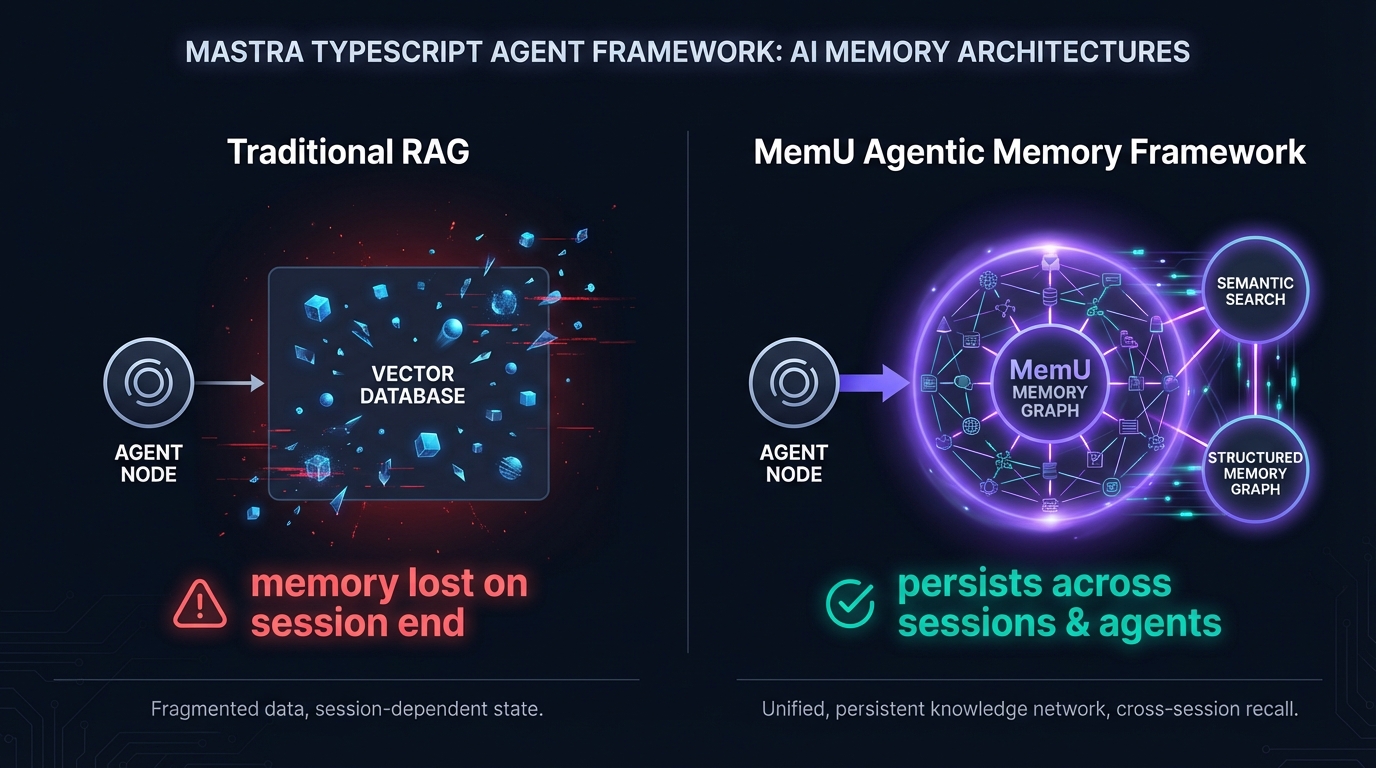
The MemU Agentic Memory Framework provides the persistent memory layer that transforms this development framework into a learning system. Instead of treating each deployment as an isolated application lifecycle, MemU captures operational intelligence — workflow routing decisions, RAG retrieval optimizations, tool selection patterns, and evaluation outcomes — storing it in a structured memory graph that persists across restarts, redeployments, and infrastructure migrations.
Consider a customer assistant built on this framework and deployed on Next.js. Without persistent memory, each deployment initializes with default RAG configurations and generic workflow routing. With the MemU Agentic Memory Framework, the assistant recalls operational history: product return inquiries resolve fastest when routed through the order-lookup workflow before the returns workflow, RAG retrieval for warranty documents performs best with a chunk size of five hundred tokens and overlap of fifty, and Zod validation errors on shipping address outputs dropped ninety percent after the schema was restructured based on three months of production data. That accumulated intelligence loads at startup, giving the freshly deployed application the sophistication of a system running continuously.
The framework addresses three core limitations of deployment-bounded intelligence:
- RAG optimization persistence: Effective retrieval configurations emerge through production experience. The MemU Agentic Memory Framework preserves which chunking strategies, embedding models, and retrieval parameters produced the best results for specific document types and query patterns.
- Workflow routing memory: Complex agent workflows involve branching decisions that improve with operational data. Persistent memory captures which branches resolved tasks fastest, enabling informed routing from the first request after deployment.
- Evaluation-driven improvement: Built-in evaluations generate quality signals that should compound over time. The MemU Agentic Memory Framework retains evaluation outcomes and the configuration changes they triggered, creating a continuous improvement loop that survives deployment cycles.
A TypeScript-native agent framework deserves TypeScript-native memory persistence. The MemU Agentic Memory Framework gives agents operational memory that survives deployments, turning every interaction into a permanent contribution to intelligence.
Integration leverages Mastra's extensible tool system and REST API patterns. At startup, accumulated intelligence loads from the memory graph through standard HTTP calls. During execution, agents query persistent memory for context on similar past tasks. New insights flow into the memory layer at shutdown or during operation. The integration uses Zod schemas to validate memory payloads with the same type safety applied to all other agent outputs.
Head-to-Head: Session Intelligence vs. Persistent Intelligence
Mastra alone: A comprehensive TypeScript-native agent framework with agents, workflows, RAG, tools, MCP integration, built-in evaluations, developer studio, observability, and seamless web framework integration. Zod-validated schemas provide compile-time type safety. Over twenty-two thousand GitHub stars and adoption by leading development teams. Session memory maintains state within a deployment. But every redeployment starts from default configurations.
Mastra + MemU: The same developer-friendly TypeScript architecture, now backed by persistent operational memory. Agents deploy with accumulated intelligence about workflow routing, RAG optimization, and tool selection. Evaluation outcomes compound across deployments. The system gets measurably better with every release cycle rather than resetting to baseline.
For teams shipping weekly or daily deployments — the standard cadence for modern web applications — the compounding effect is dramatic. An application with six months of persistent memory responds with the precision of a deeply tuned system, while a fresh deployment operates at day-one level regardless of how many requests the previous instance processed.
Empowering Mastra: Better Together
The combination of Mastra's TypeScript-native development experience and MemU persistent memory unlocks capabilities neither achieves independently:
- Cross-environment knowledge transfer: Development, staging, and production environments generate different operational insights. Persistent memory enables controlled transfer — production RAG optimizations inform staging configurations, while development experiments validate against production memory patterns.
- Progressive MCP optimization: As agents interact with MCP-connected tools, persistent memory captures which tool configurations and parameter combinations produce the best results. New integrations benefit from patterns learned through similar tools.
- Type-safe memory evolution: Zod schemas that validate agent outputs also validate memory structures. As capabilities evolve across deployments, memory schemas evolve alongside them with the same type safety guarantees, preventing memory corruption during rapid iteration.
Persistent memory transforms Mastra from the most developer-friendly agent framework into a developer-friendly learning agent framework — where TypeScript type safety extends from code to accumulated operational intelligence.
Get Started with MemU
Mastra has built the most complete TypeScript-native agent framework available — all-in-one agents, workflows, RAG, evaluations, MCP integration, developer studio, and seamless web framework compatibility under the Apache 2.0 license.
The next step is giving those TypeScript agents persistent operational memory. The MemU Agentic Memory Framework provides that foundation — API-based integration within the tool system, structured memory graphs with episodic, semantic, and procedural layers, and cross-deployment persistence that turns every interaction into compounding intelligence.
Visit memu.pro to explore the Agentic Memory Framework API, or check out the GitHub repository to start building agents that remember.
Tags: Mastra, TypeScript agents, agent framework, Gatsby team, agent memory, MemU AI, LLM memory, web framework AI