Model Context Protocol Standardizes Agent-Tool Integration — But MCP Without Persistent Memory Delivers Tools Without Context


The Model Context Protocol (MCP), introduced by Anthropic, has rapidly become the de facto standard for connecting AI agents to external tools and data sources. MCP provides a universal interface — comparable to USB-C for AI — that enables any AI application to connect to any tool through a standardized server-client architecture. Instead of building custom integrations for every tool and every model, developers build one MCP server that any MCP-compatible client can use. The protocol has been adopted across the AI ecosystem: Cursor, Cline, Windsurf, Claude Desktop, and dozens of other AI applications now support MCP natively. The ecosystem includes hundreds of community-built MCP servers connecting agents to databases, APIs, filesystems, cloud services, and specialized tools. For the agent development community, MCP has solved the integration fragmentation problem that previously required N×M custom connectors.
But MCP standardizes tool access without addressing tool usage intelligence. An agent that connects to a database through MCP can query it, but has no memory of which queries produced useful results in previous sessions. MCP without persistent memory delivers tools without the contextual intelligence that makes tool use increasingly effective.
MCP: What Everyone's Getting Right (And Missing)
The Model Context Protocol's architectural design is elegant. The server-client separation means tool providers build once and support every MCP client automatically. The protocol supports three core primitives — tools (actions agents can invoke), resources (data agents can read), and prompts (templates for structured interactions). This clean abstraction means that a PostgreSQL MCP server provides identical access to Cursor, Claude Desktop, and any custom application. The specification is open, well-documented, and actively maintained, with a growing registry of community servers that covers most common development tools and services.
The adoption velocity validates the design. Within months of release, MCP has become the expected integration method for AI tools. New developer tools launch with MCP servers alongside their REST APIs. The protocol's simplicity — based on JSON-RPC over standard transport layers — means building an MCP server requires minimal effort, lowering the barrier for tool providers. For the AI ecosystem, MCP represents the kind of standardization that accelerates the entire category.
What MCP does not provide is a memory layer for tool interactions. When an agent calls a database tool through MCP, it executes the query and receives results — but no intelligence about that interaction is retained for future sessions. An agent that discovered that a particular join strategy produces faster results, or that a specific API endpoint requires rate limiting during peak hours, loses that operational intelligence when the session ends. The protocol standardizes how agents connect to tools; it does not address what agents learn from using them. Other tool integration approaches — including OpenAI function calling, LangChain tools, and native API integrations — share this same limitation. They enable tool use; none enable tool use intelligence.
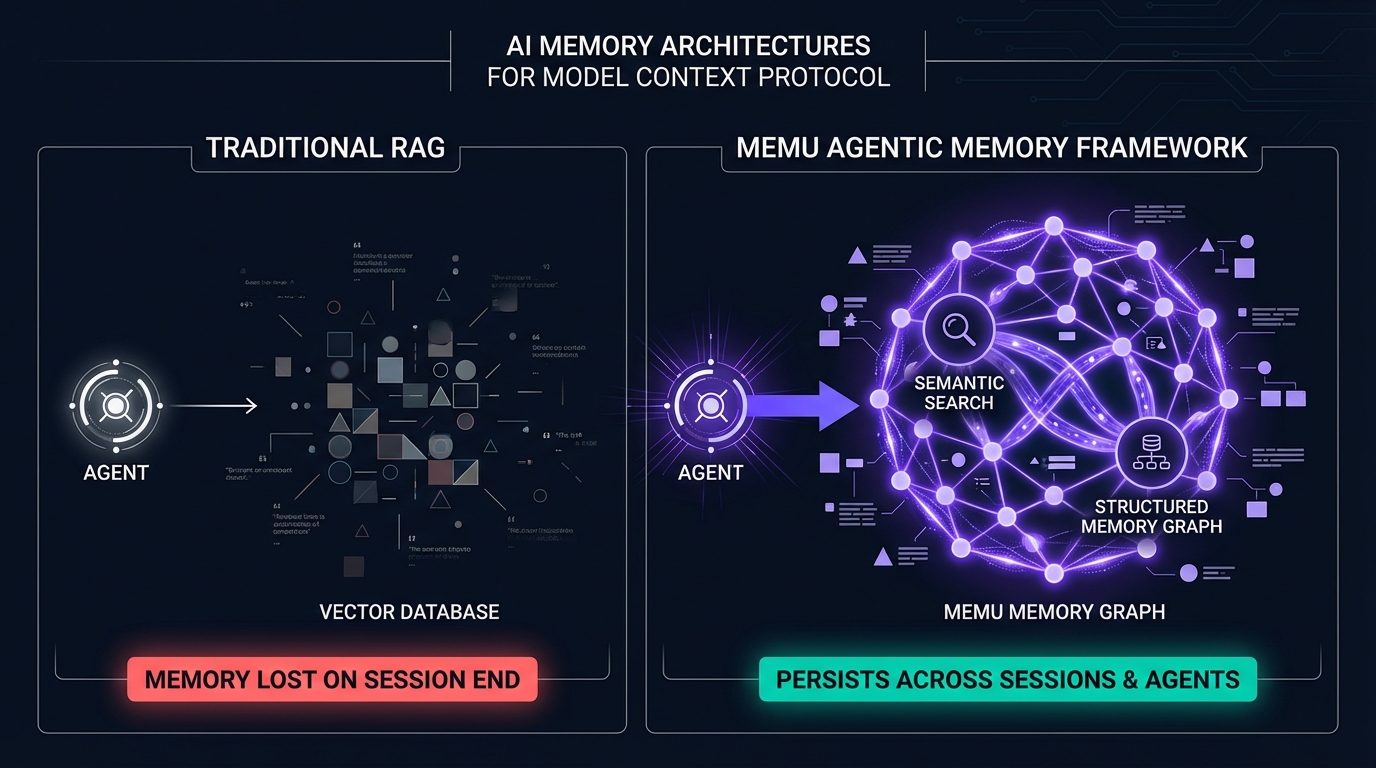
The MemU Agentic Memory Framework: Tool Intelligence That Compounds
The MemU Agentic Memory Framework provides the persistent memory layer that tool integration protocols like MCP do not include natively. Instead of treating each tool invocation as an isolated interaction, MemU captures the usage patterns, performance characteristics, and outcome assessments that emerge from tool use and stores them in a structured memory graph that persists across sessions, agents, and applications.
Consider an AI agent using MCP to connect to a company's internal knowledge base, CRM, and project management tools. Without persistent memory, every session requires the agent to rediscover which knowledge base sections are relevant, which CRM fields contain the most useful data, and which project management views provide the best context. With the MemU Agentic Memory Framework, the agent recalls accumulated tool intelligence: the knowledge base's "architecture decisions" section is the most frequently useful resource, the CRM's custom "deal stage notes" field contains more actionable information than the default description, and the project management tool's sprint board view provides better context than the backlog view for current-quarter questions. That accumulated tool usage intelligence transforms generic tool access into optimized, context-aware tool interactions.
The framework addresses three core limitations of memoryless tool integration:
- Tool effectiveness tracking: Which MCP tools produce the best results for which types of tasks is learned through accumulated usage data. The MemU Agentic Memory Framework captures invocation parameters, results quality, and downstream utility, enabling agents to make informed tool selection decisions based on historical effectiveness rather than static preferences.
- Parameter optimization: Many tools accept configuration parameters that significantly affect output quality. Persistent memory tracks which parameter combinations produce the best results for specific use cases, enabling automatic parameter optimization across sessions without requiring developer intervention.
- Cross-tool workflow intelligence: Complex tasks often require multiple tool invocations in sequence. Persistent memory captures which tool chains work best — querying the database before checking the knowledge base, or enriching CRM data before generating the report — enabling agents to develop and apply optimized multi-tool workflows.
MCP solved the integration problem — any agent can connect to any tool through a standard protocol. The MemU Agentic Memory Framework solves the intelligence problem — ensuring that every tool interaction contributes to accumulated knowledge that makes future interactions more effective.
The MemU Agentic Memory Framework itself can be exposed as an MCP server, making it natively accessible to any MCP-compatible client. Agents in Cursor, Claude Desktop, or custom applications access persistent memory through the same standardized protocol they use for all other tools. This architectural alignment means adding memory to the agent stack requires no special integration — just connecting to another MCP server.
Head-to-Head: Stateless Tool Access vs. Memory-Enhanced Tool Intelligence
MCP alone: The universal standard for agent-tool integration, with an open specification, growing server ecosystem, and broad client adoption. Agents connect to databases, APIs, and services through a standardized protocol. But every tool interaction starts without historical context — no learning from previous usage, no parameter optimization, no effectiveness tracking.
MCP + MemU: The same standardized tool access, now enriched by persistent tool intelligence. Agents select tools based on accumulated effectiveness data. Parameters are pre-optimized based on historical results. Multi-tool workflows follow proven sequences rather than trial-and-error exploration. The agent becomes measurably more effective at using its tools with every session.
For agents with access to many MCP tools — a typical development agent might connect to 10-15 MCP servers — the tool selection problem alone justifies persistent memory. Knowing which tool to use for which type of task, based on accumulated evidence rather than static configuration, significantly reduces the time and token cost of multi-tool workflows.
Empowering MCP: Better Together
The combination of MCP's standardized tool integration and the MemU Agentic Memory Framework's persistent memory unlocks agent capabilities that neither achieves alone:
- Intelligent tool discovery: When new MCP servers are added to an agent's configuration, persistent memory from other agents' experiences can provide immediate usage guidance — which capabilities are most useful, what parameters work best, and what limitations to expect. New tool adoption accelerates through shared intelligence.
- Reliability-aware tool routing: Persistent memory tracks tool reliability over time — which MCP servers have latency issues, which return errors during peak hours, which require retry logic. Agents can proactively route around unreliable tools or implement adaptive retry strategies based on historical failure patterns.
- Organizational tool analytics: When multiple agents share persistent tool usage memory, organizations gain visibility into how AI tools are actually used — which MCP servers provide the most value, which are underutilized, and which could be consolidated. This usage intelligence informs tool infrastructure decisions.
Persistent memory transforms MCP from a tool access standard into a tool intelligence platform where every interaction contributes to compounding knowledge that makes the entire agent-tool ecosystem more effective.
Get Started with MemU
The Model Context Protocol has solved one of the agent ecosystem's most important problems — creating a universal standard for tool integration that eliminates the fragmentation of custom connectors. The rapid adoption across AI applications validates the protocol's design and the industry's need for standardized tool access.
The next step is adding persistent intelligence to standardized tool access. Agents where tool selection is informed by accumulated effectiveness data. Sessions where tool parameters are pre-optimized based on historical results. Organizations where tool usage intelligence is shared across agents and applications.
The MemU Agentic Memory Framework provides that foundation — and as an MCP server itself, it integrates with the standard that the ecosystem has already adopted. Dual-mode retrieval with semantic search and structured memory graphs, cross-session persistence, and native MCP compatibility that turns every tool interaction into compounding intelligence.
Visit memu.pro to explore the Agentic Memory Framework API, or check out the GitHub repository to start building agents that remember.
Tags: Model Context Protocol, MCP, Anthropic, agentic AI, agent memory, MemU AI, LLM memory