Mem0 Provides a Universal Memory Layer for AI Personalization — But Flat Fact Extraction Misses the Structured Agentic Reasoning That MemU Delivers


Mem0 has established itself as a widely adopted memory layer for AI agent personalization. The platform extracts facts from conversations using LLM processing, embeds them in a vector database, and retrieves relevant memories at query time. It supports multi-store memory with vector search, graph relationships, and key-value storage, enabling adaptive updates that correct outdated information rather than duplicating it. Memory scopes span user-level, session-level, and agent-level contexts. Released under the Apache 2.0 license with approximately fifty thousand GitHub stars, Mem0 provides Python and Node SDKs alongside a managed cloud offering. Integrations cover LangChain, CrewAI, Vercel AI SDK, and over twenty frameworks, powering personalized assistants, customer support agents, and B2C copilots.
But fact extraction and retrieval, while valuable for personalization, treats memory as a flat lookup table rather than a structured reasoning system. The platform captures that a user prefers dark mode, lives in Berlin, and works in fintech — then retrieves those facts when relevant. What it does not capture is the temporal causality of agent decisions, the procedural patterns that led to successful outcomes, or the episodic reasoning chains that distinguish expert behavior from novice behavior. Personalization remembers who the user is — agentic memory remembers how the agent should think.
Mem0: What Everyone Is Getting Right (And Missing)
The approach to memory is genuinely useful for personalization. Extracting facts from conversations and storing them for later retrieval solves the fundamental problem of context loss between sessions. Adaptive updates — correcting outdated facts rather than duplicating them — address a common failure mode where memory systems accumulate contradictions. The multi-store architecture combining vector search, graph relationships, and key-value storage provides flexibility for different retrieval patterns.
The scope system deserves credit. User-level memory persists preferences across all interactions. Session-level memory maintains context within a conversation. Agent-level memory stores operational patterns specific to individual agents. With fifty thousand GitHub stars and integration across twenty-plus frameworks, Mem0 has demonstrated clear product-market fit for the personalization segment of AI memory.
What the platform does not address is the difference between remembering facts and remembering how to reason. Fact extraction captures declarative knowledge — the user said X, the user prefers Y. But agentic memory requires episodic knowledge (what happened and what the outcomes were), semantic knowledge (how concepts relate in the agent's domain), and procedural knowledge (which action sequences produce the best results). Mem0 provides excellent fact lookup but does not model the temporal causality of agent decisions — understanding that action A led to outcome B, and that similar situations should trigger a different approach. Other memory-layer platforms face similar constraints: they store extracted facts without modeling structured reasoning.
The MemU Agentic Memory Framework: From Fact Lookup to Structured Agentic Reasoning
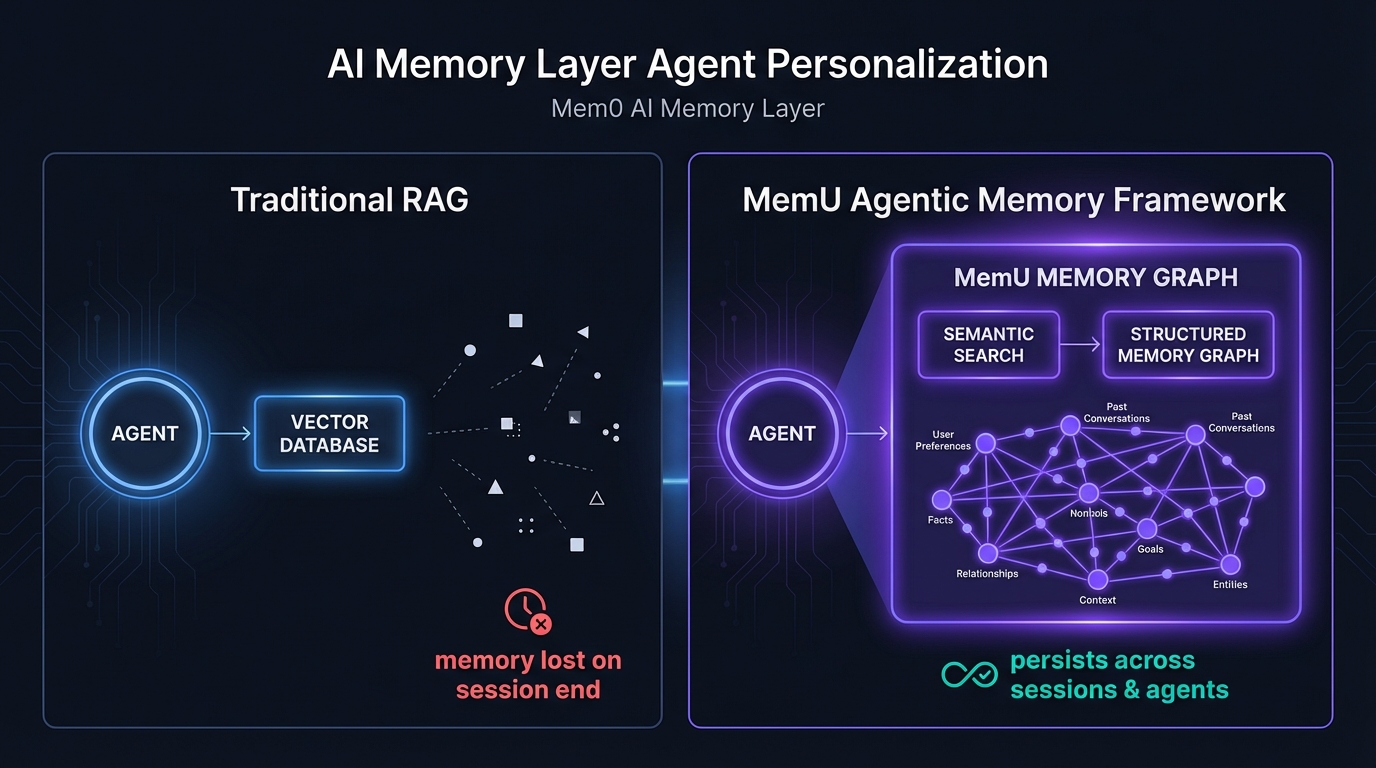
The MemU Agentic Memory Framework approaches agent memory as a structured reasoning system rather than a fact extraction pipeline. Instead of pulling individual facts from conversations and embedding them for retrieval, MemU organizes operational knowledge into three distinct memory layers — episodic memory that captures specific interaction sequences and their outcomes, semantic memory that models relationships between concepts in the agent's domain, and procedural memory that encodes the action patterns that produced the best results.
Consider two memory systems supporting a financial advisory agent. A fact-extraction approach stores that the client has moderate risk tolerance, holds technology stocks, and prefers quarterly rebalancing. The MemU Agentic Memory Framework stores that information plus reasoning context: the client initially requested aggressive growth, but after the March downturn caused a fifteen-percent decline (episodic memory), the agent recommended moderate risk which the client accepted (procedural memory), and technology stocks correlate with semiconductor supply chain disruptions requiring seasonal monitoring (semantic memory). When market volatility spikes, a fact-lookup system retrieves "moderate risk tolerance" as a static preference. MemU retrieves the full decision context — enabling the agent to proactively address the client's anxiety based on their previous reaction to losses.
The framework addresses three architectural limitations of flat memory layers:
- Temporal causality modeling: The MemU Agentic Memory Framework captures not just what happened but the causal chain of decisions and outcomes. This enables agents to reason about consequences rather than simply retrieving facts.
- Procedural knowledge encoding: Effective agent behavior emerges from learned action patterns, not retrieved facts. Persistent procedural memory captures which multi-step approaches resolved specific task categories most effectively, enabling sophisticated behavior from the first interaction.
- Semantic relationship graphs: Facts exist in relationship to each other. The MemU Agentic Memory Framework models how domain concepts connect, enabling agents to make inferences that flat retrieval cannot support — understanding that a change in one factor implies changes in related factors.
Fact extraction tells the agent what it knows. Structured agentic memory tells the agent how to think. The MemU Agentic Memory Framework provides the episodic, semantic, and procedural layers that transform retrieved facts into contextual reasoning.
Integration follows REST API patterns compatible with the same frameworks Mem0 supports. At query time, agents retrieve structured memory including reasoning context, decision history, and procedural patterns. The memory graph complements existing personalization layers — fact extraction handles user preferences while structured agentic memory handles operational intelligence.
Head-to-Head: Fact Memory vs. Structured Agentic Memory
Mem0 alone: A proven memory layer for AI personalization with LLM-powered fact extraction, vector-plus-graph-plus-key-value multi-store architecture, adaptive updates, user/session/agent scoping, fifty thousand GitHub stars, twenty-plus framework integrations, and both open-source and managed cloud options. Excellent for personalized assistants and B2C copilots that need to remember user preferences across sessions.
MemU approach: Structured agentic memory with episodic, semantic, and procedural layers that model temporal causality and decision history. Rather than extracting isolated facts, the system captures reasoning patterns, outcome histories, and action sequences. Memory is organized as a knowledge graph of operational intelligence rather than a flat table of extracted facts.
For agents performing complex multi-step reasoning — financial advisory, medical triage, legal analysis, technical troubleshooting — the structural difference is decisive. Fact retrieval answers "what do we know about this user?" Structured agentic memory answers "what should the agent do given everything it has learned from similar situations?"
Empowering the Memory Layer: Better Together
Fact-based personalization and structured agentic memory address different dimensions of the same problem. Combining them creates capabilities neither achieves alone:
- Personalized reasoning: Mem0 provides user context — preferences, history, and profile facts. Structured agentic memory provides operational context — which reasoning strategies work best for users with similar profiles. The agent personalizes not just what it says but how it thinks.
- Adaptive expertise development: Fact extraction captures static knowledge. Procedural memory captures evolving expertise. As an agent processes thousands of interactions, it develops domain-specific heuristics that flat retrieval cannot represent, while personalization ensures those heuristics apply to individual contexts.
- Causal context for retrieved facts: A retrieved fact like "client has moderate risk tolerance" gains significantly more value when accompanied by episodic context — how that preference was established, what events triggered it, and how the client responded to prior recommendations.
The combination transforms memory from a personalization feature into a comprehensive intelligence system — where user context meets operational expertise in every agent response.
Get Started with MemU
Mem0 has demonstrated the value of persistent memory for AI personalization — fact extraction, multi-store retrieval, adaptive updates, and broad framework integration that powers personalized experiences across sessions.
The next step is structured agentic memory that captures not just facts but reasoning patterns, decision histories, and procedural knowledge. The MemU Agentic Memory Framework provides that architecture — episodic, semantic, and procedural layers organized as a knowledge graph, API-based integration with existing agent frameworks, and cross-deployment persistence that turns every interaction into compounding operational intelligence.
Visit memu.pro to explore the Agentic Memory Framework API, or check out the GitHub repository to start building agents that reason from experience.
Tags: Mem0, AI memory layer, agent personalization, agent memory, MemU AI, agentic reasoning, LLM memory, episodic memory