Memori Cloud Launches SQL-Native Agent Memory — Why Tables Alone Can't Replace a Memory Graph

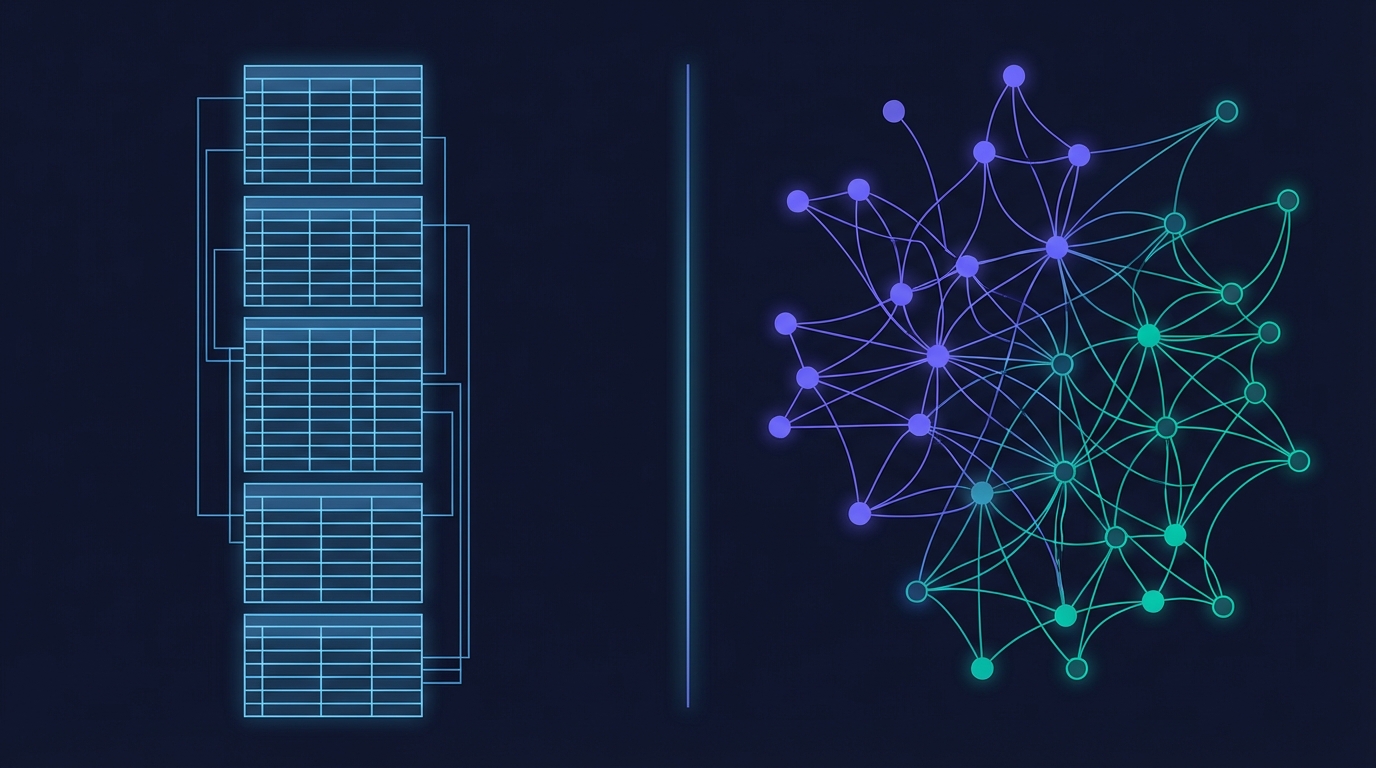
Memori Cloud launched as a fully hosted SQL-native memory layer for production AI agents. The premise is straightforward: use PostgreSQL as the backing store, expose memory through SQL queries, and let developers leverage familiar relational patterns for agent memory. For teams that already run Postgres and want to add basic agent memory without introducing new infrastructure, the simplicity is appealing.
But there is a foundational architectural choice that SQL-native memory makes — and that choice introduces structural limitations when agents need to remember the way humans remember: through relationships, context, and meaning.
Memori Cloud: What Everyone's Getting Right (And Missing)
Memori Cloud gets operational simplicity right. SQL is a known quantity. Developers can query agent memory with familiar JOIN and WHERE clauses. The hosted model eliminates database management overhead. For straightforward key-value memory — "remember this user's preference" or "store this conversation summary" — SQL tables work fine.
What SQL-native memory does not address is the structural complexity of how agents actually need to recall information. Agent memory is not a flat table of facts. It is a web of relationships — between entities, decisions, contexts, and outcomes — that requires traversal, not just lookup. Memori Cloud stores memories in rows; agents think in graphs.
Other SQL-based memory approaches — Zep with Postgres, LangChain memory with SQLAlchemy, custom conversation stores — share this same architectural limitation. Relational storage handles structured records; it does not natively represent knowledge topology.
The MemU Agentic Memory Framework: Dual-Mode Architecture for How Agents Actually Think
The MemU Agentic Memory Framework was built for the way agents need to recall information — not just as stored records, but as connected knowledge.
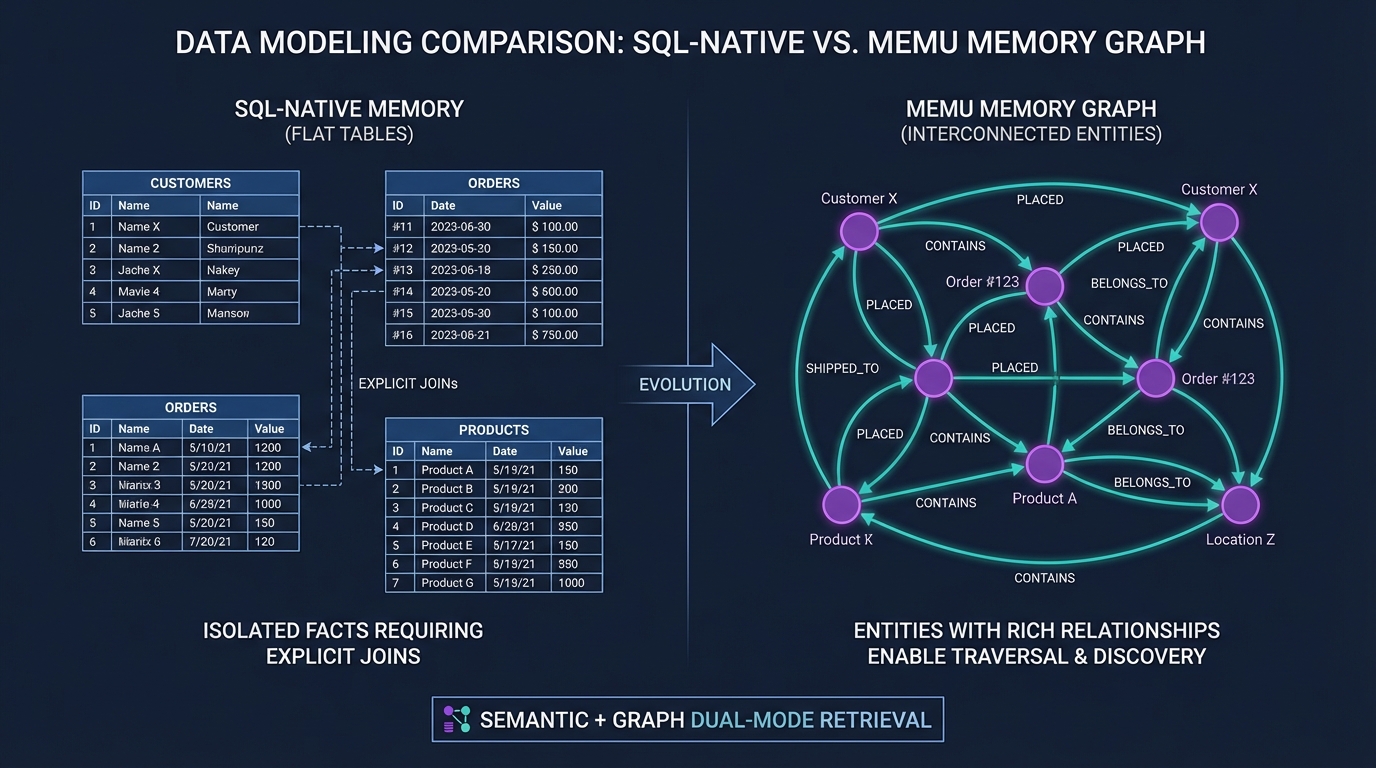
Consider an agent helping a team plan a product launch. With MemU, it recalls that this product's predecessor had a delayed launch due to a compliance issue, that the compliance team's preferred reviewer is on leave, that the marketing team's previous campaigns for similar products performed 40% better with video content, and that these facts are connected — the compliance delay affected marketing timing. With SQL-native memory, each fact exists as an isolated row. The connections require manual JOINs that the agent must somehow know to construct.
The MemU Agentic Memory Framework provides:
- Drop-in integration: A simple API that works with any agent framework — no need to manage database schemas, write SQL queries, or maintain connection pools. The agent speaks to MemU; MemU handles storage, indexing, and retrieval.
- Dual-mode retrieval: Semantic search for fuzzy, meaning-based recall — "what do we know about launches like this?" — plus a structured memory graph for precise relationship traversal — "which teams were involved in the last compliance issue and what was the resolution?" Both modes in one API call.
- Native knowledge topology: Memory is stored as a graph of entities and relationships, not rows in tables. Connections between memories are first-class citizens, not afterthoughts requiring schema design.
SQL stores facts. A memory graph stores understanding. The MemU Agentic Memory Framework provides the knowledge architecture that agents need to reason about their experience, not just retrieve it.
Retrieval operates across 10,000+ memory entries with sub-100ms latency, matching or exceeding SQL query performance while providing structurally richer results.
Head-to-Head: SQL-Native Memory vs. MemU Graph Memory
SQL-native memory: Store memories as rows. Query with SQL. Simple for flat lookups. But when the agent needs to traverse relationships — "what happened the last time we changed this, who was involved, and what were the downstream effects?" — SQL requires pre-designed schemas and multi-table JOINs that the agent must explicitly construct. Schema changes break existing queries.
MemU Agentic Memory Framework: Store memories as connected knowledge. Query with natural language or structured graph traversal. The agent asks "what do I know about this?" and receives not just matching facts but their full relational context — connections to people, decisions, outcomes, and timelines that inform the current task.
Schema evolution: SQL-native memory requires schema migrations when memory structure changes. MemU's graph adapts organically — new entity types and relationship patterns are accommodated without migration scripts or downtime.
Empowering Agent Memory: Why Architecture Matters
The right memory architecture makes agents fundamentally more capable:
- Complex reasoning: When agents need to connect dots across dozens of past interactions, graph traversal finds paths that flat queries miss. MemU surfaces non-obvious connections that drive better decisions.
- Multi-agent sharing: MemU's graph naturally supports multiple agents reading from and writing to shared knowledge — each agent's contributions become part of the collective intelligence without schema conflicts.
- Semantic flexibility: MemU's dual-mode retrieval means agents can query by meaning when the exact structure is unknown, and by structure when precision matters. SQL-native memory only supports the latter.
Get Started with MemU
Add graph-powered persistent memory to your agents in minutes — no SQL schemas, no migrations, no connection management. The MemU Agentic Memory Framework provides the knowledge architecture agents need. Visit memu.pro to explore the Agentic Memory Framework API, or check out the GitHub repository to start building agents that remember.
Tags: Memori Cloud, SQL agent memory, memory graph, agentic memory architecture, LLM memory, MemU AI