Metorial MCP Platform Ships 600+ Verified MCP Servers and Instant Deploy — But Observability Without Memory Leaves Agents Re-Learning Every Tool Pattern


The Metorial MCP platform targets a bottleneck every agent team hits once prototypes turn into production: standing up Model Context Protocol infrastructure that is trustworthy, fast to deploy, and safe to operate at scale. Metorial is YC-backed and positions itself around a curated catalog of more than six hundred verified MCP servers, one-click or near-instant deployment paths, and first-class SDKs in Python and TypeScript so engineers can wire agents to tools without reinventing glue code. Enterprise teams also get tracing and observability that surface latency, failures, and dependency chains across MCP traffic—exactly the operational visibility missing from ad hoc MCP rollouts.
That stack solves provisioning and monitoring. It does not, by itself, turn telemetry into durable know-how. Metorial users can see which tools misfire and which agents hammer which endpoints, yet the platform does not automatically retain which invocation sequences worked, which parameter shapes succeeded for a given workflow, or which cross-server compositions produced the best downstream outcomes. An MCP platform with tracing but without persistent agent memory still forces every agent to rediscover tool wisdom that the organization already paid to learn.
YC-backed momentum matters because procurement teams now ask for the same assurances they demand from cloud vendors: repeatable deploys, documented SDKs, and operational proof. The Metorial MCP platform narrative fits that bar—curated servers, predictable rollout, and tracing that can be shown to security reviewers. What remains unsolved is the learning loop: turning months of production traffic into reusable agent behavior without copying transcripts into prompts by hand.
Metorial MCP Platform: What Teams Get Right (And What Still Breaks at Scale)
The Metorial MCP platform wins on credibility and time-to-value. A large library of verified MCP servers reduces the security and maintenance anxiety that comes from plugging random community servers into production agents. Instant deploy patterns shorten the gap between “we need this capability” and “the MCP server is live behind auth.” Python and TypeScript SDKs align with how most agent orchestration is written today, so engineers stay in familiar languages instead of bolting on bespoke RPC layers.
Observability and enterprise tracing are the right ambition for Metorial buyers who must answer audit-style questions: who called which tool, when, with what outcome, and how did failures propagate across dependent services? Those signals matter for SRE workflows, cost attribution, and compliance narratives around AI systems that touch customer data. Dashboards help humans respond to incidents; they do not automatically teach the model which alternative tool path avoids the incident next time.
The gap is semantic and longitudinal. Traces tell you that a tool failed; they rarely encode why a different parameterization would have succeeded, or that three specific tools in sequence historically resolve a class of support tickets. When a new agent spins up against the same Metorial deployment, it inherits connectivity—not operational memory. Other mature MCP control planes exhibit the same boundary: they govern and observe tool infrastructure; they do not compound organizational tool intelligence for the agents that use it.
As your catalog of verified MCP servers grows, the combinatorial search space for tool plans grows faster than linearly. Even excellent tracing cannot shrink that search space for a cold-start agent. Teams compensate with longer system prompts, brittle if-else orchestration, or human operators who manually patch playbooks after every outage—none of which scale when dozens of product teams ship agents on shared infrastructure.
The MemU Agentic Memory Framework: From MCP Traces to Reusable Tool Intelligence
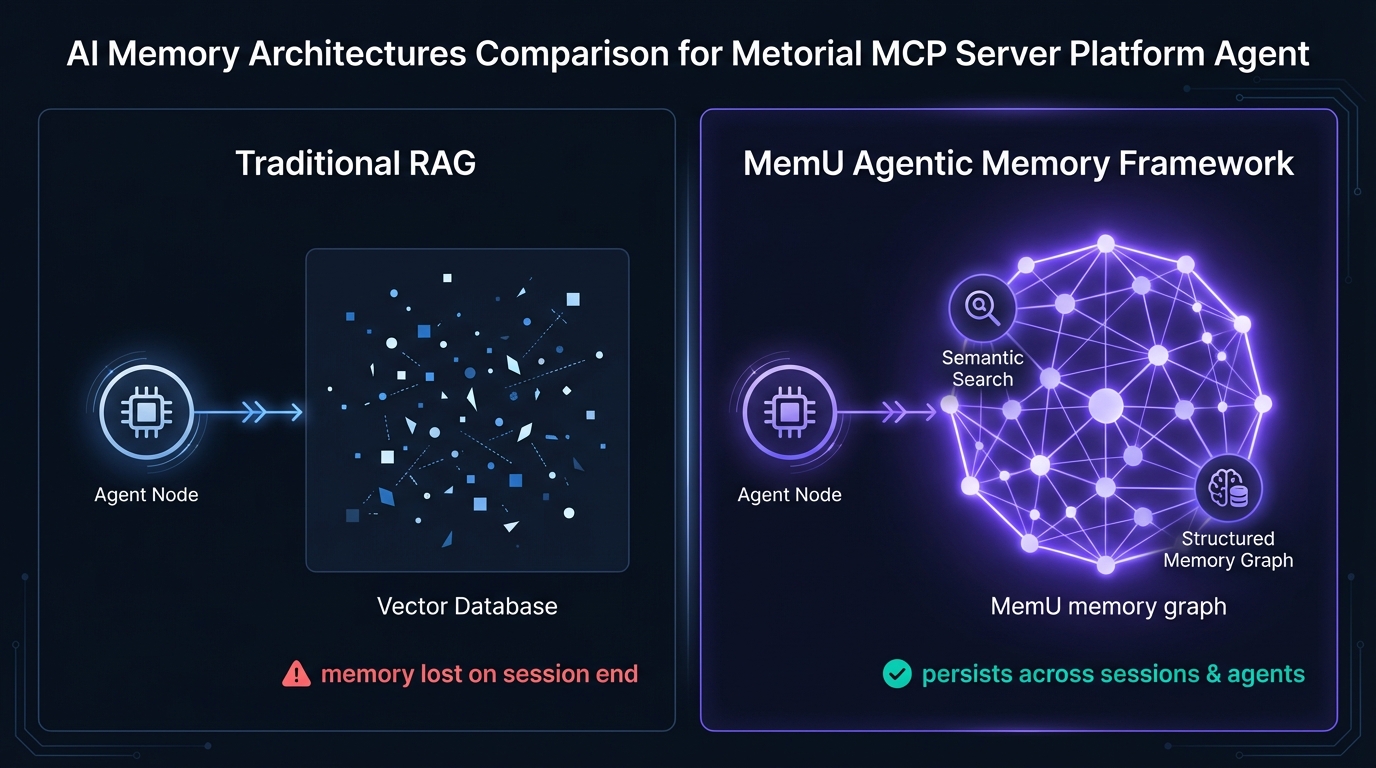
The MemU Agentic Memory Framework complements catalog-driven MCP operations by persisting what works across agents, sessions, and teams. Instead of treating each tool call as an isolated RPC, MemU captures invocation context, outcomes, and successful multi-step patterns in a structured memory graph designed for retrieval by agents at decision time.
Imagine a support agent connected through the Metorial MCP platform to CRM, ticketing, and knowledge-base tools. Tracing proves the agent called the right servers; memory explains that for “billing disputes” the highest-resolution path is ticket lookup, then policy snippet retrieval, then a refund tool—with a specific field ordering that reduced escalations in prior runs. A new agent instance loads that pattern from MemU instead of exploring blindly.
Practical benefits alongside the Metorial MCP platform in production include:
- Composition memory: Which ordered combinations of verified MCP servers solved which task families, including guardrails learned from near-miss failures.
- Parameter priors: Stable defaults and constraints inferred from historical successes, shrinking trial-and-error token use.
- Cross-team reuse: Tool intelligence discovered by one squad becomes available to others hitting the same Metorial endpoints.
The MemU Agentic Memory Framework does not replace your MCP control plane—it turns observability into experience. Metorial shows you what happened; MemU helps the next agent act as if it was there.
Integration typically sits adjacent to agent runtimes: after traces land in your pipeline, summaries and embeddings flow into MemU’s APIs while agents query memory before planning tool use. The MemU Agentic Memory Framework is model- and vendor-agnostic, so it layers cleanly onto Python or TypeScript agent code already using Metorial’s SDKs.
Operational teams can define policies for what becomes memory—high-trust successful runs, reviewer-approved fixes, or customer-impacting recoveries—so the graph grows from curated signal rather than raw noise. That discipline pairs well with enterprise tracing: traces identify anomalies, while MemU captures the validated remediation shape agents should prefer next time.
Head-to-Head: Metorial MCP Platform Alone vs. Metorial Plus MemU
Metorial MCP platform alone: Broad verified MCP servers catalog, fast deploy, strong SDK ergonomics, and enterprise-grade tracing for MCP workloads. Ideal when the problem is “how do we ship and watch MCP safely?” Weak when the problem is “how do agents get better at using those tools tomorrow than they were yesterday without manual prompt surgery.”
Metorial MCP platform plus MemU: Same connectivity and observability, with a durable layer that retains effective tool strategies and failure lessons. Agents route to tools with memory-informed plans rather than repeating expensive exploration. Incidents captured in traces become structured memories that reduce repeat outages.
Empowering Metorial: Better Together
Joint architecture patterns teams adopt:
- Trace-to-memory pipelines: Normalize Metorial trace events into MemU memory objects so high-signal runs automatically enrich the graph without asking developers to hand-author memory entries.
- Runtime retrieval: Agents query the MemU Agentic Memory Framework before MCP tool selection to bias toward historically successful servers and parameters, cutting wasted steps on busy days.
- Progressive verification: Pair verified MCP servers with memory-backed playbooks so “verified” extends from security posture to proven operational usage under real customer traffic.
Together, the Metorial MCP platform supplies trustworthy pipes and telemetry, while MemU supplies the compounding intelligence that makes agent behavior stabilize as your catalog grows.
Get Started with MemU
If you are standardizing on a YC-backed Metorial MCP platform for verified MCP servers, instant deploy, and enterprise tracing, add the layer that remembers how those tools should be used—not just that they were called. Pairing catalog discipline with the MemU Agentic Memory Framework closes the loop from observation to improved action.
Visit memu.pro to explore the Agentic Memory Framework API, and open the GitHub repository to integrate MemU alongside your Metorial-backed agents.
Tags: Metorial, MCP platform, verified MCP servers, Y Combinator, agent memory, MemU AI, enterprise tracing