Microsoft Agent Framework Reaches Release Candidate — A Unified SDK That Still Lacks Persistent Memory

Microsoft Agent Framework just hit Release Candidate status for both .NET and Python, unifying Semantic Kernel and AutoGen under one programming model. The framework delivers multi-provider support spanning Azure OpenAI, Anthropic Claude, AWS Bedrock, and Ollama. Graph-based workflows handle sequential, concurrent, and handoff patterns with built-in checkpointing and human-in-the-loop capabilities. For enterprise teams that struggled with Microsoft's fragmented agent tooling, this is a welcome consolidation.
But there is a foundational layer that the Microsoft Agent Framework, like its predecessors, still depends on getting right — memory.
Microsoft Agent Framework: What Everyone's Getting Right (And Missing)
The Agent Framework gets unification right. One SDK replaces two competing libraries. The AgentThread abstraction provides a consistent invocation pattern across different agent types. A2A protocol support enables agent-to-agent communication, and MCP integration standardizes tool sharing. This is what enterprise-grade agent infrastructure should look like.
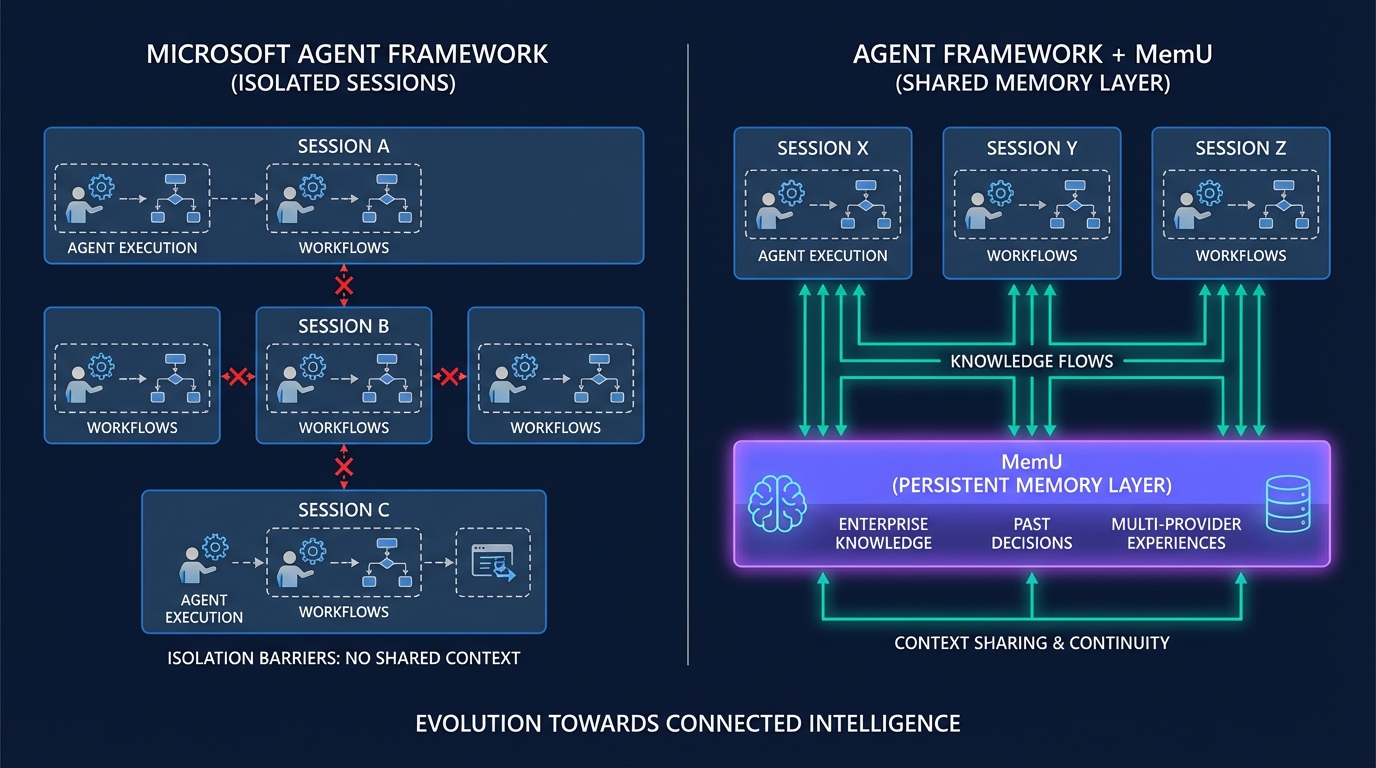
What the Agent Framework does not address is what agents remember between sessions. Checkpointing saves workflow state, but it does not persist learned context. The agent that spent hours understanding your enterprise data model yesterday starts from scratch today. Microsoft unified the SDK, but memory is still a per-session afterthought.
Other agent frameworks — LangChain, CrewAI, Amazon Bedrock AgentCore — share this same architectural constraint. They manage agent execution; none of them manage agent experience.
The MemU Agentic Memory Framework: Persistent Experience for Enterprise Agent SDKs
The MemU Agentic Memory Framework adds the missing layer. Where the Microsoft Agent Framework manages how agents execute and communicate, MemU manages what agents retain.
Consider a multi-agent workflow that onboards new enterprise customers. With MemU, the agents remember past onboarding patterns — which configurations work for similar company profiles, which integration steps commonly fail, what documentation gaps customers hit. Without MemU, every customer onboarding starts at zero.
The MemU Agentic Memory Framework provides:
- Drop-in integration: A simple API that works alongside the Microsoft Agent Framework, LangChain, or any custom pipeline. Add memory calls to your AgentThread; your agents gain continuity without changing your orchestration logic.
- Dual-mode retrieval: Semantic search for finding relevant past experiences plus a structured memory graph for tracking relationships between entities, decisions, and outcomes. Not just embeddings — actual knowledge architecture.
- Cross-session persistence: Memory survives across sessions, agents, and users. One agent's discoveries feed every subsequent agent's context automatically.
A unified SDK without unified memory is consistent execution without accumulated intelligence. The MemU Agentic Memory Framework gives enterprise agents the ability to learn from experience, not just follow instructions.
Retrieval operates across 10,000+ memory entries with sub-100ms latency, ensuring memory lookup never becomes the bottleneck in your enterprise agent pipelines.
Head-to-Head: Agent Framework Alone vs. Agent Framework + MemU
Agent Framework alone: Each agent session executes within current context. Graph workflows orchestrate beautifully, but the agent that resolved a complex data migration issue last week cannot recall its own approach when a similar issue appears. Checkpoints save state mid-workflow; they do not save institutional knowledge.
Agent Framework + MemU Agentic Memory Framework: Each session reads from and writes to persistent memory. The agent recalls past decisions, their outcomes, and patterns across hundreds of prior interactions. Enterprise knowledge compounds with every workflow execution.
Multi-provider memory sharing: With MemU, memory persists regardless of which LLM provider backs the agent. Switch from Azure OpenAI to Claude — the accumulated experience follows. Without MemU, provider migration means starting from zero.
Empowering Microsoft Agent Framework: Better Together
MemU does not replace the Agent Framework — it makes the Agent Framework dramatically more capable:
- Customer support: The Agent Framework orchestrates ticket routing and resolution workflows; MemU remembers past resolutions, customer preferences, and escalation patterns across thousands of interactions.
- Data analysis: The Agent Framework manages multi-step analytical pipelines; MemU remembers which data quality issues exist, what transformations work for specific datasets, and which insights the team has already explored.
- DevOps automation: The Agent Framework coordinates deployment agents; MemU remembers past deployment failures, environment-specific quirks, and configuration patterns that work for each service.
Get Started with MemU
Add persistent memory to your Microsoft Agent Framework workflows in minutes. The MemU Agentic Memory Framework works with any agent SDK — one API, zero lock-in, immediate enterprise intelligence. Visit memu.pro to explore the Agentic Memory Framework API, or check out the GitHub repository to start building agents that remember.
Tags: Microsoft Agent Framework, Semantic Kernel, AutoGen, agentic memory, enterprise AI agents, LLM memory, MemU AI