MiniMax M2.5 Matches Opus 4.6 on SWE-Bench at 1/20th the Cost — Open-Weight Coding Models Still Can't Remember Your Codebase


MiniMax M2.5 just hit 80.2% on SWE-Bench Verified — within 0.6 percentage points of Claude Opus 4.6 — while costing 1/20th as much and running 3x faster. The 229-billion-parameter open-weight model uses a Mixture-of-Experts architecture trained with reinforcement learning across 200,000+ real-world coding environments. On Multi-SWE-Bench, it actually beats Opus 4.6 (51.3% vs 50.3%). The Lightning variant hits 100 tokens per second. The performance gap between open-weight and proprietary coding models has effectively closed.
M2.5 developed an emergent "spec-writing" ability during training: before writing code, it plans and decomposes projects like an architect, producing implementation blueprints that guide the actual coding. This architectural reasoning isn't just impressive on benchmarks — it's the kind of capability that makes AI coding assistants genuinely useful for real-world software engineering. MiniMax M2.5 can be self-hosted via vLLM, SGLang, or Transformers, giving organizations full control over their coding AI.
But benchmark performance and production effectiveness are different things: M2.5 solves SWE-Bench tasks in isolation, while real software engineering requires accumulated understanding of codebases that grows over weeks and months.
What 80% on SWE-Bench Actually Means
SWE-Bench Verified tests whether a model can resolve real GitHub issues from popular open-source repositories. Each task provides the issue description and the repository state, and the model must produce a patch that passes the project's test suite. An 80% success rate means M2.5 can autonomously fix four out of five real software bugs — a capability that seemed impossible two years ago.
The cost advantage makes this capability accessible at scale. At $1 per hour for 100 tokens per second, organizations can run M2.5 as a continuous code review and bug-fixing service. Self-hosting on existing GPU infrastructure eliminates API costs entirely. For enterprises that rejected Claude Opus 4.6's pricing for high-volume coding workloads, M2.5 makes the same capability affordable.
But SWE-Bench tasks are self-contained: each issue includes all the context needed for resolution. Real software engineering is the opposite — context accumulates over days, weeks, and months of working with a codebase. Understanding why a module was designed a certain way, which approaches were tried and failed, and what the team's conventions are — this context doesn't exist in any single issue description.
Benchmarks vs. Production: The Memory Gap
Consider a team deploying M2.5 as their primary code review agent. The first review of a pull request is impressive: M2.5 identifies potential bugs, suggests optimizations, and flags style inconsistencies. The second review is equally good — but starts from scratch. By the fiftieth review, the model has generated tremendous insight about the codebase that has been entirely discarded.
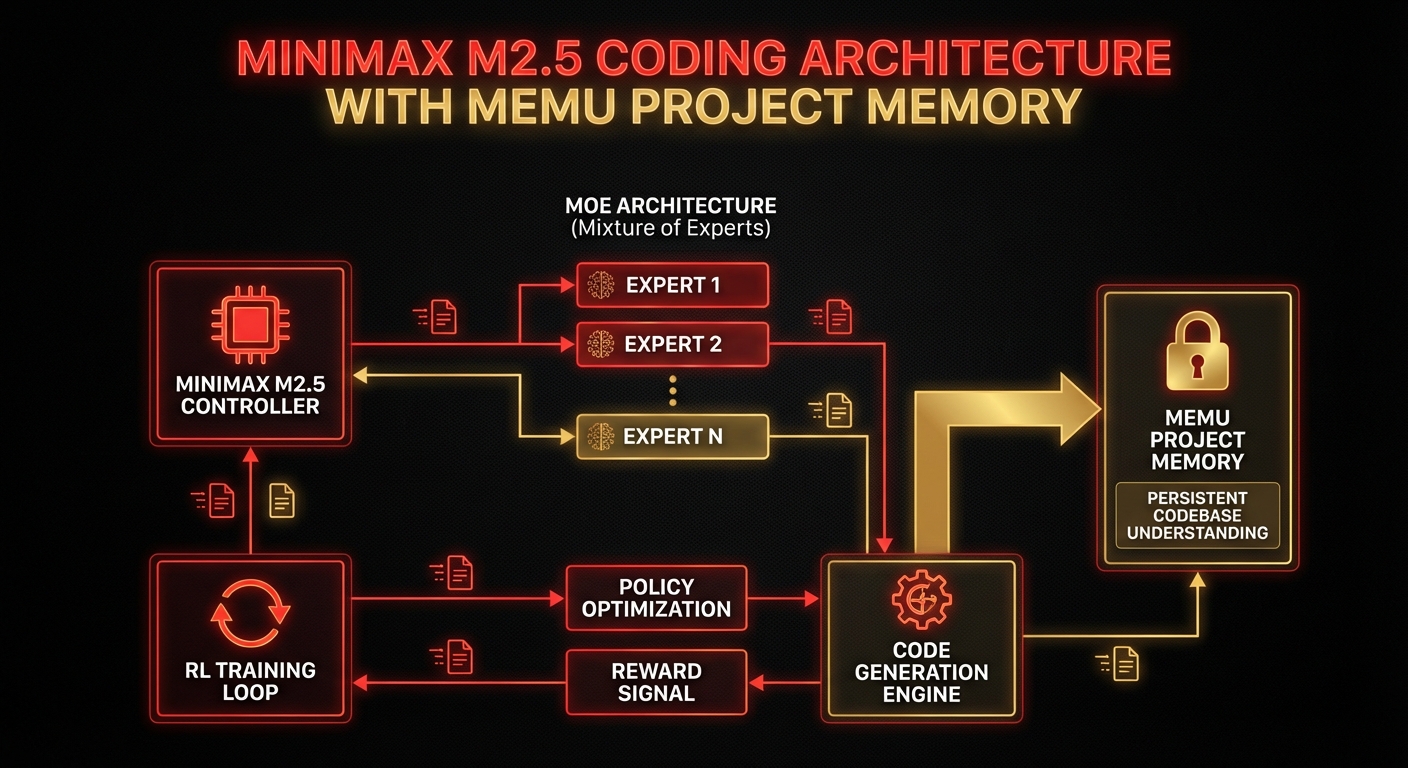
A human reviewer who has done fifty code reviews knows the codebase intimately: common patterns, recurring issues, team preferences, and architectural constraints. They don't re-derive this understanding for each review. M2.5, despite its 80% SWE-Bench score, must re-derive everything every time. The model is as capable on review fifty as review one — but no more capable, despite fifty opportunities to learn.
The spec-writing capability makes this gap more visible. M2.5's architectural reasoning is excellent at decomposing individual tasks. But it can't reference previous decompositions, reuse architectural patterns it discovered in earlier sessions, or maintain a evolving understanding of the project's design. Each spec is written in isolation, unaware of every spec that came before it.
Open-Weight Advantage Meets Memory Need
M2.5's open-weight nature creates a unique opportunity for memory integration. Unlike proprietary models accessed through APIs, self-hosted M2.5 can be wrapped in custom infrastructure that includes memory operations as part of the inference pipeline. Retrieve relevant codebase memories before each task. Write newly discovered patterns after each task. The model weights stay unchanged; the memory layer adds context.
The cost efficiency amplifies the memory advantage. At 1/20th the cost of proprietary models, the compute budget saved can fund memory infrastructure. Organizations running M2.5 on their own GPUs can co-locate the memory layer, minimizing latency. The economics that make M2.5 attractive for high-volume coding workloads also make persistent memory feasible at the same scale.
How MemU Adds Memory to Open-Weight Coding Models
MemU provides the persistent memory layer that transforms M2.5 from a benchmark champion into a production coding partner. Every code review, bug fix, and architectural analysis generates memories: codebase patterns, team conventions, known issues, and effective approaches. Before each new task, relevant memories are retrieved, giving the model accumulated project understanding.
For self-hosted deployments, MemU runs alongside M2.5 on the same infrastructure. The memory retrieval adds negligible latency compared to the model's inference time. The result is a coding AI that costs 1/20th of proprietary alternatives, runs on your own hardware, and gets smarter with every task — exactly what enterprise development teams need.
Get Started
Give your open-weight coding model a memory that compounds. Explore MemU at memu.pro and on GitHub.