Mistral Large 3 Open-Sources 675 Billion Parameters — But Open Weights Don't Include Open Memory


Europe's AI champion just open-sourced a frontier model. Mistral Large 3, released under the Apache 2.0 license, delivers 675 billion total parameters with 41 billion active through sparse mixture-of-experts architecture. Trained on 3,000 NVIDIA H200 GPUs, the model achieves 85.5% on MMLU across 8 languages, 92% on HumanEval, and ranks among the top open-source models on the LMArena leaderboard.
The 256K token context window, multimodal capabilities (vision, document OCR), and function calling support make Mistral Large 3 a genuine alternative to proprietary models for organizations that require data sovereignty or want to avoid vendor lock-in. For European enterprises navigating GDPR and AI Act requirements, an open-source model from a French company offers regulatory alignment that US-based alternatives struggle to match.
Open weights are transformative for the AI ecosystem. But they solve the model access problem, not the memory problem: Mistral Large 3 is open, capable, and entirely amnesic between conversations.
Mistral Large 3: What Open-Source Frontier AI Delivers
The MoE architecture makes Mistral Large 3 remarkably efficient. Only 41 billion of the 675 billion parameters activate per token, routing each request to the most relevant expert clusters. This sparse activation achieves frontier-level performance at a fraction of the compute cost of dense models with equivalent capability.
Multilingual capability spans major European and global languages — a critical feature for international organizations. The model handles chat, coding, structured output, function calling, and vision tasks through a unified architecture. Document AI with OCR support enables processing of business documents directly.
Apache 2.0 licensing means organizations can deploy, modify, and build on Mistral Large 3 without usage restrictions. Self-hosting ensures data never leaves organizational infrastructure — a requirement for many European enterprises.
Open weights provide the model. They don't provide memory. Organizations self-hosting Mistral Large 3 get full control over inference but face the same session-scoped limitation as every other LLM. Users interact, the model responds brilliantly, and then the interaction vanishes. Self-hosting gives data sovereignty over current conversations — not over accumulated knowledge from past ones.
How Self-Hosted Models Handle Persistence
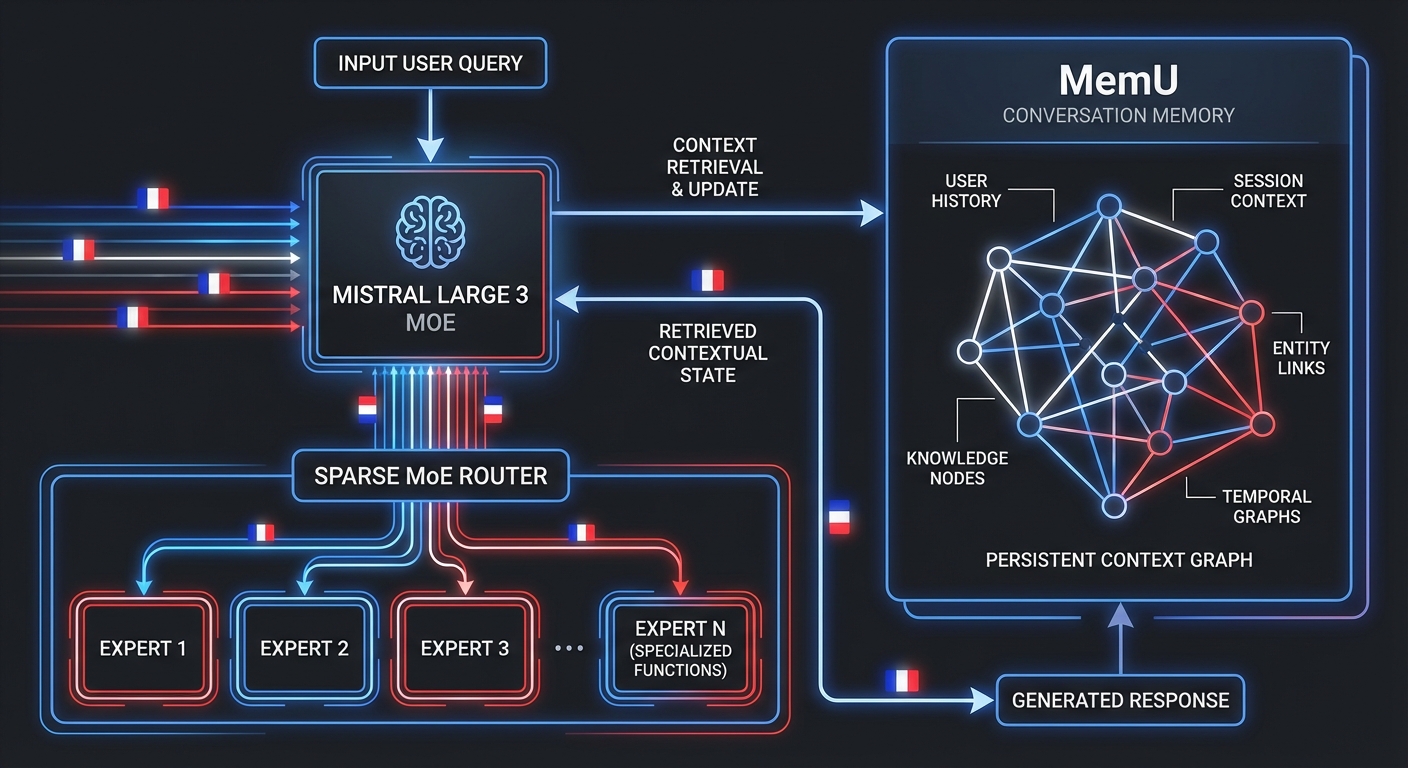
Self-hosted open-source models typically handle persistence through RAG (Retrieval-Augmented Generation) pipelines. Organizations build vector databases of documents, previous conversations, or knowledge bases. At inference time, relevant context is retrieved and injected into the prompt alongside the user's query.
This approach provides information retrieval but not experiential memory. The model can access documents that were explicitly stored. It cannot access the synthesized understanding that emerged from processing those documents. The difference is between a filing cabinet (RAG) and a colleague's expertise (memory).
Open-source stacks lack standardized memory infrastructure. While proprietary platforms sometimes offer conversation history features, self-hosted deployments must build memory from scratch. Most don't — the engineering effort is significant, and the result is usually basic conversation logging rather than structured, queryable knowledge persistence.
The MemU Agentic Memory Framework: Open-Source Memory for Open-Source Models
The MemU Agentic Memory Framework provides the standardized memory infrastructure that open-source model deployments need. Rather than building custom persistence from scratch, organizations add structured memory through a drop-in API that works with any model — including self-hosted Mistral Large 3.
Consider a European legal firm self-hosting Mistral Large 3 for GDPR compliance. Lawyers use the model daily for contract analysis, regulatory research, and case preparation. With the MemU Agentic Memory Framework, accumulated legal intelligence persists — precedent analyses carry forward, regulatory interpretation patterns are retrievable, and case preparation builds on previous research rather than starting fresh each session.
The architecture complements open-source deployments through three capabilities:
- Model-agnostic memory: MemU works with any LLM — Mistral, Llama, Qwen, or proprietary models. Organizations can switch models without losing accumulated memory. Knowledge persists independently of the model that created it.
- Self-hostable persistence: For organizations that self-host models for data sovereignty, MemU provides memory infrastructure that can be self-hosted with the same sovereignty guarantees.
- Beyond RAG: While RAG retrieves documents, MemU provides structured experiential memory — synthesized insights, relationship graphs, and accumulated understanding that emerges from conversations rather than being explicitly stored.
MemU completes the open-source AI stack: Mistral provides the model, MemU provides the memory. Both self-hostable, both open.
Head-to-Head: Open Model vs. Open Model + Memory
Mistral Large 3 alone: Frontier open-source performance with 675B parameters, multilingual capability, and full data sovereignty. But conversations don't persist. Self-hosting controls the model — it doesn't create memory.
Mistral Large 3 + MemU: Same open-source capability plus persistent structured memory. Conversations build on previous ones. Organizational knowledge accumulates. Both model and memory under organizational control.
Get Started with MemU
Mistral Large 3 represents the strongest case yet for open-source AI as a viable alternative to proprietary models. The capability, licensing, and European regulatory alignment make it compelling for organizations that value sovereignty.
The MemU Agentic Memory Framework provides the memory layer that makes open-source deployments genuinely competitive with the convenience features of proprietary platforms. Persistent memory, self-hostable, model-agnostic.
Visit memu.pro to explore the Agentic Memory Framework API, or check out the open-source repository on GitHub to start building persistent memory into your open-source AI deployments today.