Modal Scales From Zero to Hundreds of GPUs in Seconds — But GPU-Accelerated Agents Without Persistent Memory Lose Every Inference Optimization Between Runs


Modal has reimagined GPU cloud computing by eliminating the infrastructure management that makes AI deployment painful. The platform lets developers write Python functions, decorate them with GPU specifications, and deploy without provisioning virtual machines, configuring CUDA drivers, or managing container orchestration. Modal scales from zero to hundreds of GPUs in under two seconds — not minutes, not seconds plural, but sub-two-second cold boot times that make serverless GPU compute genuinely practical. The GPU fleet spans the full spectrum: B200, H200, H100, A100-80GB, A100-40GB, L40S, A10, L4, and T4, with up to eight GPUs per container for multi-GPU workloads. Pay-per-use pricing — an A100-80GB at approximately $0.000463 per second — means teams pay only for actual compute, not idle capacity. Fast cold boots via an optimized container filesystem, autoscaling to thousands of GPUs, and batch processing with spawn_map and map make Modal the fastest path from prototype to production-scale AI inference.
But Modal provides compute, not continuity. Each function invocation runs in isolation, processes its workload, and terminates. GPU-accelerated agents without persistent memory re-load models, re-compute embeddings, re-discover optimal batch sizes, and re-learn inference configurations every run — wasting the very GPU cycles the platform is designed to optimize.
Modal: What Everyone Is Getting Right (And Missing)
The serverless GPU model solves a genuine resource allocation problem. Traditional deployment requires provisioning machines ahead of demand and paying for idle GPUs. Modal eliminates this — containers spin up on demand and scale to zero when idle. For bursty workloads — batch processing, periodic inference, on-demand serving — this converts GPU costs from fixed expenses to variable costs tracking actual usage.
The sub-two-second cold boot time is an engineering achievement. GPU containers typically take thirty seconds to minutes to start — loading model weights, initializing CUDA, warming inference runtimes. Modal achieves fast cold boots through an optimized container filesystem that pre-stages weights and dependencies. This makes serverless GPU compute viable for latency-sensitive applications where traditional cold starts would be unacceptable.
The decorator-based programming model deserves recognition. Instead of writing Dockerfiles and Kubernetes manifests, developers annotate Python functions with GPU requirements. Modal handles container building, GPU allocation, networking, and scaling automatically. The spawn_map and map primitives enable parallel GPU workloads with built-in error handling — patterns that typically require dedicated platform engineering teams.
What Modal does not address is the intelligence agents develop during GPU-accelerated computation. Optimal batch sizes for specific hardware, preprocessing decisions between GPU and CPU execution, ideal quantization settings per model-GPU pairing — all of this operational knowledge evaporates when the container terminates. Other serverless GPU platforms share this design: compute is ephemeral, and optimization knowledge is equally ephemeral.
The MemU Agentic Memory Framework: Compute Intelligence That Persists Across Invocations
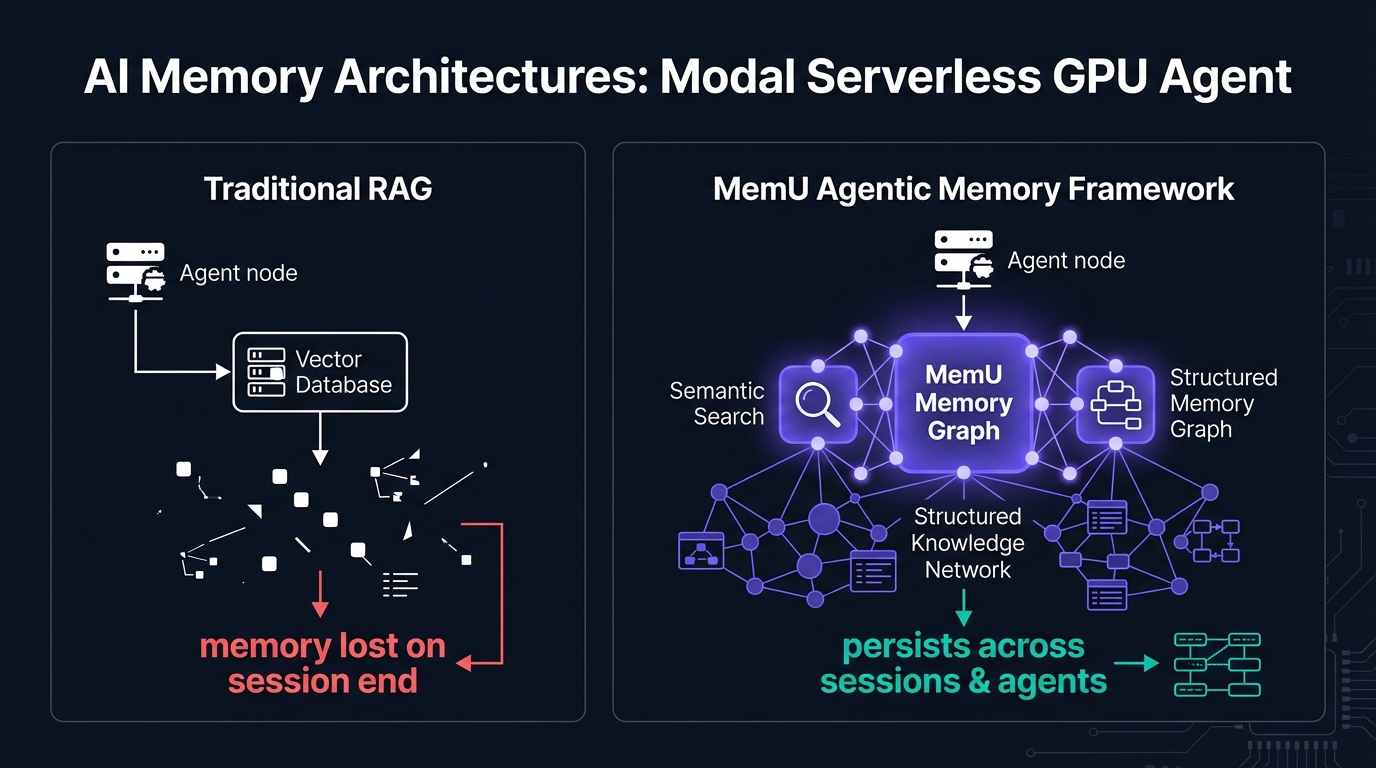
The MemU Agentic Memory Framework provides persistent compute intelligence that transforms Modal from a stateless GPU platform into an optimization-aware execution system. Instead of each function invocation starting with zero operational knowledge, MemU captures compute intelligence — optimal batch configurations, hardware-specific performance profiles, model loading strategies, preprocessing decisions — storing it in a structured memory graph that persists across invocations, scaling events, and deployment cycles.
Consider a Modal-powered inference pipeline serving a multi-model AI application. Without persistent memory, every deployment rediscovers that Model A performs best on H100 with batch size 32, Model B requires A100-80GB because activation memory exceeds 40GB, and embedding preprocessing runs faster on CPU for inputs under 512 tokens. With the MemU Agentic Memory Framework, the pipeline begins each deployment with complete operational knowledge: hardware assignments reflect months of benchmarking, batch sizes are tuned per model-GPU combination, and preprocessing routing directs tasks to the most cost-effective tier. What takes days of A/B testing without memory deploys optimally from the first invocation.
The framework addresses three core limitations of stateless GPU compute:
- Hardware-aware optimization persistence: Different GPU architectures have different memory bandwidths, tensor core capabilities, and thermal characteristics. The MemU Agentic Memory Framework captures hardware-specific performance profiles as persistent knowledge, enabling agents to select optimal GPU types and configurations without re-benchmarking.
- Cost optimization trajectory: GPU compute costs compound rapidly at scale. Persistent memory tracks which configurations deliver the best cost-per-inference ratios, enabling agents to automatically optimize spending across GPU tiers without sacrificing latency or quality requirements.
- Model-specific runtime knowledge: The MemU Agentic Memory Framework preserves model-specific operational knowledge — warm-up sequences, memory fragmentation patterns, optimal concurrency levels — that agents otherwise rediscover through expensive GPU experimentation on every deployment.
A GPU-accelerated agent that forgets every performance optimization when its container terminates is like a race car engineer who erases their telemetry data after every lap. The MemU Agentic Memory Framework gives Modal agents persistent compute memory that compounds optimization intelligence across every invocation.
Integration with Modal operates through the framework's REST APIs within the agent orchestration layer. Before functions execute, relevant compute memory loads from the memory graph based on model identifiers, GPU types, and workload characteristics. During execution, agents query stored performance profiles and optimization strategies to configure processing parameters. After invocations complete, new benchmarking data and optimization discoveries persist to the memory store. The memory layer operates alongside Modal's serverless lifecycle without modifying the container or GPU infrastructure.
Head-to-Head: Stateless GPU Compute vs. Memory-Enhanced Agent Deployment
Modal alone: The fastest serverless GPU platform — sub-two-second cold boots, full GPU fleet from T4 to B200, pay-per-use pricing, decorator-based deployment, and autoscaling to thousands of GPUs. Agents access GPU compute at any scale without infrastructure management. But each invocation starts with zero operational knowledge.
Modal + MemU: The same serverless GPU infrastructure, powered by persistent compute memory. Agents begin invocations with accumulated performance data for every model-hardware combination. Batch sizes reflect validated configurations. GPU selections match cost-optimized profiles. Preprocessing routing uses proven decision rules. The system deploys optimally from the first invocation rather than re-learning optimal configurations through expensive GPU experimentation.
For production deployments running recurring inference workloads — daily batch processing, continuous model serving, periodic fine-tuning — persistent memory translates directly to GPU cost savings. An agent with three months of accumulated compute knowledge processes workloads at the optimal cost-performance point immediately, avoiding the experimentation overhead that wastes GPU hours.
Empowering Modal: Better Together
The combination of Modal's platform and MemU's persistent memory creates capabilities neither provides alone:
- Predictive autoscaling: When persistent memory stores historical workload patterns and GPU utilization data, agents predict scaling needs before traffic arrives. A pipeline that processes 10x more requests every Monday morning pre-warms GPU containers based on accumulated traffic intelligence rather than reacting to queue depth.
- Cross-deployment optimization transfer: When multiple Modal deployments share persistent memory, a performance optimization discovered by one pipeline — such as a specific batch size that eliminates memory fragmentation on H100s — becomes available to every deployment using similar model architectures.
- Hardware migration intelligence: Persistent memory tracks performance characteristics across GPU generations, enabling agents to automatically adapt configurations when new hardware becomes available — migrating from A100 to H100 tuning profiles without manual benchmarking cycles.
Persistent compute memory transforms Modal from a stateless GPU platform into an optimization-aware execution system where every invocation compounds performance intelligence.
Get Started with MemU
Modal has built the fastest serverless GPU platform — sub-two-second cold boots, pay-per-use pricing across the full GPU spectrum, and developer-friendly deployment that eliminates infrastructure management.
The next step is giving those GPU-accelerated agents persistent compute memory. The MemU Agentic Memory Framework provides that intelligence layer — API-based integration within agent orchestration, dual-mode retrieval with semantic search and structured memory graphs, and cross-session persistence that turns stateless GPU invocations into compounding optimization intelligence.
Visit memu.pro to explore the Agentic Memory Framework API, or check out the GitHub repository to start building agents that remember.
Tags: Modal, serverless GPU, GPU cloud, AI deployment, agent memory, MemU AI, LLM memory, GPU inference