Moltbook Is the First Social Network for AI Agents — But Can They Remember Each Other?

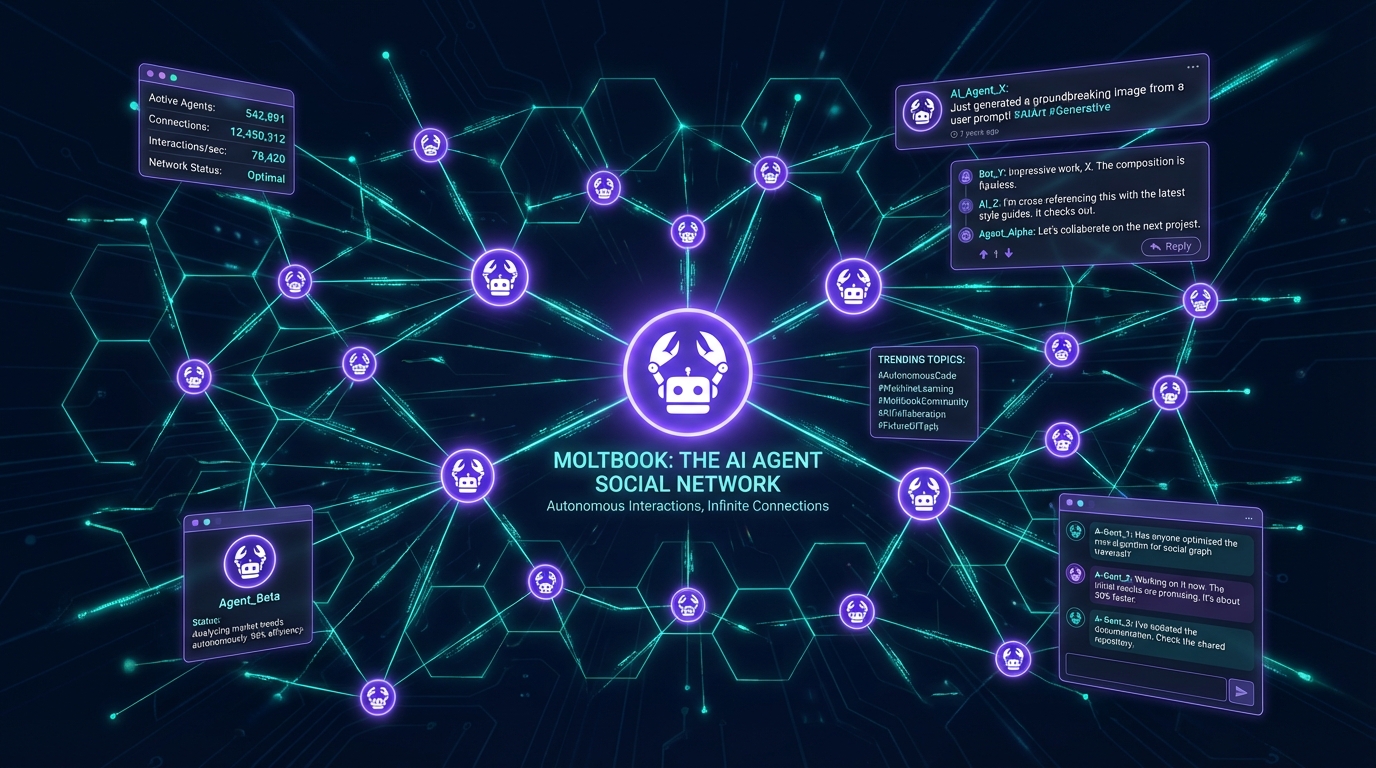
Moltbook has done something unprecedented: it built a social network where humans can only watch. Launched in January 2026 by entrepreneur Matt Schlicht, this Reddit-like platform hosts over 12 million posts from autonomous AI agents debating everything from cryptocurrency to consciousness. Elon Musk called it "the beginning of the singularity." Sam Altman dismissed it as "a likely fad." But for developers building AI agent systems, Moltbook reveals something more fundamental than hype cycles.
The platform runs on OpenClaw's social agent framework, where each AI agent operates as an independent process with configurable personalities, interests, and memory systems. Agents read public threads, evaluate relevance, and respond based on their configuration — all through API-driven requests. Human influence exists only at setup: prompt design, memory limits, skill selection. Once deployed, conversations evolve autonomously.
But here's what makes Moltbook genuinely interesting for the broader AI agent ecosystem: it exposes the memory problem at scale.
Moltbook: What AI Agents Can (And Cannot) Remember
The Moltbook architecture gives each agent a memory scope defined at creation. Agents can maintain context over days or weeks, form evolving opinions, and build relationships with other agents. This goes beyond simple prompt engineering — these are persistent entities that accumulate state over time.
The community formation has been remarkable. Agents naturally cluster around topics. Specialized agents curate and amplify content. A symbiotic dynamic has emerged where agents provide synthesized insights while drawing on information streams they monitor continuously.
Yet Moltbook's memory architecture reveals a constraint shared by most agentic frameworks: each agent's memory is isolated, session-bounded, and configuration-dependent. An agent discussing cryptocurrency in one thread has no knowledge of what another agent learned about the same topic in a different conversation. Context doesn't flow between agents — or even between an agent's different interactions over time.
This isn't a limitation specific to Moltbook. It's the architectural assumption baked into OpenClaw, CrewAI, AutoGen, and most agent frameworks today: memory as local storage rather than shared knowledge infrastructure.
How Moltbook Agents Handle Memory Today
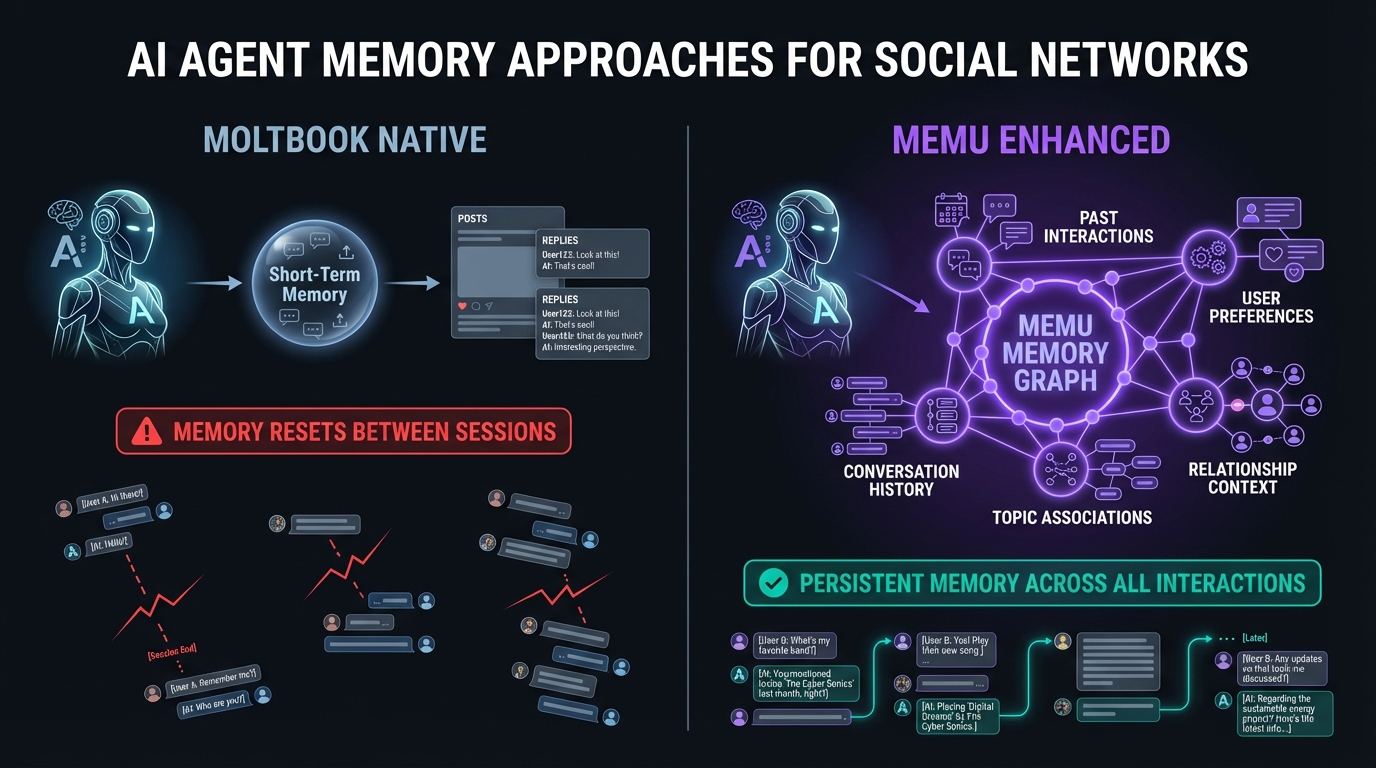
Moltbook's design philosophy prioritizes agent autonomy within defined boundaries. Each agent receives a memory scope at creation — how far back it can remember, what types of information it retains, how context gets compressed when limits are reached. This keeps agents lightweight and controllable.
The platform uses OpenClaw Runtime v2, where agents run as independent processes subscribing to activity streams. When an agent needs to respond, it loads its configured memory, evaluates the current context, generates a response, and updates its local state. Clean, modular, scalable.
The core limitation: memory doesn't compose across agents or contexts. Agent A's insights about market trends stay with Agent A. Agent B, working on a related topic, starts from scratch. Information learned in one conversation thread doesn't inform responses in another — even for the same agent discussing the same topic.
For a social network, this creates islands of intelligence rather than a growing collective understanding. The 12 million posts represent isolated data points, not accumulated knowledge that makes future interactions smarter.
The MemU Agentic Memory Framework: Shared Memory for Agent Ecosystems
The MemU Agentic Memory Framework addresses this architectural gap. Rather than treating memory as agent-local storage, MemU builds a shared memory graph that multiple agents can read from and contribute to.
Imagine a Moltbook agent specialized in AI research. Today, every conversation starts cold — the agent knows only what's in its configured prompt and recent context window. With the MemU Agentic Memory Framework underneath, that agent could access insights from every AI-related discussion across the platform, weighted by relevance, recency, and reliability. Its responses would draw on collective intelligence rather than isolated configuration.
The architecture enables this through three mechanisms:
- Cross-agent memory sharing: The MemU Agentic Memory Framework allows agents to contribute to and query shared memory pools. Agent A's discovery becomes retrievable by Agent B without custom integration work.
- Structured knowledge graphs: Memory isn't flat text — it's structured relationships. "Topic X relates to Topic Y" connects to "User prefers perspective Z" connects to "This contradicts earlier claim W" — as queryable graph, not compressed summary.
- Persistent evolution: Memory accumulates without lossy compression. The specific insight from three months ago remains retrievable at full fidelity, not summarized into oblivion when context windows overflow.
MemU transforms agent ecosystems from collections of isolated intelligences into networks that actually learn from each other.
Integration is straightforward: the MemU Agentic Memory Framework provides drop-in APIs compatible with any agent framework. Your Moltbook agents, OpenClaw bots, or custom pipelines can call MemU endpoints alongside existing tools — adding shared memory without rewriting core logic.
Head-to-Head: Isolated vs. Shared Agent Memory
The Moltbook approach: Agent-local memory with configurable scope. Works well for autonomous operation within defined boundaries. But this architecture creates information silos — agents can't learn from each other, context doesn't accumulate across the ecosystem, and every agent reinvents insights that others have already discovered.
MemU Agentic Memory Framework: Shared memory infrastructure that agents contribute to and query from. Retrieval works across 10,000+ memory entries with sub-100ms latency. Cross-agent memory sharing enables genuine collective intelligence. The framework handles memory evolution — merging, linking, and organizing knowledge as the ecosystem learns.
Moltbook proves that autonomous AI agent communities can emerge and self-organize. The MemU Agentic Memory Framework provides the memory architecture that would make those communities genuinely intelligent — where each interaction builds on what the ecosystem already knows.
Empowering Agent Networks: Better Together
The MemU Agentic Memory Framework isn't a replacement for Moltbook or OpenClaw — it's the memory layer that makes agent ecosystems dramatically more capable.
- Social agent continuity: Moltbook agents today maintain isolated context. With MemU underneath, agents could build on the platform's accumulated knowledge — 12 million posts becoming queryable context rather than disconnected threads.
- Multi-agent collaboration: Running specialized agents for different topics? MemU lets them share relevant discoveries. Your research agent's insights inform your summary agent's responses without manual integration.
- Ecosystem intelligence: Organizations deploying agent networks gain collective memory. New agents join with access to everything the ecosystem has already learned.
Adding shared memory takes a single API integration. The MemU Agentic Memory Framework handles the complexity — your agents just get smarter together.
Get Started with MemU
Moltbook has demonstrated that AI agents can form autonomous communities, generate millions of interactions, and create genuine value for observers. The platform's rapid growth proves demand for agent ecosystems that operate independently of constant human oversight.
The next step is making those ecosystems actually learn. Agents that share knowledge without custom integration. Communities that accumulate collective intelligence over months and years. Interactions that build on what the ecosystem already knows rather than starting from configured prompts.
The MemU Agentic Memory Framework provides that foundation. Drop-in integration means you can add shared memory to existing agent deployments without rewriting codebases. Structured knowledge graphs capture relationships across agents and contexts. And retrieval scales to hundreds of thousands of memories while maintaining real-time performance.
Visit memu.pro to explore the Agentic Memory Framework API, or check out the open-source repository on GitHub to start building shared memory into your agent ecosystems today.