n8n AI Adds Agent Nodes to Workflows — But Workflow Agents Without Shared Memory Operate in Isolation

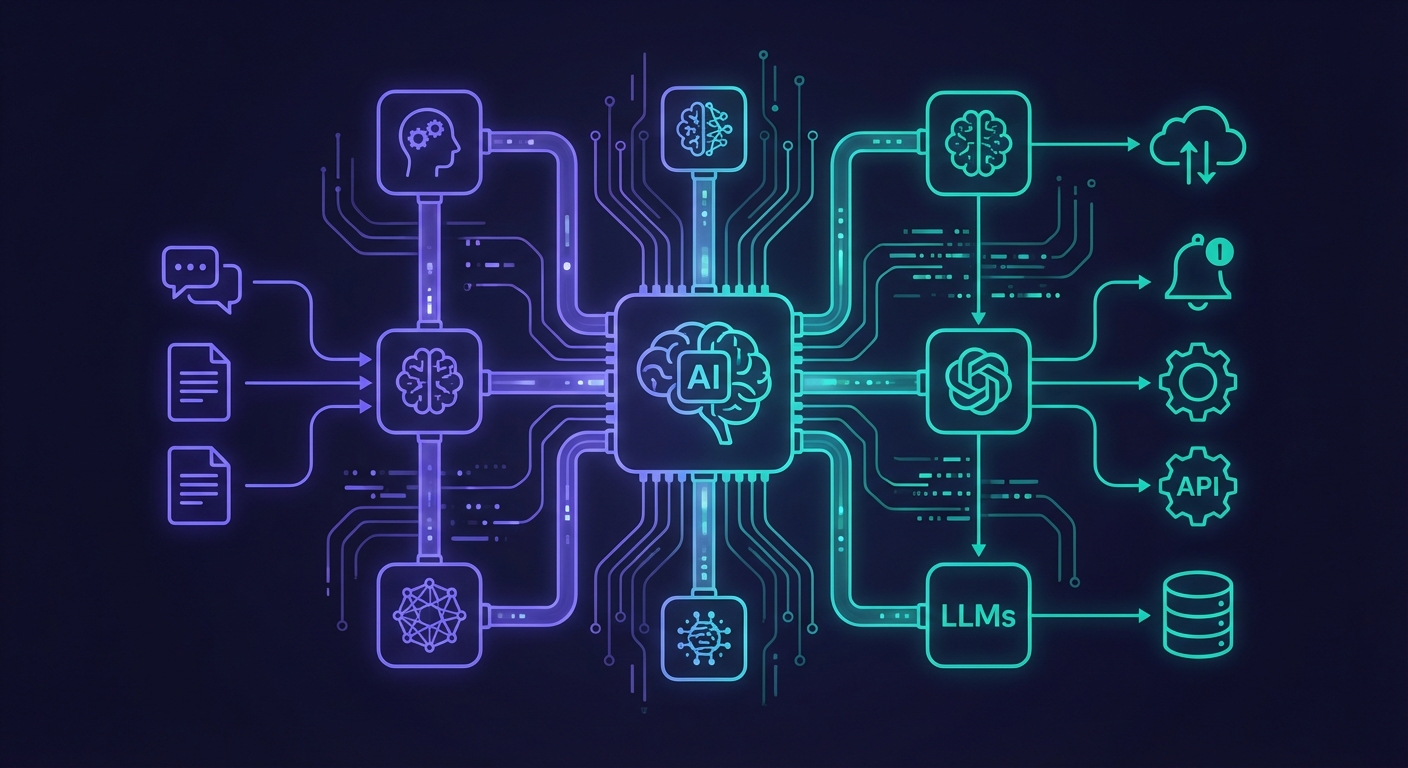
n8n AI has brought agentic capabilities to the open-source workflow automation space. The platform's AI Agent nodes go beyond static chains — they reason about tasks, decide which tools to invoke, and collaborate with other agents through the AI Agent Tool node that enables multi-agent hierarchies. With connections to 422+ applications and support for agent types including Conversational AI, ReAct, Plan and Execute, SQL Agent, and Tools Agent, n8n provides the infrastructure for building sophisticated AI-powered workflows that can handle chatbots, RAG systems, web scraping, database operations, and social media automation. The self-hosted, open-source model gives organizations full control over their data and execution environment.
But n8n AI's agent nodes operate within session-bounded contexts. Each workflow execution starts fresh — the agent that solved a complex data routing problem in the previous run cannot recall that solution for the next run. Workflow agents without shared memory operate in isolation, solving the same problems repeatedly without compounding intelligence.
n8n AI: What Everyone's Getting Right (And Missing)
n8n's approach to AI integration is architecturally sound. Rather than building a monolithic AI system, n8n treats AI agents as composable nodes within its visual workflow builder. Developers connect agent nodes to data sources, tools, and other agents using the same drag-and-drop interface they use for traditional automation. The AI Agent Tool node is particularly powerful — it allows one agent to use another agent as a tool, enabling hierarchical multi-agent architectures where a coordinator agent delegates specialized tasks to sub-agents. This composability makes complex AI workflows approachable for teams familiar with visual workflow builders.
The open-source, self-hosted model is also a significant differentiator. Organizations running sensitive workflows — healthcare data processing, financial analysis, legal document review — can deploy n8n on their own infrastructure with their own LLM providers, maintaining complete data sovereignty. The fair-code license provides transparency while allowing commercial use, and the active community contributes nodes, workflows, and templates that accelerate development.
What n8n AI does not provide is memory that persists across workflow executions. A ReAct agent that explores multiple tool-calling strategies to handle a complex customer query generates valuable problem-solving intelligence during that execution. But when the next similar query arrives, the agent restarts the same exploration process. The SQL Agent that discovered the optimal join strategy for a complex database query re-derives that strategy every time. Multi-agent hierarchies that coordinate effectively during one execution lose their coordination patterns when the execution completes. Other workflow automation platforms with AI capabilities — including Langflow, Flowise, and Dify — face the same limitation. They orchestrate agent execution; none persist the intelligence that agents generate during that execution.
The MemU Agentic Memory Framework: Agent Intelligence That Persists Across Workflows
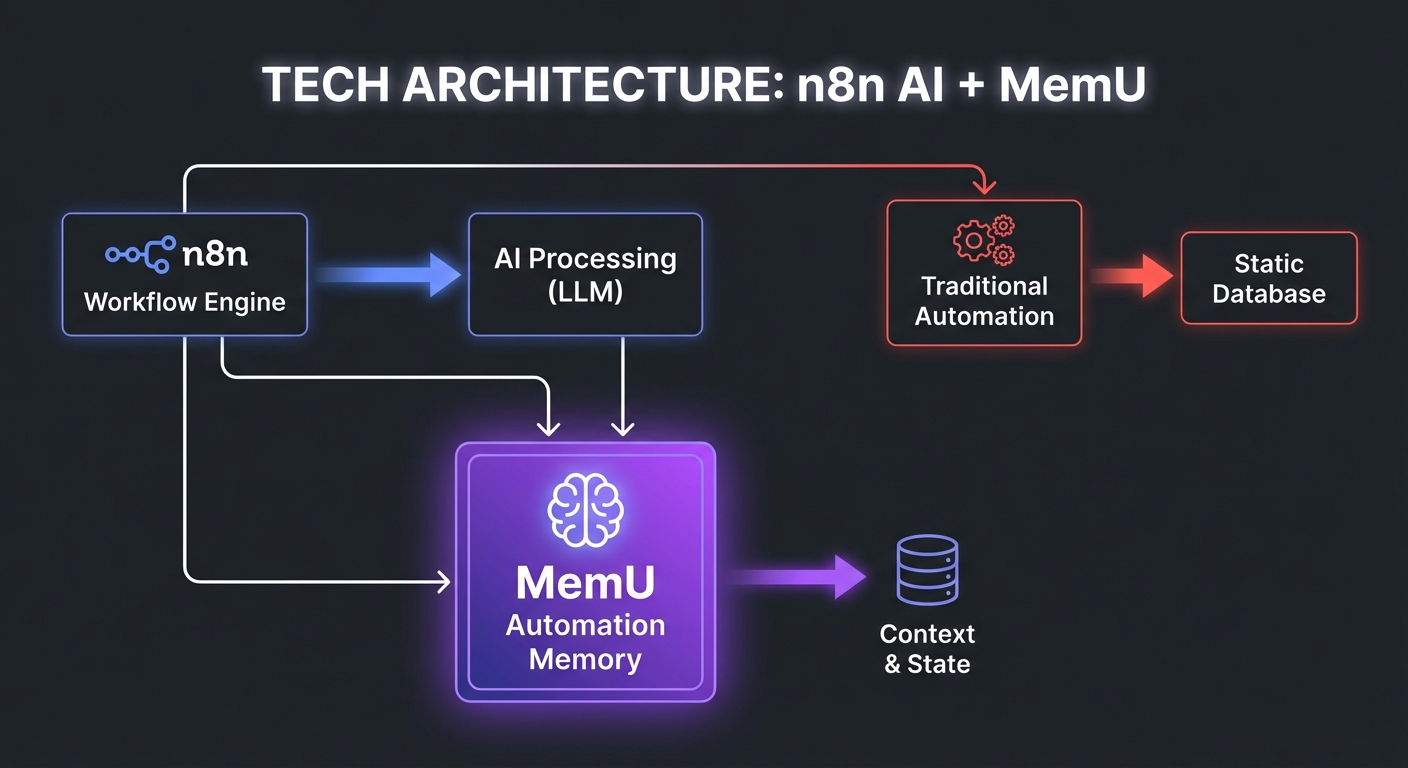
The MemU Agentic Memory Framework provides the persistent memory layer that workflow AI platforms like n8n do not include natively. Instead of treating each workflow execution as an isolated event, MemU captures the reasoning paths, tool-calling strategies, and coordination patterns that agents develop during execution and stores them in a structured memory graph that persists across runs, workflows, and multi-agent systems.
Consider a multi-agent n8n workflow for customer support. A coordinator agent receives a ticket, classifies it, and delegates to specialized agents — a billing agent, a technical support agent, or an account management agent. Without persistent memory, the coordinator applies the same classification logic regardless of outcome history. With the MemU Agentic Memory Framework, the coordinator recalls that tickets mentioning "API" and "timeout" were misclassified as billing issues 30% of the time and should go to technical support, that the billing agent resolves refund requests faster when given the customer's subscription tier upfront, and that escalations from the technical agent to account management happen most often for enterprise accounts with custom SLAs. That accumulated coordination intelligence transforms a static routing workflow into an adaptive system.
The framework addresses three core limitations of session-bounded workflow agents:
- Reasoning path persistence: When a ReAct agent explores multiple tool-calling strategies to solve a problem, the successful path is stored. Future encounters with similar problems can skip the exploration and apply the proven strategy directly, reducing execution time and token costs.
- Multi-agent coordination memory: The MemU Agentic Memory Framework captures how agents in a hierarchy interact — delegation patterns, information sharing strategies, and handoff protocols that work well. Multi-agent workflows that have been running for weeks develop more effective coordination than freshly deployed workflows because they build on accumulated collaboration patterns.
- Tool effectiveness tracking: Agents in n8n have access to many tools via connected applications. Persistent memory tracks which tools are most effective for which types of tasks, their reliability patterns, and their latency characteristics. Agent nodes that need to choose between multiple tools for a task can make informed selections based on execution history rather than static configuration.
Open-source workflow automation gives organizations control over their AI infrastructure. But agents that forget everything between executions waste that infrastructure on repeated problem-solving. The MemU Agentic Memory Framework ensures that every workflow execution contributes to a compounding intelligence base that makes the next execution more effective.
Integration with n8n is architecturally natural. The MemU Agentic Memory Framework can be accessed through HTTP Request nodes or custom n8n community nodes that wrap the memory API. Agent nodes query persistent memory before task execution and store insights after completion. The self-hosted nature of both n8n and MemU means the entire stack — workflow engine, agent execution, and persistent memory — can run on the organization's own infrastructure.
Head-to-Head: Stateless Workflow Agents vs. Memory-Enhanced Orchestration
n8n AI alone: Powerful open-source workflow automation with composable AI agent nodes, multi-agent hierarchies, and 422+ app integrations. Self-hosted deployment provides data sovereignty. But every workflow execution starts fresh — agents re-explore, re-reason, and re-coordinate without benefit from previous runs.
n8n AI + MemU: The same composable agent architecture, now backed by persistent workflow memory. Agents begin each execution with accumulated intelligence from previous runs. ReAct agents skip failed reasoning paths and apply proven strategies. Multi-agent coordination patterns improve over time as the system learns which delegation and handoff approaches work best. Tool selection becomes data-driven rather than configuration-driven.
For high-volume workflows, the improvement compounds rapidly. A customer support workflow processing 200 tickets daily generates 200 learning opportunities per day. Within a month, the persistent memory contains 6,000+ execution records that inform increasingly accurate routing, faster resolution, and more effective agent coordination — improvements that stateless execution can never achieve.
Empowering n8n AI: Better Together
The combination of n8n AI's open-source agent workflow platform and the MemU Agentic Memory Framework's persistent memory unlocks capabilities that neither achieves alone:
- Self-improving agent hierarchies: Multi-agent workflows where coordinator agents learn optimal delegation strategies over time. The coordinator that initially routes tickets based on keyword matching evolves into one that considers ticket complexity, agent workload, historical resolution rates, and customer context — all learned from accumulated execution memory.
- Community knowledge sharing: n8n's community-driven model extends naturally to shared memory patterns. Workflow templates can include pre-built memory contexts — a customer support workflow template ships with initial routing intelligence learned from anonymized execution patterns across the community.
- Adaptive error recovery: When workflow steps fail, persistent memory enables increasingly sophisticated recovery strategies. Instead of static retry logic, agents can apply contextual recovery — trying an alternative API endpoint that succeeded for similar failures in the past, adjusting request parameters based on historical error patterns, or proactively routing around known unreliable services.
Persistent memory transforms n8n AI from a workflow execution platform into an intelligent orchestration system where every execution contributes to compounding operational intelligence, and every agent benefits from the collective experience of all previous runs.
Get Started with MemU
n8n has built a robust open-source foundation for AI-powered workflow automation — composable agent nodes, multi-agent hierarchies, and self-hosted deployment that gives organizations control over their data and execution environment. The 422+ app integrations and visual workflow builder make sophisticated AI automation accessible.
The next step is giving those agent nodes persistent memory. Workflows where agents start every execution with accumulated intelligence from previous runs. Multi-agent hierarchies where coordination patterns improve over time. Organizations where operational knowledge compounds across every workflow execution.
The MemU Agentic Memory Framework provides that foundation. Native integration through n8n's HTTP Request or community nodes, dual-mode retrieval with semantic search and structured memory graphs, and cross-execution persistence that turns every workflow run into compounding intelligence.
Visit memu.pro to explore the Agentic Memory Framework API, or check out the GitHub repository to start building agents that remember.
Tags: n8n AI, workflow automation, agentic AI, agent memory, MemU AI, LLM memory, multi-agent orchestration