NanoClaw Gets 12K GitHub Stars in Days — 500 Lines of Code, Container Isolation, and a Memory Problem


NanoClaw just gained 12,000+ GitHub stars within days of release — proving that developers want AI agent frameworks that are simple enough to understand completely. The entire core is approximately 500 lines of TypeScript across four source files and a SQLite database. Compare that to OpenClaw's 53+ config files and 70+ dependencies. NanoClaw's philosophy is radical simplicity: every line of code is auditable by a single developer, and every agent runs in its own isolated Linux container for OS-level security.
Built on Anthropic's Agent SDK, NanoClaw supports WhatsApp integration, scheduled jobs, and function-calling tool orchestration. Each chat session gets its own container — Apple Container on macOS, Docker elsewhere — with only explicitly mounted directories accessible. This isn't application-level sandboxing; it's true OS-level isolation that prevents agents from accessing anything they shouldn't. For security-conscious deployments, this architecture is a game-changer.
NanoClaw includes a SQLite-based memory system for within-session context. But the 500-line philosophy creates a tension: persistent cross-session memory requires infrastructure that exceeds the minimalist core, leaving agents that restart with blank context.
Why 500 Lines Matters
The AI agent framework landscape has a complexity problem. Production frameworks like LangGraph, CrewAI, and OpenClaw offer powerful capabilities but require significant investment to understand, configure, and debug. When something goes wrong in a 70-dependency system, diagnosing the issue can take longer than building the agent. NanoClaw's answer is radical: make the entire system small enough that one developer can hold it in their head.
The 500-line constraint isn't a limitation — it's a design principle. Every feature earns its place. The SQLite database provides stateful sessions within a running instance. The container isolation provides security without complex permission systems. The Agent SDK integration provides model capabilities without custom inference code. The result is a framework that does less but does it transparently.
For developers building production agents, this transparency creates confidence. You know exactly what your agent can do, how it does it, and what could go wrong. There are no hidden behaviors, no surprising dependency interactions, and no configuration mysteries. The codebase is the documentation.
Container Isolation Meets Memory Isolation
NanoClaw's container isolation is excellent for security but creates a memory challenge. Each session runs in its own container with its own SQLite instance. When the container stops, the session's accumulated context is preserved in SQLite — but only for that specific session. New sessions start in new containers with fresh databases.
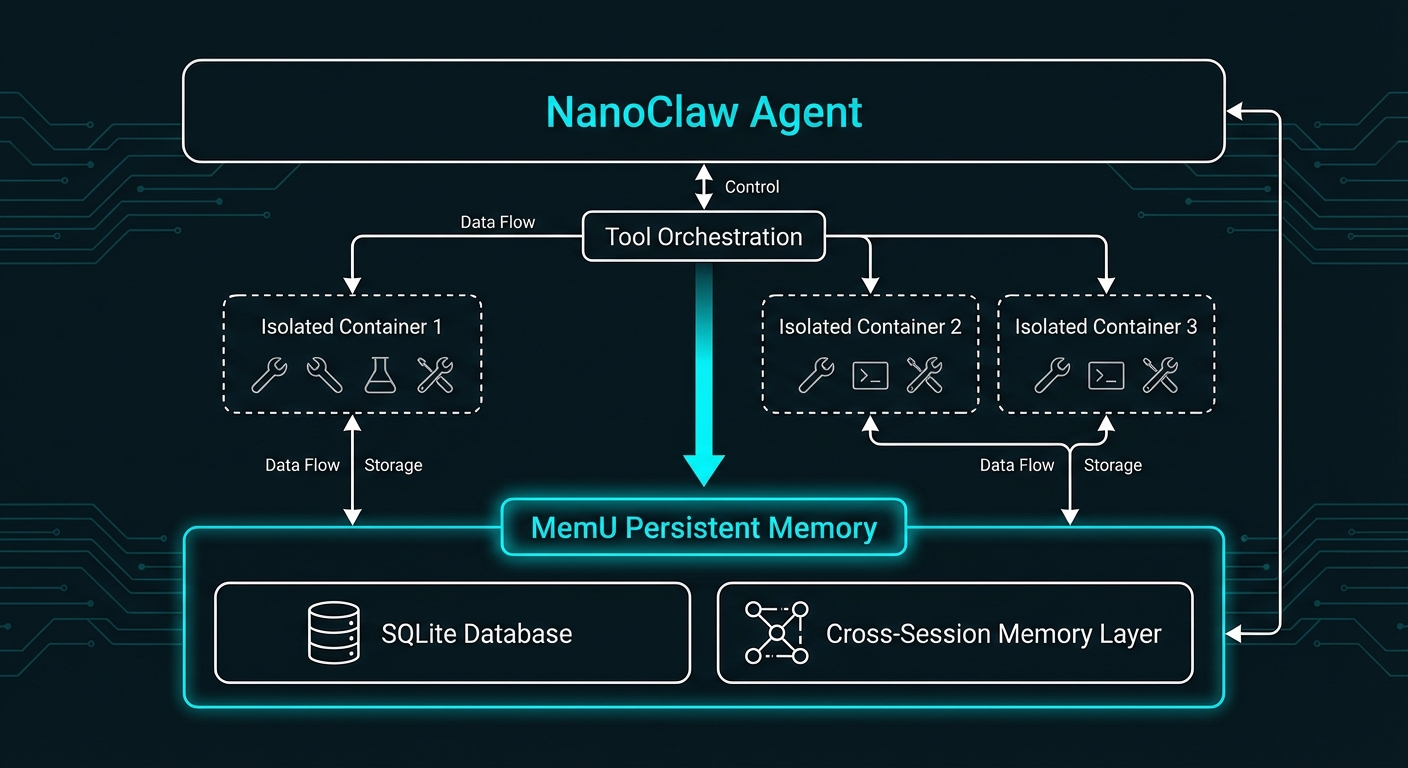
This is the correct security trade-off: agents shouldn't have implicit access to other sessions' data. But it means that an agent handling customer support in Session A has no knowledge of resolutions discovered in Session B. An agent that processed a complex workflow yesterday provides no benefit to today's similar workflow. The isolation that protects security also prevents learning.
The tension between isolation and memory is fundamental to agent architecture. Security requires that agents can't access unauthorized data. Effectiveness requires that agents can access relevant past experience. Resolving this tension requires an explicit memory layer with proper access controls — not implicit database sharing, but deliberate memory retrieval with appropriate permissions.
How MemU Adds Memory Without Adding Complexity
MemU provides external persistent memory that integrates with NanoClaw's minimalist architecture. Instead of expanding the 500-line core, MemU operates as a memory service that agents can call through standard tool interfaces. Write memories at the end of a session. Retrieve relevant memories at the start of the next. The core framework stays simple; the memory layer handles persistence.
The access control model respects NanoClaw's security philosophy. Agents only retrieve memories they're authorized to access. Cross-session knowledge sharing is explicit, not implicit — an agent must request memories, and the memory layer enforces permission boundaries. Security isolation is maintained while enabling the experiential learning that makes agents effective over time.
NanoClaw proved that powerful agents don't need complex frameworks. MemU proves that persistent memory doesn't need to compromise simplicity. Together, they deliver agents that are understandable, secure, and continuously improving.
Get Started
Add persistent memory to your lightweight agent framework. Explore MemU at memu.pro and on GitHub.