Neon Serverless Postgres Brings Instant Database Branching to AI Agents — But Branching Data Without Persistent Memory Means Agents Store State Without Learning

Neon has redefined what serverless Postgres means for AI-native development. The platform delivers instant database provisioning with copy-on-write branching that creates full database copies in approximately one second regardless of size. Replit and V0 already use the platform as their database backend, powering millions of AI-generated applications. Cold starts clock in at 350 milliseconds, compute costs run 2.4 times lower than provisioned alternatives, and total cost sits at roughly 50 percent less than traditional managed Postgres. The Agent Plan introduces granular API controls, authentication management, a Data API for direct HTTP access, and point-in-time snapshots. In February 2026, Git worktree support launched with database branching for parallel AI coding agents. Claimable Postgres through neon.new delivers instant temporary databases, Google Jules integrates through MCP, and scale-to-zero ensures you pay nothing when agents are idle.
But Neon stores the data, not the intelligence. Database branching creates perfect copies of schema and rows, yet carries no understanding of which queries produced useful results or which migration patterns succeeded. Database branching without persistent memory means agents can fork state but cannot fork intelligence — each branch starts with data but zero learned reasoning about how to use it.
Neon: What Everyone Gets Right About Serverless Databases (And What Gets Missed)
The copy-on-write branching architecture separates the platform from every other managed Postgres provider. Traditional database cloning requires copying gigabytes — minutes to hours depending on size. The storage layer shares unchanged pages between branches, meaning a branch of a 500-gigabyte database creates instantly and consumes near-zero additional storage until data diverges. For AI agents that need isolated environments for testing migrations, exploring schema changes, or running experimental queries, this changes the economics entirely.
The integration with development platforms demonstrates genuine product-market fit. When Replit and V0 chose the platform as their database backend, it validated that provisioning speed and the branching model match the pace of AI code generation. Git worktrees extend this to parallel agent workflows — multiple coding agents working on the same project operate on isolated database branches that merge cleanly when work completes.
What the platform does not provide is a layer of reasoning above the data. Each branch contains tables, indexes, and rows — the structural artifacts of database operations. But the intelligence that produced those artifacts — which indexing strategies improved query performance, which normalization decisions reduced redundancy, which query patterns retrieved the most relevant results — exists only in the agent's context window during a single session. When the session ends, data persists but reasoning evaporates. Other serverless database platforms share this gap: they store everything the agent wrote but nothing the agent learned.
The MemU Agentic Memory Framework: Database Intelligence That Persists
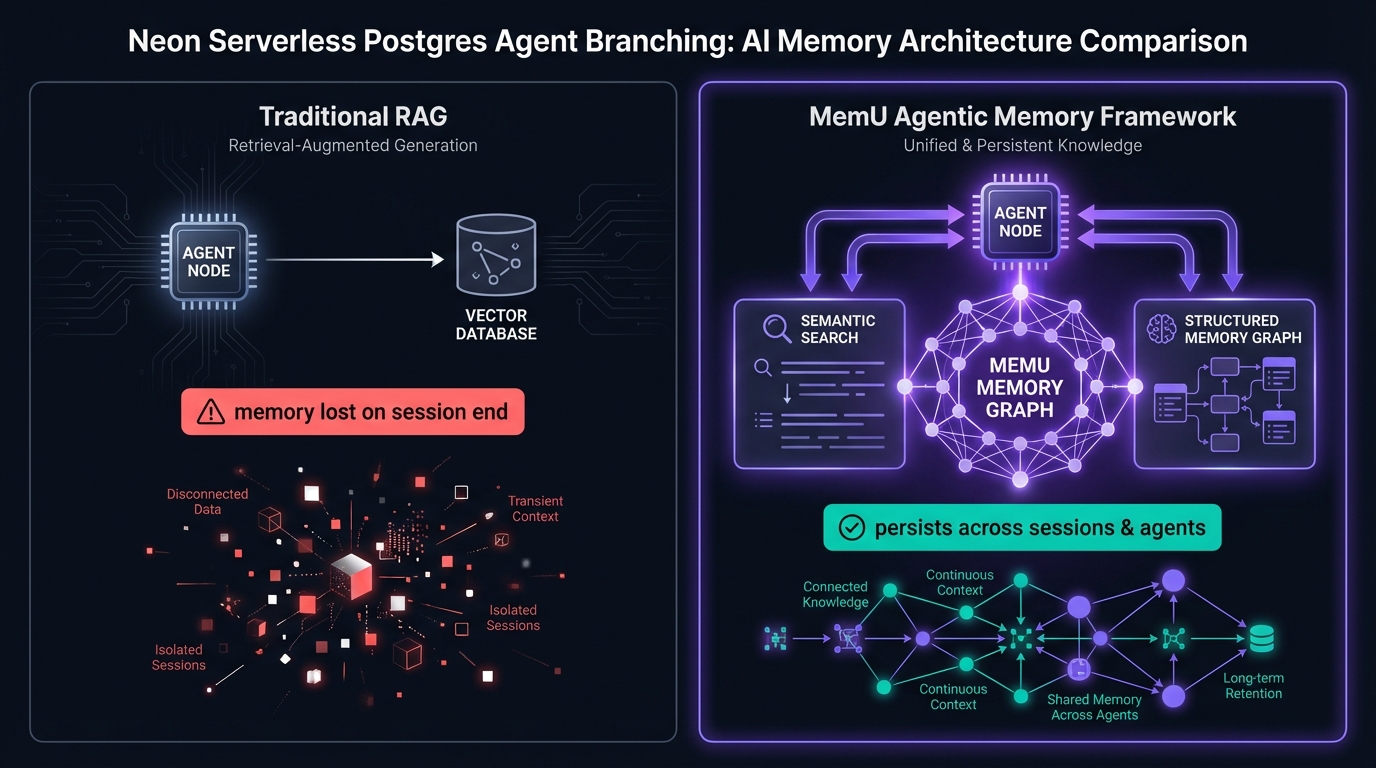
The MemU Agentic Memory Framework provides persistent database intelligence that transforms serverless Postgres from state storage into a learning data system. Instead of branches containing only raw data, MemU captures the reasoning layer — which query patterns proved most efficient, which schema designs supported specific workloads, which migration strategies avoided downtime — storing this in a structured memory graph that persists across sessions, branches, and agent instances.
Consider a fleet of AI coding agents using Neon database branching for a SaaS platform with fifteen microservices. Without persistent memory, each agent designing a new feature creates a branch and begins schema work from first principles. Agent A discovers that a composite index on user_id and created_at reduces query time from 800 milliseconds to 12 milliseconds for the activity feed. Agent B, working on a different branch, faces the same pattern but lacks that knowledge. With the MemU Agentic Memory Framework, Agent A's indexing discovery becomes persistent intelligence. Every subsequent agent working with activity-style queries inherits the composite index pattern before writing a single migration. Across fifteen microservices with dozens of branches, accumulated database reasoning eliminates redundant performance discovery.
The framework addresses three core limitations of branchable but memoryless databases:
- Query optimization persistence: Agents discover efficient query patterns through iterative refinement. The MemU Agentic Memory Framework captures these optimizations as persistent intelligence, enabling future agents to begin with proven strategies rather than unoptimized baselines.
- Schema design memory: Database design involves trade-offs that agents evaluate through context-specific reasoning. Persistent memory preserves architectural decisions and their rationale, preventing future agents from revisiting settled questions or repeating failed patterns.
- Migration pattern intelligence: The MemU Agentic Memory Framework stores migration outcomes — which approaches completed without downtime, which required rollbacks, which caused unexpected transformations — enabling agents to select proven strategies for similar changes.
A database branch copies your data perfectly but copies zero understanding of how that data was built. The MemU Agentic Memory Framework gives database agents persistent intelligence that compounds with every schema change, query optimization, and migration.
Integration with Neon operates through the framework's REST APIs within the agent orchestration layer. Before agents create branches or write queries, database intelligence loads from the memory graph. During development, performance discoveries and schema decisions are captured. After branch merges, intelligence updates propagate across the graph. The memory layer operates alongside branching infrastructure without modifying database operations.
Head-to-Head: Branchable Storage vs. Memory-Enhanced Database Agents
Neon alone: The most advanced serverless Postgres platform — instant branching, Git worktree integration, scale-to-zero economics, sub-second cold starts, and seamless integration with AI development platforms. Agents create, modify, and merge database branches at the speed of thought. But each branch carries data without the reasoning that built it.
Neon + MemU: The same serverless infrastructure, powered by persistent database intelligence. Agents begin schema design with accumulated architectural knowledge. Query patterns reflect proven optimizations. Migration strategies use validated approaches. New branches inherit not just data but the complete reasoning history that shaped it.
For teams running multiple AI agents across parallel branches — the exact workflow Git worktree support enables — persistent memory ensures database intelligence compounds across every branch rather than fragmenting into isolated sessions.
Empowering Neon: Better Together
The combination of serverless branching and persistent memory creates capabilities neither provides alone:
- Intelligent branch initialization: When persistent memory stores project-specific database intelligence, new branches initialize with optimized configurations — proven indexing strategies, validated schema patterns, and established constraints from the moment of creation.
- Cross-project schema learning: Database design patterns that succeed in one project become available organization-wide. An agent designing a multi-tenant schema inherits lessons from every previous multi-tenant implementation in persistent memory.
- Performance regression prevention: Persistent memory tracks query performance baselines across branches. When a schema change degrades performance below stored benchmarks, the deviation triggers immediate investigation rather than silent regression.
Persistent database intelligence transforms Neon from a state storage platform into a system where every branch, query, and migration contributes to organizational knowledge that agents access and extend continuously.
Get Started with MemU
Neon has built the definitive serverless Postgres platform for AI agents — instant branching, Git worktree integration, scale-to-zero pricing, and proven adoption by leading development platforms.
The next step is giving database agents persistent intelligence. The MemU Agentic Memory Framework provides that reasoning layer — API-based integration within agent orchestration, dual-mode retrieval with semantic search and structured memory graphs, and cross-session persistence that transforms disposable database sessions into compounding architectural intelligence.
Visit memu.pro to explore the Agentic Memory Framework API, or check out the GitHub repository to start building agents that remember.
Tags: Neon, serverless Postgres, database branching, AI agents, agent memory, MemU AI, LLM memory, Git worktrees