New Relic Agentic Platform Monitors Systems With AI — But Diagnostic Memory Doesn't Persist Between Incidents

New Relic Agentic Platform launched as a no-code solution for building and governing custom AI agents focused on observability. These agents monitor infrastructure, detect anomalies, correlate events, and suggest remediations — tasks that traditionally required specialized SRE knowledge. By lowering the barrier to creating observability agents, New Relic enables teams to deploy AI-powered monitoring without deep platform expertise.
But there is a foundational layer that observability agents, like every monitoring tool before them, still depend on getting right — memory.
New Relic Agentic Platform: What Everyone's Getting Right (And Missing)
The Agentic Platform gets accessibility right. No-code agent creation means that operations teams can build monitoring workflows without writing Python or configuring complex pipelines. The governance layer ensures agents operate within defined boundaries. For organizations drowning in telemetry data, AI agents that can surface actionable insights are a genuine force multiplier.
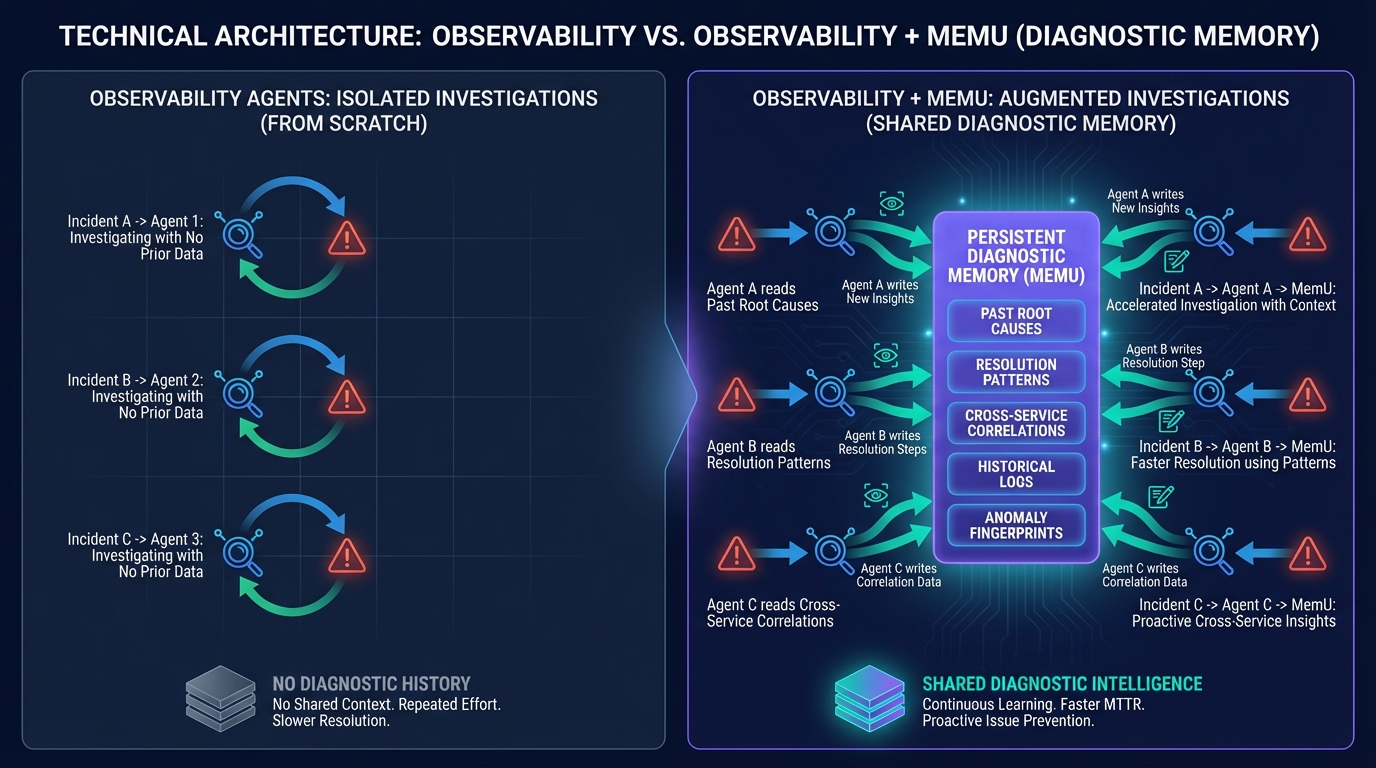
What the Agentic Platform does not address is what observability agents remember between incidents. Each alert triggers a fresh investigation. The agent that diagnosed a cascading failure in your payment service last Tuesday has no memory of that diagnosis when a similar pattern emerges this Thursday. New Relic agents observe the present; they do not learn from the past.
Other AIOps platforms — Datadog AI, Dynatrace Davis, PagerDuty AIOps — share this same architectural constraint. They correlate current telemetry; none of them accumulate diagnostic intelligence across incidents.
The MemU Agentic Memory Framework: Persistent Diagnostic Intelligence for Observability Agents
The MemU Agentic Memory Framework adds the missing layer. Where the New Relic Agentic Platform monitors what is happening now, MemU tracks what the monitoring agent has learned over time.
Consider an observability agent investigating a spike in API latency. With MemU, it recalls that this same service experienced a similar spike six weeks ago, that the root cause was a connection pool exhaustion triggered by a batch job, that the fix was adjusting pool limits during peak hours, and that the batch job team was already notified and committed to a scheduling change. Without MemU, the agent starts the investigation from zero.
The MemU Agentic Memory Framework provides:
- Drop-in integration: A simple API that works alongside any observability platform — New Relic, Datadog, Grafana, or custom monitoring stacks. Add memory calls; your observability agents gain institutional operational knowledge.
- Dual-mode retrieval: Semantic search for finding similar past incidents — "what looked like this before?" — plus a structured memory graph for tracking causal chains — "what sequence of events led to the last outage of this type?" Not just alert history — actual diagnostic topology.
- Cross-incident persistence: Memory survives across incidents, alert resets, and dashboard refreshes. One investigation's root cause analysis feeds the next investigation's hypothesis generation automatically.
Observability without diagnostic memory is pattern matching without pattern learning. The MemU Agentic Memory Framework gives monitoring agents the ability to recognize recurring issues, not just detect them fresh every time.
Retrieval operates across 10,000+ memory entries with sub-100ms latency, so diagnostic memory lookup never delays incident response.
Head-to-Head: Agentic Observability Alone vs. With MemU
New Relic Agentic Platform alone: Each incident investigation starts with current telemetry. The agent correlates events within the active time window, but the hundredth investigation of a recurring issue carries the same context as the first. Mean time to resolution stays flat.
New Relic + MemU Agentic Memory Framework: Each investigation reads from persistent diagnostic memory. The agent recalls past incidents, their root causes, which hypotheses were dead ends, and which remediations worked. Mean time to resolution decreases with every incident as the agent's diagnostic intelligence deepens.
Cross-service pattern recognition: With MemU, the observability agent remembers that a latency pattern in the API gateway correlated with a database issue three months ago — across services that don't share dashboards. Without MemU, cross-service patterns only emerge if a human analyst remembers to check.
Empowering New Relic Agentic Platform: Better Together
MemU does not replace New Relic — it makes observability agents dramatically more effective:
- Incident diagnosis: New Relic agents detect the anomaly; MemU provides historical context about similar anomalies, their causes, and resolutions — turning raw detection into informed diagnosis.
- Capacity planning: New Relic agents monitor resource utilization; MemU tracks utilization trends across quarters, remembering seasonal patterns and growth trajectories that inform proactive scaling decisions.
- Runbook evolution: New Relic agents follow remediation playbooks; MemU remembers which playbook steps were effective and which needed modification, so runbooks improve organically with every incident.
Get Started with MemU
Add persistent diagnostic memory to your observability agents in minutes. The MemU Agentic Memory Framework works with any monitoring platform — one API, zero lock-in, immediate operational intelligence. Visit memu.pro to explore the Agentic Memory Framework API, or check out the GitHub repository to start building agents that remember.
Tags: New Relic, AIOps, observability agents, incident response, agentic memory, LLM memory, MemU AI