Notion AI Agents Automate Knowledge Work Across Docs and Databases — In a Workspace That Forgets Cross-Project Context

Notion has evolved from a note-taking app into an AI-powered workspace operating system. With Notion AI Agents, teams can automate knowledge work that spans documents, databases, wikis, and project trackers. These agents draft content from existing knowledge bases, generate meeting summaries, populate database entries from unstructured text, and answer questions by synthesizing information across thousands of workspace pages.
The integration is seamless — Notion AI understands your workspace structure natively. It knows which databases relate to which projects, which documents contain relevant context, and how your team has organized information. For organizations already living in Notion, the AI layer feels like a natural extension of the platform.
But Notion AI's intelligence is workspace-scoped and session-limited. The agent that brilliantly synthesized insights across your product roadmap, customer feedback database, and engineering specs yesterday doesn't remember that synthesis today.
Notion AI: What Everyone's Getting Right (And Missing)
Notion's approach of embedding AI directly into the workspace where knowledge already lives is architecturally sound. Rather than requiring users to copy context into a separate AI tool, Notion AI Agents operate on native workspace data with full structural awareness. This eliminates the context assembly problem that plagues standalone AI tools.
Teams report significant time savings on routine knowledge work: weekly status reports generated from project databases, customer feedback synthesized from scattered notes, technical documentation drafted from engineering discussions. Notion AI handles the pattern-matching and assembly work that previously consumed hours.
The missing layer is cross-session intelligence. When Notion AI synthesizes a quarterly review from 200+ pages of project data, that synthesis — the patterns identified, the connections discovered, the insights generated — exists only in the output document. The agent's analytical understanding evaporates. The next synthesis request processes the same 200 pages from scratch.
What Notion AI Does With Knowledge Today
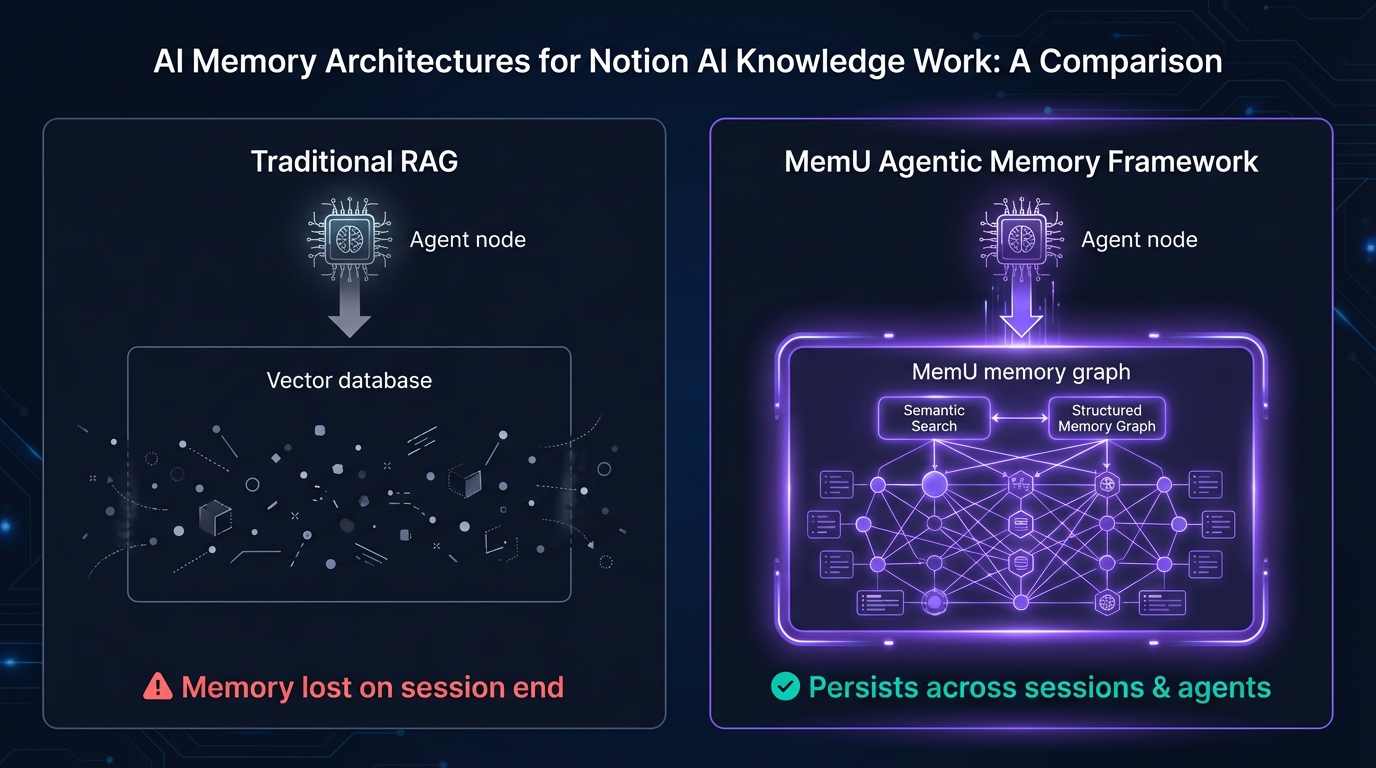
Notion AI indexes workspace content and uses retrieval-augmented generation to answer questions and generate content. The system understands Notion's data model — pages, databases, properties, relations, rollups — and can query structured data alongside unstructured text.
This gives Notion AI a significant advantage over generic AI tools. When you ask it to summarize project status, it knows which database tracks projects, which properties indicate status, and which linked pages contain relevant updates. The structural awareness is impressive.
What's absent is temporal intelligence. Notion AI can tell you what your workspace contains right now, but it doesn't track how information evolved, which decisions changed direction, or what patterns emerge over time. Each query is answered from the current snapshot without historical context. Competing workspace AI tools — from Confluence AI to Coda AI — share this same limitation.
The MemU Agentic Memory Framework: Knowledge Work That Builds on Itself
The MemU Agentic Memory Framework adds persistent analytical memory to workspace AI agents. Instead of re-analyzing the same data on every request, the agent retrieves insights from previous analyses and builds on accumulated understanding.
Think of a product team using Notion AI for weekly customer feedback synthesis. Week 1: the agent analyzes 50 feedback entries, identifies three emerging themes, and generates a summary. Week 8: the agent analyzes 50 new entries. Without MemU, it processes them in isolation — potentially missing that two of the themes from Week 1 have intensified while one has disappeared. With the MemU Agentic Memory Framework, the agent retrieves the full trend history and contextualizes new feedback against eight weeks of accumulated pattern recognition.
The framework provides three key capabilities for knowledge work agents:
- Analytical continuity: Insights, patterns, and synthesis results from previous sessions persist as structured memory. Each new analysis builds on previous findings rather than starting from raw data.
- Cross-project intelligence: Patterns discovered in one project inform analysis of related projects. The MemU Agentic Memory Framework captures connections that span workspace silos.
- Temporal awareness: How metrics changed, which decisions shifted direction, what feedback themes intensified or faded — temporal patterns that only emerge across multiple analysis sessions persist in the memory graph.
Notion AI knows what your workspace contains. MemU remembers what your workspace has taught it — and applies those lessons to every future analysis.
Head-to-Head: Snapshot Intelligence vs. Cumulative Intelligence
Notion AI alone: Native workspace awareness with powerful retrieval across documents and databases. Excellent for single-query analysis and content generation from existing data. But each query processes the workspace snapshot independently — no accumulated analytical context.
Notion AI + MemU Agentic Memory Framework: Same workspace intelligence plus persistent analytical memory. Previous synthesis results, identified patterns, and cross-project insights are retrieved in sub-100ms. The agent's understanding of your workspace deepens with every interaction rather than resetting.
The same limitation exists in Confluence AI, Coda AI, and Slack AI — platform-embedded AI that queries current state without historical analytical context. MemU provides the cross-session memory layer for any workspace AI integration.
Empowering Notion AI: Better Together
MemU enhances Notion AI's native workspace intelligence with the temporal dimension that transforms point-in-time analysis into longitudinal understanding.
- Recurring reports: Weekly, monthly, and quarterly reports generated by Notion AI alone repeat the same analysis. With the MemU Agentic Memory Framework, each report builds on previous ones — highlighting what changed, what trends accelerated, and what new patterns emerged.
- Institutional knowledge: As team members come and go, Notion retains documents but loses context about why decisions were made. MemU captures the analytical layer — the reasoning behind decisions, not just the decisions themselves.
- Cross-workspace intelligence: For organizations with multiple Notion workspaces, MemU provides shared memory that connects insights across organizational boundaries.
Get Started with MemU
Notion AI Agents make knowledge work faster. The MemU Agentic Memory Framework makes knowledge work cumulative. The combination transforms workspace AI from a query tool into a system that genuinely understands your organization better over time.
Visit memu.pro to explore the Agentic Memory Framework API, or check out the open-source repository on GitHub to start building persistent memory into your knowledge work automation today.
Tags: Notion AI, knowledge work, AI agents, agentic memory, workspace automation, MemU AI, enterprise AI, cross-project memory