NVIDIA Posts $216B Revenue, Declares Agentic AI Inflection — But Agents Still Can't Remember Yesterday


NVIDIA just posted $215.9 billion in fiscal 2026 revenue — a 65% year-over-year jump — with Q4 alone hitting a record $68.1 billion. CEO Jensen Huang declared the arrival of the "agentic AI inflection point," signaling that autonomous AI agents are no longer a research curiosity but the primary driver of enterprise compute demand. Data Center revenue reached $193.7 billion for the year, up 68%, as every major cloud provider scaled up AI infrastructure. Grace Blackwell with NVLink is delivering order-of-magnitude lower cost per token for inference workloads.
The market response was clear: NVIDIA's guidance of $78 billion for Q1 FY2027 signals continued exponential growth. Enterprise customers aren't just training models anymore — they're deploying agentic systems that run 24/7, consuming inference at unprecedented scale. NVIDIA is betting its entire roadmap on the agentic AI thesis, from Blackwell to the upcoming Vera Rubin platform.
But here's the paradox that NVIDIA's record earnings expose: the hardware to run AI agents at scale is ready, but the agents themselves still can't remember what they did five minutes ago.
The Agentic AI Inflection in Numbers
Jensen Huang's inflection point claim is backed by data. Enterprise customers deploying agentic AI systems are consuming 5-10x more inference compute than traditional chatbot deployments. Each agent runs continuous loops of reasoning, tool use, and decision-making — every cycle consuming GPU resources. The $193.7 billion Data Center revenue reflects a fundamental shift from model training to always-on agent inference.
The numbers are staggering: 75% gross margins, $1.76 EPS, and a forward outlook that assumes zero China Data Center revenue. NVIDIA is essentially saying the agentic demand from Western markets alone justifies unprecedented investment. AWS, Microsoft Azure, Google Cloud, and CoreWeave are all scaling Blackwell deployments specifically for agent workloads.
But scaling inference hardware solves only half the problem. An AI agent that processes customer requests, manages workflows, or automates business operations needs more than fast token generation — it needs persistent memory that survives across sessions, tasks, and context windows.
Why Agentic AI Creates a Memory Crisis
Traditional AI interactions are stateless: user sends a prompt, model returns a response, context is discarded. Agentic AI fundamentally changes this pattern. Agents execute multi-step tasks over hours or days. They collaborate with other agents. They interact with the same users and systems repeatedly. Without persistent memory, every interaction starts from zero.
Consider an enterprise deploying customer service agents on NVIDIA hardware. Each agent handles thousands of tickets per day. Without memory, the agent that resolved a complex issue for Customer A yesterday treats Customer A as a complete stranger today. The agent that learned the optimal workflow for resolving billing disputes forgets that workflow when the session ends. The agent that collaborated with a sales agent on a cross-functional issue has no record of the collaboration.
NVIDIA's hardware makes it economically feasible to run these agents at scale. The $68.1 billion quarter proves enterprises are doing exactly that. But the memory gap means these agents operate at a fraction of their potential — powerful reasoning with zero institutional knowledge.
Hardware Speed vs. Memory Persistence
NVIDIA's Blackwell platform reduces inference costs by 10x compared to Hopper. The upcoming Vera Rubin promises another order-of-magnitude improvement. Faster, cheaper inference means agents can run more complex reasoning chains, use more tools, and handle more tasks. But speed and cost improvements are orthogonal to memory persistence.
A model running on Blackwell generates tokens 10x faster than on Hopper. It still forgets everything between sessions. A model running on Vera Rubin will generate tokens even faster. It will still have no memory of previous interactions. The context window is the fundamental bottleneck — no matter how fast you fill it, it empties when the session ends.
This creates a counterintuitive situation: as NVIDIA makes inference cheaper and agents become more ubiquitous, the memory problem gets worse, not better. More agents running more tasks means more knowledge generated and lost. The agentic AI inflection that drives NVIDIA's revenue also amplifies the memory crisis.
What Agents Actually Need to Remember
The memory requirements for production AI agents go far beyond conversation history. Effective agent memory includes:
Task Memory: What the agent has worked on, what approaches succeeded, and what failed. An agent that has processed 10,000 support tickets should have accumulated knowledge about common failure patterns, effective resolution strategies, and customer-specific context — without stuffing all of that into a context window.
Collaboration Memory: When multiple agents work together, each agent needs access to shared context. A research agent that found relevant data needs to persist that finding so a writing agent can use it hours later. Without collaboration memory, multi-agent systems can't build on each other's work.
User Memory: Agents that interact with the same humans repeatedly need to remember preferences, history, and relationship context. This is what transforms a generic AI assistant into a personalized one — and it requires memory that persists indefinitely.
Skill Memory: Agents learn through experience. An agent that discovers a more efficient approach to a task should retain that learning. Without skill memory, agents repeat the same mistakes and rediscover the same solutions endlessly.
How MemU Completes the Agentic Stack
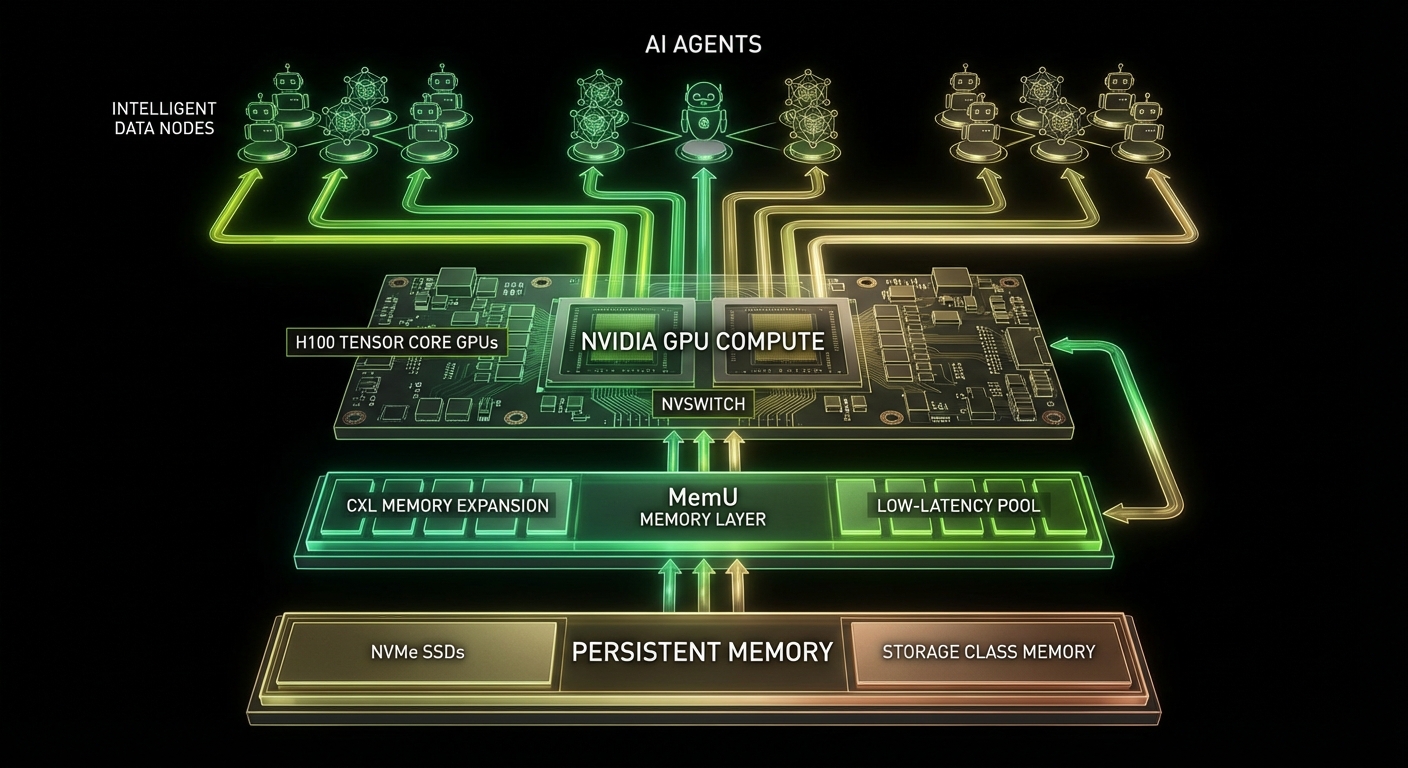
MemU provides the persistent memory layer that NVIDIA's hardware stack lacks. While NVIDIA handles the compute — making inference fast, efficient, and affordable — MemU handles the memory, ensuring agents retain knowledge across sessions, share context across collaborations, and accumulate expertise over time.
The integration is straightforward: agents running on NVIDIA infrastructure write experiences to MemU's memory layer. Before each new task, they retrieve relevant memories. The cost of memory operations is negligible compared to the inference costs that NVIDIA is optimizing. But the impact on agent effectiveness is transformational.
With NVIDIA providing 10x cheaper inference and MemU providing persistent memory, the full agentic AI stack becomes viable at enterprise scale. Agents that run 24/7 on Blackwell GPUs, remember everything they've learned, and collaborate through shared memory — this is the architecture that justifies NVIDIA's $216 billion revenue trajectory.
Get Started
NVIDIA has built the engine. MemU provides the memory. Together, they enable the agentic AI future that Jensen Huang's earnings call described. Explore MemU at memu.pro and on GitHub.