NVIDIA Blackwell Powers Trillion-Parameter Inference — Every Inference Run Forgets the Last


NVIDIA Blackwell is shipping, and hyperscalers are deploying it for trillion-parameter inference. Inference at this scale is no longer just "run the model" — it's request routing, batching, failure recovery, and cost optimization. Every inference run generates signals: which requests timed out, which shards are hot, which patterns correlate with errors. Today that signal is logged and discarded after the run.
Blackwell's throughput makes the memory gap more expensive. When you're serving millions of inferences per day, repeating the same mistakes — routing to the same overloaded shard, batching in a way that caused OOMs last week — costs real money and reliability. Inference systems that don't remember request patterns and failure modes are flying blind.
Why Inference Needs Operational Memory
Traditional observability gives you metrics and logs. It doesn't give the inference stack a structured memory of what worked and what didn't. The MemU Agentic Memory Framework provides persistent operational memory: every run can store and retrieve patterns, so the next run avoids known failure modes and optimizes for known-good configurations.
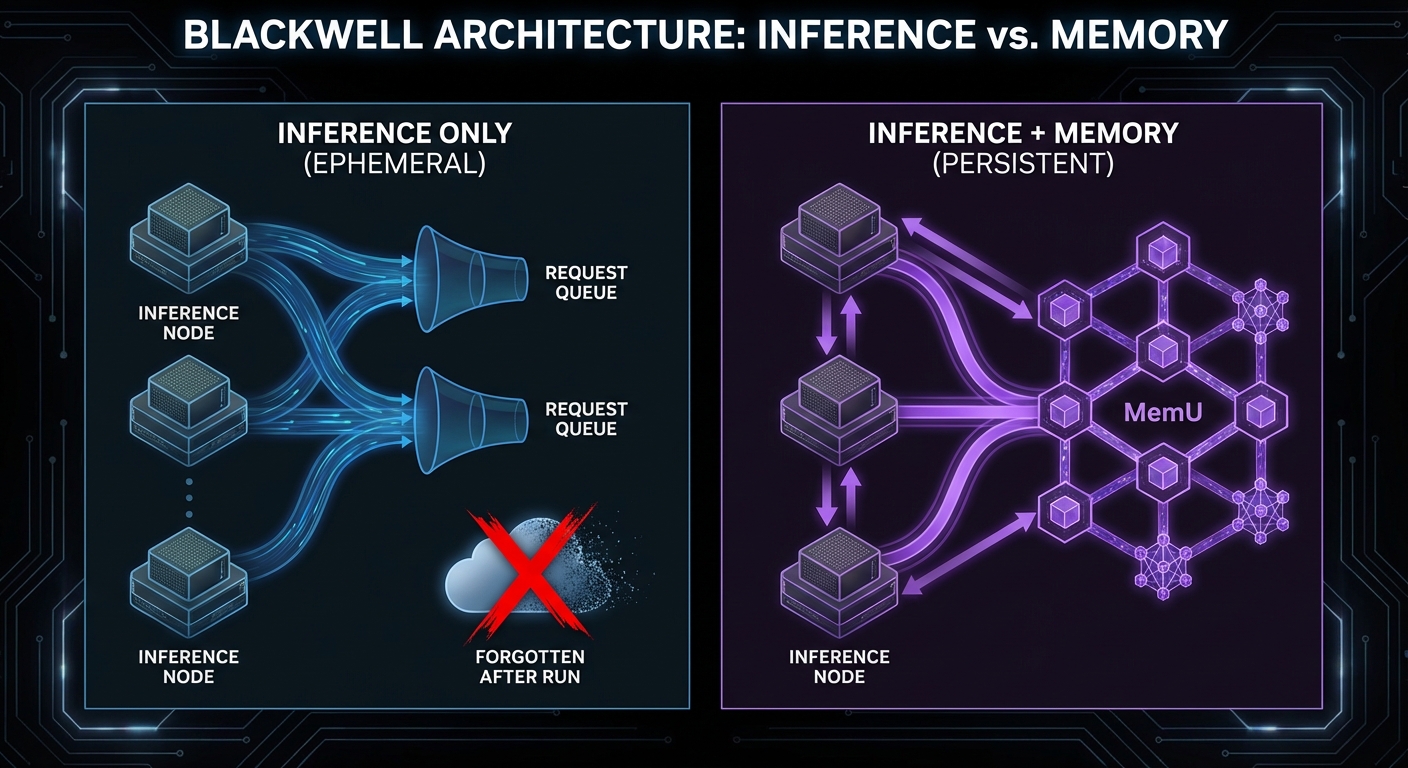
For Blackwell-scale deployments, the MemU Agentic Memory Framework turns inference from stateless execution into a learning system. Same hardware, same models — with memory that persists across runs and improves reliability and cost over time.
Blackwell gives you the compute. MemU gives inference a memory that learns from every run.
Get Started
Add persistent operational memory to your inference stack. Explore the MemU Agentic Memory Framework at memu.pro and on GitHub.
Tags: NVIDIA Blackwell, inference memory, MemU Agentic Memory Framework, AI infrastructure