NVIDIA NemoClaw Launches OpenShell Security for Open-Source Agent Toolkits — But Secure Execution Without Persistent Memory Leaves Agents Starting from Zero


At GTC 2026 on March 6, NVIDIA unveiled NemoClaw, an open-source secure agent toolkit that pairs the Nemotron family of models with OpenShell — a sandboxed execution environment governed by declarative YAML policy rules that prevent unauthorized file access, network calls, and system-level operations. For enterprises that have watched agentic AI capabilities surge while security assurances lagged behind, NemoClaw represents a serious answer: a hardware-agnostic framework that runs on NVIDIA, AMD, Intel, and CPU-only infrastructure, supports multi-agent supervisor-worker delegation patterns, and ships with the AI-Q blueprint for enterprise search agents that has already demonstrated 50% or greater query cost reductions in early deployments at Adobe, IBM Red Hat, Box, and Cadence.
But there is a structural gap that even the most rigorous sandbox cannot close — secure agent toolkits that reset between sessions cannot learn from past executions. An agent that safely completed a complex data pipeline yesterday has no memory of which tools it used, which policies it navigated, or which execution paths succeeded. Security is essential, but security without continuity means every session starts from scratch.
Secure Agent Toolkits: What NemoClaw Gets Right (And What It Misses)
NemoClaw's architecture addresses the single biggest barrier to enterprise agent deployment: trust. The OpenShell sandbox wraps every agent action in a policy layer defined through human-readable YAML configuration files. Administrators specify exactly which filesystem paths an agent can read or write, which network endpoints it can reach, and which system calls are permitted. This is compile-time enforcement that prevents unauthorized actions from executing at all, not runtime monitoring that flags violations after the fact.
The multi-agent architecture adds another layer of practical value. NemoClaw implements a supervisor-worker delegation pattern where a coordinating agent decomposes complex tasks and delegates subtasks to specialized worker agents, each operating within its own security boundary. The AI-Q blueprint extends this pattern to enterprise search, combining retrieval-augmented generation with structured tool use to answer complex queries across heterogeneous data sources while maintaining access controls at every step. Early adopters report that the blueprint reduces query processing costs by more than 50% compared to naive RAG approaches, primarily by eliminating redundant document retrievals through intelligent caching and query decomposition.
The hardware-agnostic design is equally significant. Unlike frameworks that implicitly assume NVIDIA GPU availability, NemoClaw runs on AMD GPUs, Intel accelerators, and CPU-only environments. This makes the secure agent toolkit viable for organizations with heterogeneous infrastructure, on-premise deployments where GPU selection is constrained by procurement cycles, and edge computing scenarios where specialized hardware is unavailable.
What NemoClaw does not provide is persistence. The supervisor agent that learned to decompose a particular type of compliance query efficiently last week has no record of that learning this week. Worker agents that discovered optimal tool sequences for specific data sources cannot carry those discoveries forward. The security policies persist in YAML files, but the operational intelligence — the accumulated knowledge of what works, what fails, and what each data source actually contains — evaporates when the session ends. The secure agent toolkit ensures agents cannot do harm, but it does not help agents accumulate wisdom.
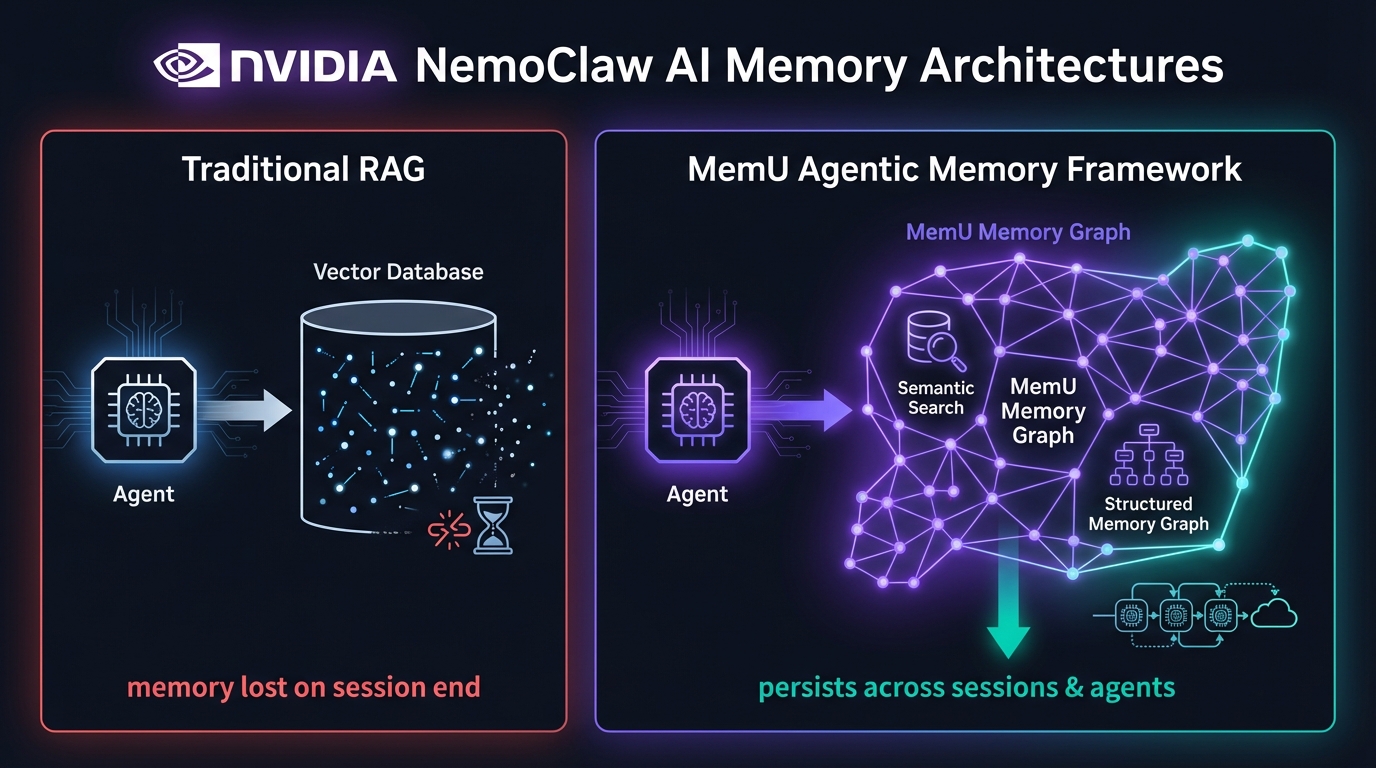
The MemU Agentic Memory Framework: Persistent Memory for Secure Agent Toolkits
The MemU Agentic Memory Framework adds the memory substrate that NemoClaw's architecture structurally lacks. Where OpenShell governs what agents can do, MemU governs what agents remember — creating a persistent intelligence layer that operates within and respects the security boundaries NemoClaw enforces, while ensuring that no operational learning is discarded between sessions.
Consider an enterprise search agent built on the AI-Q blueprint. A compliance analyst asks it to find all contracts mentioning force majeure clauses across three document management systems. With MemU, the agent recalls that System A stores contracts as PDFs requiring OCR preprocessing, that System B uses a non-standard date format requiring transformation, and that System C has a rate limit that triggers at 200 requests per minute. Without persistent memory, the agent discovers these constraints through trial and error every single time — wasting tokens, burning API calls, and delivering slower results for a query pattern it has already solved.
The MemU Agentic Memory Framework provides capabilities purpose-built for secure multi-agent environments:
- Scoped memory isolation: Each worker agent maintains its own memory namespace, preventing cross-agent information leakage while allowing the supervisor agent to access aggregated insights. This mirrors the security boundary model that NemoClaw enforces at the execution layer, extending it to the memory layer with equal rigor.
- Policy-aware retrieval: Memory queries respect the same access control policies defined in OpenShell YAML configurations. An agent that cannot access a filesystem path also cannot retrieve memories derived from that path, maintaining end-to-end security from execution through persistence.
- Cross-session knowledge graphs: Entity relationships, tool performance metrics, and execution histories stored as structured graphs that survive session boundaries. The secure agent toolkit gains institutional knowledge — not just per-session intelligence — without compromising its security guarantees.
Security constrains what agents can do. The MemU Agentic Memory Framework ensures that everything agents learn within those constraints compounds across every session, turning safe execution into safe and progressively smarter execution.
Head-to-Head: NemoClaw vs. Other Secure Agent Frameworks
NemoClaw alone: Every agent session begins with full security enforcement but zero operational context. The supervisor agent re-learns delegation strategies from scratch. Worker agents re-discover data source quirks and optimal tool sequences through repeated trial and error. Security is constant, but intelligence resets — the hundredth execution of a query pattern is no faster or smarter than the first.
NemoClaw + MemU Agentic Memory Framework: Every agent session begins with full security enforcement and full operational context from all prior sessions. The supervisor agent recalls which delegation strategies worked for similar tasks. Worker agents access stored knowledge about data sources, tool performance characteristics, and prior error patterns. The secure agent toolkit becomes a secure learning system — each session deposits intelligence that subsequent sessions withdraw and build upon.
Compared to other agent security approaches — Docker-based isolation, AWS Lambda sandboxing, or application-level permission systems — NemoClaw's YAML policy model offers superior granularity and auditability. But all of these approaches share the same memory limitation: they secure the execution environment without persisting the execution intelligence. Adding persistent memory to NemoClaw addresses what no sandbox can: the absence of continuity across the boundary between one secure session and the next.
Empowering NemoClaw: Better Together
MemU does not replace NemoClaw's security model — it amplifies the value of every secure execution:
- Enterprise search agents: The AI-Q blueprint handles query decomposition and retrieval with proven cost efficiency; MemU stores query patterns, source reliability scores, and retrieval strategies — cutting repeat query costs even further by eliminating redundant discovery and transforming the blueprint from a stateless query engine into an adaptive knowledge system.
- Multi-agent delegation: The supervisor-worker pattern distributes tasks across security boundaries; MemU persists delegation outcomes, worker specialization profiles, and task completion metrics — enabling the supervisor to make increasingly optimal assignment decisions based on accumulated evidence rather than static heuristics.
- Compliance workflows: OpenShell enforces access policies at the execution layer; the MemU Agentic Memory Framework maintains audit trails, decision rationales, and regulatory context across sessions — giving compliance teams both the security guarantees they require and the operational intelligence they need to respond to queries efficiently and consistently.
Get Started with MemU
Give your NemoClaw agents the persistent memory they need to transform secure agent toolkit deployments from stateless sandboxes into learning systems that compound intelligence with every session. The MemU Agentic Memory Framework integrates with any agent framework — one API, instant persistence, zero compromise on security. Visit memu.pro to explore the Agentic Memory Framework API, or check out the GitHub repository to start building agents that remember.
Tags: NemoClaw, NVIDIA, OpenShell, secure agent toolkit, AI-Q blueprint, multi-agent security, agentic memory, persistent agent memory, MemU AI