NVIDIA Nemotron Nano Arrives on Amazon Bedrock as a Serverless SLM — But Small Language Models Without Persistent Memory Stay Small in Intelligence

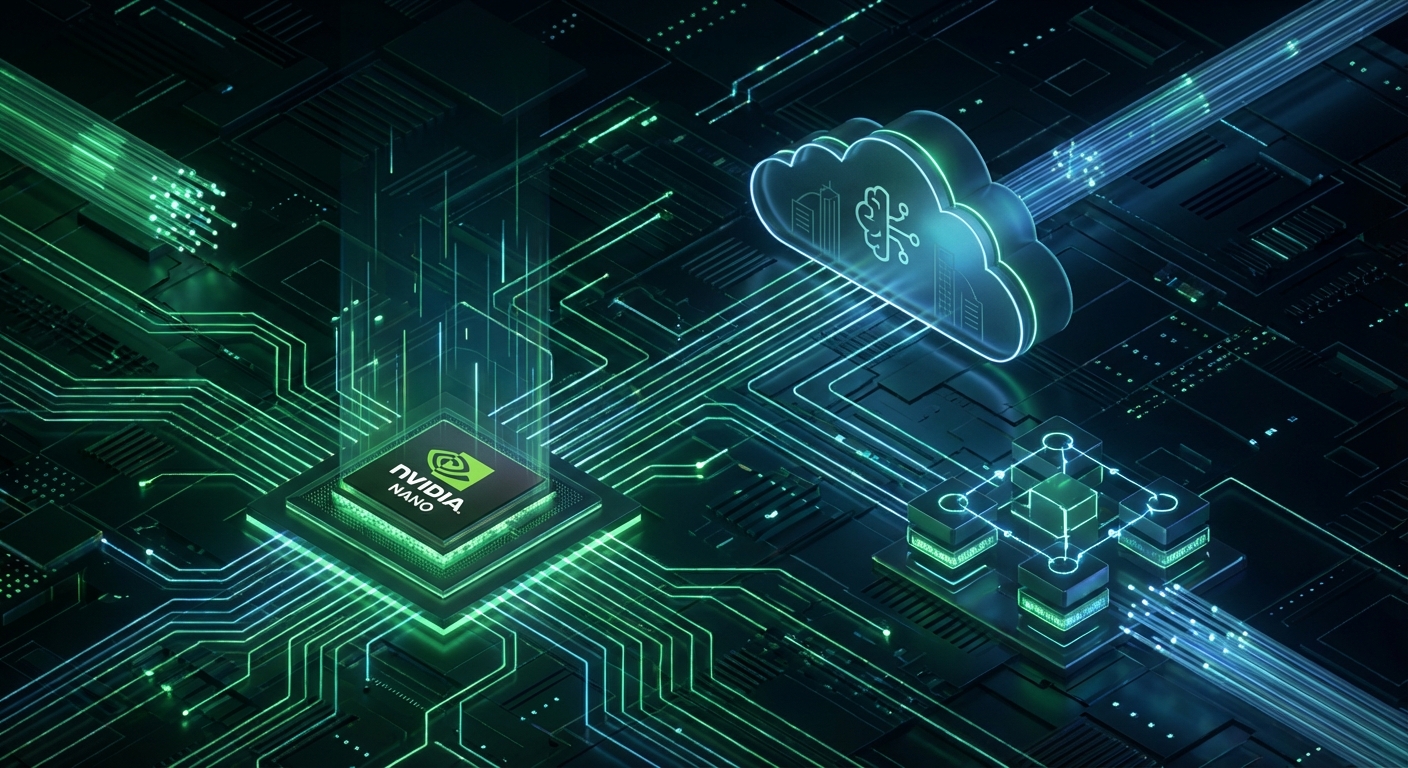
Nemotron Nano has arrived on Amazon Bedrock, giving developers access to NVIDIA's high-performance small language model as a fully managed serverless AI inference endpoint. Built on a hybrid Mixture-of-Experts architecture that combines Mamba and Transformer layers, the model leads SWE Bench Verified and AIME 2025 benchmarks while fitting into edge and cost-constrained deployments. For teams that need strong coding, reasoning, and math capabilities without provisioning GPU clusters, serverless AI inference through Bedrock makes this SLM immediately practical for production workloads at a fraction of frontier model costs.
But there is a structural limitation that no amount of model architecture innovation can address — small language models that reset between calls cannot accumulate intelligence over time. No matter how capable the model is per request, amnesia across requests caps the effective intelligence of every agent built on top of it.
Small Language Models: What Everyone's Getting Right (And Missing)
NVIDIA's approach to the small language model category is technically impressive. Nemotron Nano uses a hybrid Mamba-Transformer architecture where Mamba layers handle long-range dependencies efficiently while Transformer layers provide the attention mechanisms needed for complex reasoning tasks. The Mixture-of-Experts design activates only relevant parameter subsets per token, keeping serverless AI inference fast and compute costs low. On Amazon Bedrock, this translates to fully managed endpoints with no cold-start GPU provisioning and pay-per-token pricing that makes small models economically viable for high-volume production workloads serving thousands of concurrent users.
The benchmarks tell a compelling story. The model tops SWE Bench Verified for code generation, outperforms larger models on AIME 2025 math reasoning, and demonstrates strong performance across multi-step logical tasks. For developers evaluating small language models against frontier models, the capability gap has narrowed significantly while cost per token remains an order of magnitude lower than flagship offerings from OpenAI and Anthropic.
What the benchmarks do not measure is continuity. Every call to the SLM starts from a blank slate. The model that solved a complex debugging problem for your codebase yesterday has no recollection of that solution today. The agent that reasoned through your business logic in one session cannot reference that reasoning in the next. Per-request intelligence is high, but cross-request intelligence is zero — and for production agents that interact with users and codebases over weeks and months, that amnesia is the bottleneck that no benchmark captures and no architecture improvement at the model layer can fix.
The MemU Agentic Memory Framework: Persistent Memory for Small Language Models
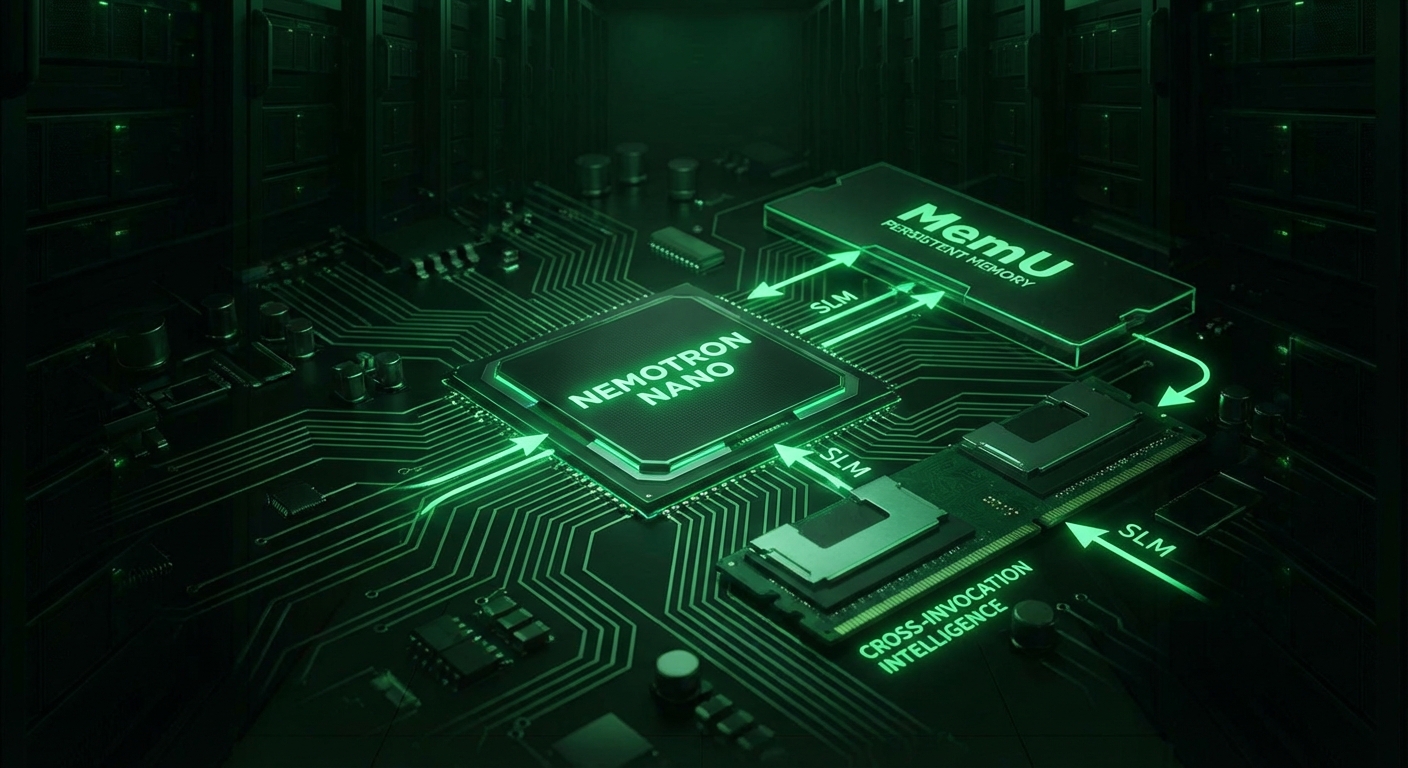
The MemU Agentic Memory Framework adds the persistence layer that SLMs structurally lack. Where Nemotron Nano delivers fast, capable inference per request, MemU delivers the memory substrate that makes every subsequent request smarter than the last. The combination turns a stateless endpoint into a stateful intelligence system.
Consider a coding assistant powered by the SLM on Bedrock. A developer asks it to refactor an authentication module. With MemU, the agent recalls that this codebase uses a custom JWT library, that the team prefers functional patterns over class-based abstractions, and that a similar refactor last month introduced a race condition caught in staging. Without persistent memory, the agent generates technically correct but contextually blind code — unaware of the project's history, the team's conventions, or the hard-won lessons embedded in past decisions.
The MemU Agentic Memory Framework provides capabilities that directly complement small language models:
- Semantic memory retrieval: Fast vector-based search across thousands of stored memories lets the SLM access relevant context from past interactions without consuming its limited context window with raw conversation history. The model receives distilled, relevant knowledge instead of token-expensive logs, maximizing the utility of every token in its constrained window.
- Structured knowledge graph: Entity relationships, project hierarchies, and decision histories stored as graph structures that small language models can query efficiently. A model with a 4K or 8K context window can access the equivalent of millions of tokens of accumulated project knowledge through targeted graph queries that return precisely what the current task requires.
- Cross-session persistence: Memory survives model updates, endpoint restarts, and session boundaries. Intelligence accumulated over a thousand interactions remains fully available on interaction one thousand and one, regardless of infrastructure changes underneath. The memory layer is decoupled from the model layer entirely.
Small language models are optimized for per-request intelligence. The MemU Agentic Memory Framework transforms per-request intelligence into compounding intelligence — every call builds on every prior call, and no reasoning work is ever discarded.
With sub-100ms retrieval latency across 10,000+ memory entries, MemU adds negligible overhead to serverless AI inference pipelines, preserving the speed and cost advantages that make the SLM attractive for latency-sensitive applications in the first place.
Head-to-Head: Nemotron Nano vs. Other SLMs on Bedrock
Nemotron Nano alone: Each API call processes the current prompt with no awareness of prior calls. Coding agents generate solutions based solely on the code and instructions in the current context window. Repeated questions receive inconsistent answers because the model has no record of previous responses. Agents built this way are capable but stateless — fast thinkers with no long-term memory, treating every interaction as if it were the first.
Nemotron Nano + MemU Agentic Memory Framework: Every inference call is enriched with relevant memories retrieved from the persistent store. Coding agents recall prior solutions, project conventions, and past mistakes. Repeated questions receive consistent, refined answers because the model draws on accumulated context. The small language model punches above its weight class because it accesses intelligence that no context window could hold — the distilled knowledge of hundreds or thousands of prior interactions.
Compared to other SLMs on Bedrock — Mistral Small, Phi-3, Llama 3.2 — the model's hybrid MoE architecture gives it a clear reasoning edge on a per-request basis. But all SLMs share the same memory limitation. Adding persistent memory to any of these models addresses the fundamental constraint that benchmark rankings cannot fix: the absence of continuity. The combination of strong per-request capability with cross-request memory creates a system that is both fast and wise — and that gets wiser with every deployment day.
Empowering Nemotron Nano: Better Together
MemU does not replace Nemotron Nano — it amplifies what the model already does well:
- Coding agents: The SLM handles code generation and debugging with benchmark-leading accuracy; MemU supplies project history, coding standards, and past bug patterns — transforming generic code suggestions into project-aware, context-rich recommendations that reflect the team's actual practices.
- Reasoning pipelines: The model excels at multi-step math and logic; MemU stores intermediate results, prior reasoning chains, and domain-specific heuristics — letting the model build on previous analytical work instead of recomputing from scratch each time a similar problem appears.
- Cost-optimized production: The core value proposition of serverless AI inference through Bedrock is cost efficiency. The MemU Agentic Memory Framework maximizes intelligence extracted per dollar by ensuring that no reasoning work is ever lost. Every inference call deposits knowledge that future calls can withdraw, turning operational cost into compounding intellectual capital.
Get Started with MemU
Give your Nemotron Nano agents the memory they need to compound intelligence across every call. The MemU Agentic Memory Framework integrates with any model on Amazon Bedrock — one API, instant persistence, zero infrastructure overhead. Visit memu.pro to explore the Agentic Memory Framework API, or check out the GitHub repository to start building agents that remember.
Tags: Nemotron Nano, NVIDIA, Amazon Bedrock, small language model, serverless AI inference, agentic memory, SLM persistent memory, MemU AI