Obin AI Emerges from Stealth with Trustworthy Agentic Workforce for Finance — But Without Persistent Memory, Compliance Intelligence Resets


Obin AI emerged from stealth on March 18, 2026 with a bold proposition: an agentic workforce purpose-built for financial institutions that prioritizes trust, accuracy, and regulatory compliance above all else. Backed by a $7M seed round led by Motive Partners, with angel investments from Stanford professor Dr. Fei-Fei Li and Transformer co-inventor Lukasz Kaiser, it brings serious credentials to financial AI. CEO Apoorv Saxena served as Head of AI at JPMorgan. CTO Dr. Valliappa Lakshmanan led data analytics at Google. The platform features an open architecture where institutions retain full ownership of their models and data, built specifically for regulated environments with auditable, traceable interactions. Accuracy levels meet the threshold for core financial workflows, and deployments move from pilot to production in weeks rather than months.
But the financial services challenge that Obin AI addresses — trustworthy AI for regulated environments — contains an inherent tension. Every compliance decision, every regulatory interpretation, every risk assessment generates institutional knowledge. When agents process a complex KYC case, navigate an ambiguous regulatory requirement, or identify a novel fraud pattern, they produce insights specific to that institution's regulatory posture. Without persistent organizational memory, that compliance intelligence resets with every new session. Trustworthy AI for finance without persistent compliance memory means re-learning regulatory nuance the institution has already resolved.
Obin AI: What Everyone's Getting Right (And Missing)
Obin AI gets the trust equation right for financial services. The open architecture — where institutions retain ownership of models and data — addresses the core concern that has kept major financial institutions from deploying third-party AI agents for sensitive workflows. When JPMorgan or Goldman Sachs evaluates an agentic workforce platform, model ownership is not a feature; it is a prerequisite. The approach ensures that proprietary trading strategies, customer data, and regulatory interpretations never leave institutional control.
The focus on auditability and traceability is equally critical. Financial regulators do not accept black-box decision-making. Every interaction produces auditable trails that demonstrate why an agent made a specific recommendation, what data it accessed, and how it arrived at its conclusion. The accuracy thresholds for core workflows reflect an understanding that financial operations demand precision — an agent that is 95% accurate on trade settlement is not acceptable when the 5% represents millions in misallocated capital.
What the platform does not yet provide is persistent memory across the compliance intelligence that agents generate through operation. Consider a KYC analyst agent processing politically exposed persons screening. Over hundreds of cases, the agent develops nuanced understanding: which jurisdictions have reciprocal information-sharing agreements that simplify due diligence, which corporate structures are common in specific regions and do not indicate layering, which documentation patterns are standard versus suspicious. That accumulated compliance intelligence is what makes a senior human analyst invaluable — and it resets when the agent session ends.
Competing financial AI platforms — Palantir AIP for financial services, Bloomberg AI, Kensho by S&P Global — share this limitation. They process financial data with impressive accuracy. None accumulate the institutional compliance intelligence that emerges from thousands of regulatory interactions.
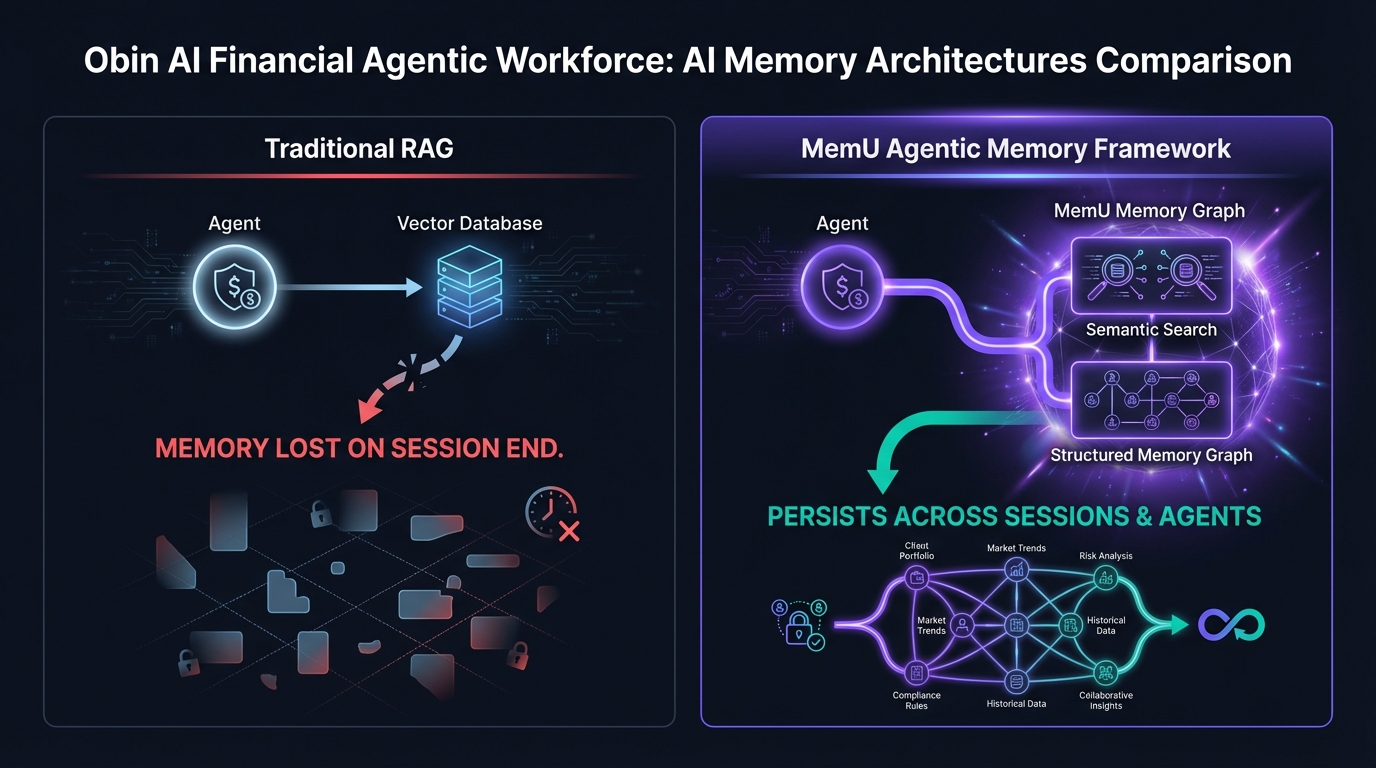
The MemU Agentic Memory Framework: Compliance Memory for Financial Agent Workforces
The MemU Agentic Memory Framework provides the persistent compliance memory layer that financial agent workforces require to compound institutional intelligence. Instead of treating each regulatory interaction as isolated, MemU captures compliance reasoning, risk assessment patterns, regulatory interpretations, and resolution strategies in a structured memory graph designed for financial services auditability requirements.
Consider a deployment at a major bank. The anti-money laundering agent processes thousands of transaction alerts monthly. Without persistent memory, each alert is evaluated against static rules and current transaction data. With the MemU Agentic Memory Framework, the agent retrieves institutional memory: similar transaction patterns investigated and cleared six months ago, corporate structures validated through enhanced due diligence in a different jurisdiction, and seasonal patterns in wire transfer volumes that appear anomalous but reflect legitimate business cycles. Each investigation builds on accumulated compliance intelligence rather than starting from regulatory first principles.
The MemU Agentic Memory Framework addresses three critical gaps in financial agent operations:
- Regulatory interpretation persistence: Financial regulations are principles-based, requiring interpretation in context. When an agent navigates an ambiguous regulatory requirement — determining whether a specific transaction structure triggers reporting obligations under multiple jurisdictions — that interpretive reasoning becomes institutional memory. Future agents retrieve the prior analysis rather than re-deriving it.
- Cross-workflow compliance intelligence: KYC findings inform transaction monitoring. Credit risk assessments inform trading limits. Regulatory reporting requirements shape operational procedures. The framework maintains structured relationships across compliance domains, enabling agents in one workflow to access insights generated in another.
- Audit-ready memory retrieval: Every memory access and storage operation produces an auditable trail. Regulators can trace not just what an agent decided, but what institutional memory it accessed, when that memory was created, and how it influenced the current decision.
A senior compliance officer's value comes from years of accumulated regulatory experience. The MemU Agentic Memory Framework gives financial agent workforces that same compounding institutional intelligence — auditable, traceable, and persistent.
Head-to-Head: Stateless Financial Agents vs. Memory-Enhanced Compliance Workforce
Obin AI alone: A trustworthy agentic workforce for financial institutions with open architecture, model ownership, auditable interactions, and accuracy thresholds for core workflows. Agents process financial operations with the precision regulators demand. But each session starts without institutional memory — compliance interpretations, risk assessment patterns, and regulatory nuance must be re-derived from static rules and current data.
Obin AI + MemU: The same trustworthy architecture and institutional control, now backed by persistent compliance memory. Agents begin each session with accumulated regulatory intelligence. KYC screening recalls prior investigations of similar entity structures. Transaction monitoring retrieves seasonal patterns and previously validated business cycles. Risk assessments incorporate institutional memory of how similar exposures were evaluated and resolved.
For financial institutions deploying across compliance, risk, and operations — where regulatory accuracy is non-negotiable and institutional knowledge is a competitive advantage — persistent compliance memory transforms agents from accurate processors into institutional experts.
Empowering Obin AI: Better Together
The combination of the trustworthy financial agent platform and MemU's persistent memory creates capabilities that neither achieves independently:
- Regulatory change adaptation: When regulations change, persistent memory tracks how the institution interpreted and implemented prior versions. New regulatory requirements are analyzed in the context of institutional compliance history, enabling faster, more consistent adaptation.
- Cross-institutional pattern intelligence: With appropriate anonymization and consent, persistent memory enables identifying compliance patterns across different institutional contexts. A fraud pattern detected at one institution — anonymized and generalized — can inform proactive screening at others.
- Examiner-ready institutional memory: During regulatory examinations, persistent memory provides examiners with a comprehensive view of how agents developed their compliance reasoning over time. Rather than presenting static policy documents, the institution demonstrates a learning compliance system with auditable decision evolution.
Get Started with MemU
Obin AI has built the trustworthy foundation that financial institutions require — open architecture, model ownership, auditable interactions, and the accuracy thresholds that regulated environments demand.
The next step is giving that foundation persistent institutional memory. Sessions where compliance agents recall regulatory interpretations from thousands of prior interactions. Workflows where risk intelligence compounds across KYC, AML, and transaction monitoring. Institutions where every agent interaction strengthens collective compliance expertise.
The MemU Agentic Memory Framework provides that persistence layer. Audit-ready compliance memory graphs, cross-workflow regulatory intelligence, and institutional knowledge accumulation designed for the standards financial regulators require.
Visit memu.pro to explore the Agentic Memory Framework API, or check out the GitHub repository to start building agents that remember.
Tags: Obin AI, financial AI, agentic workforce, compliance memory, agent memory, MemU AI, LLM memory, RegTech