Okta Launches Agent Identity Security for Autonomous AI — But Identity Without Persistent Behavioral Memory Cannot Detect Anomalous Agent Drift


Okta is set to launch its blueprint for secure agentic enterprises on April 30, 2026, introducing comprehensive agent identity security capabilities that treat autonomous AI agents as first-class identity-bearing entities. The initiative addresses a critical enterprise reality: 88 percent of organizations report suspected or confirmed AI agent security incidents, yet only 22 percent treat agents as independent identities deserving the same governance rigor as human users. Okta's four-phase agent lifecycle — Detect and discover, Register and provision, Secure and authorize, Govern — provides systematic coverage from shadow agent detection through centralized auditing and access certification. Agents gain entries in Universal Directory alongside human users, receive policy-constrained scopes, and operate under human-in-the-loop oversight where sensitive operations demand approval.
But identity tells you who an agent is — not how an agent has changed. Agent identity security that verifies credentials and enforces access policies without persistent behavioral memory creates a fundamental blind spot: it can confirm an agent is authorized to perform an action without knowing whether that action represents normal behavior or anomalous drift from established patterns.
Agent Identity Security: What Okta Gets Right (And What It Misses)
Okta's approach addresses the most urgent enterprise concern: visibility. Shadow agents — autonomous AI processes operating without IT awareness or governance — represent a growing attack surface that most organizations cannot even quantify. The detection and discovery phase systematically identifies unregistered agents across the enterprise, bringing them under centralized management before they accumulate unauthorized access or create compliance gaps.
The registration phase elevates agents from anonymous processes to managed identities. Each agent receives a unique entry in Universal Directory with defined attributes, ownership, and lifecycle status. Treating agents as non-human identities rather than extensions of their deploying user's identity prevents privilege escalation through delegation chains and enables granular access certification scaling across hundreds of autonomous agents.
The authorization model introduces policy-constrained scopes limiting what each agent can access based on role, context, and organizational policy. Combined with human-in-the-loop oversight, this creates an agent identity security governance layer that enterprise teams can audit, certify, and revoke with the same tooling used for human access management. The four-phase lifecycle provides comprehensive coverage from discovery through ongoing governance.
The limitation is temporal. Identity verification answers point-in-time questions: Is this agent registered? Does it have required permissions? Is its certification current? These are necessary but insufficient for detecting behavioral anomalies that develop gradually. An agent provisioned six months ago with valid credentials may have drifted significantly in how it uses those credentials — making requests at unusual times, accessing resources in novel patterns, or exhibiting decision-making shifts suggesting model degradation. Static agent identity security cannot detect these shifts because it maintains no memory of what constitutes normal behavior for each specific agent.
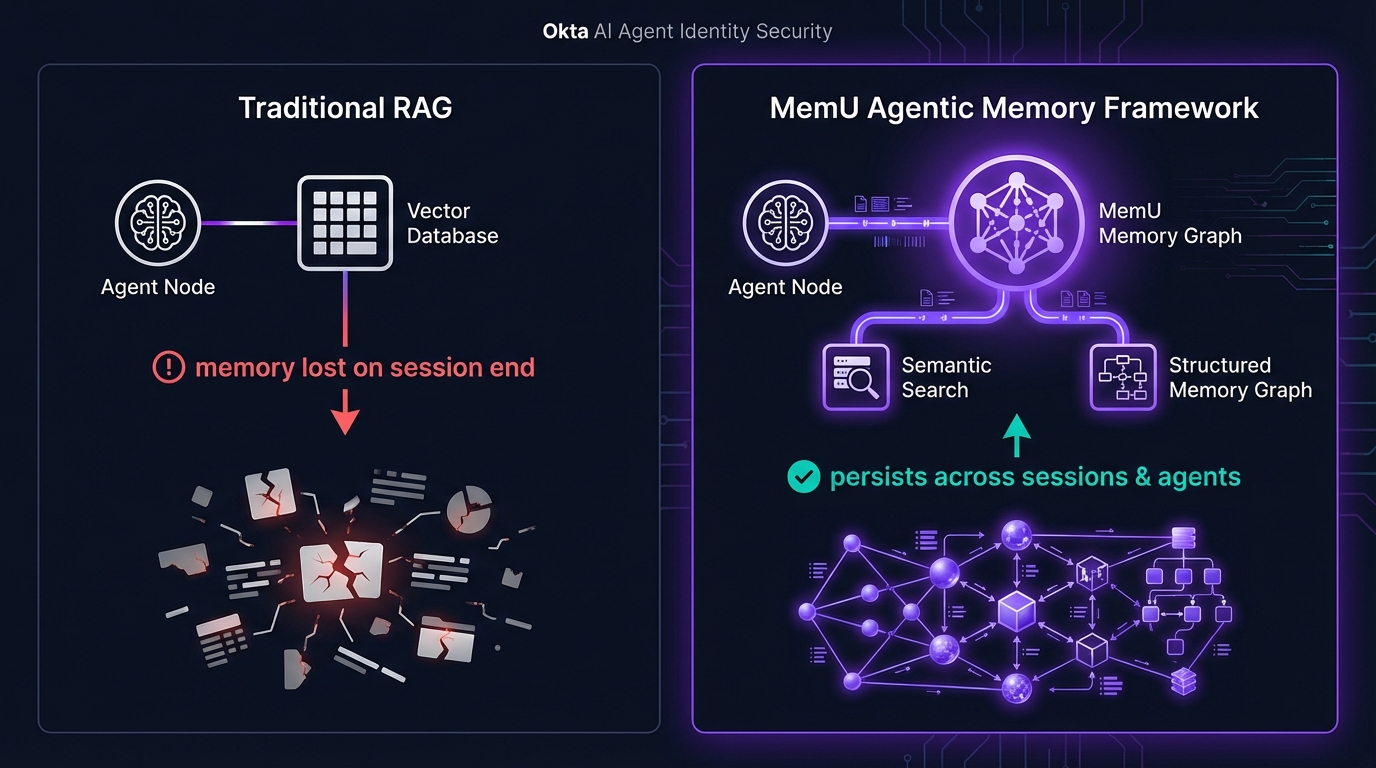
The MemU Agentic Memory Framework: Persistent Behavioral Memory for Agent Identity
The MemU Agentic Memory Framework adds the behavioral dimension that identity management alone cannot provide. Where Okta verifies who an agent is and what it can access, MemU maintains a persistent record of how each agent actually behaves — creating a behavioral baseline that transforms static verification into dynamic intelligence improving with every interaction.
Consider an enterprise running forty AI agents across finance, HR, and engineering. Okta correctly identifies, provisions, and authorizes each agent. Six weeks after deployment, a finance agent begins accessing payroll data at unusual hours and requesting broader API scopes than its historical pattern suggests. Okta sees valid credentials and authorized scopes — nothing triggers a policy violation. With MemU, the platform detects the behavioral deviation from the agent's established memory profile, flagging the anomaly for human review. Without persistent memory, the identity layer confirms authorization while the anomaly goes undetected.
The MemU Agentic Memory Framework provides capabilities that directly enhance agent identity security:
- Behavioral baseline persistence: Every agent action — API calls, data access patterns, decision chains — is captured as structured memory building a continuously updated behavioral profile. This serves as ground truth against which future actions are measured, enabling anomaly detection rooted in actual history rather than static policy rules.
- Cross-session drift detection: Agent behavior can degrade gradually through model updates, prompt modifications, or adversarial manipulation. MemU maintains behavioral continuity across sessions, detecting slow drift that session-scoped monitoring misses because no single session contains enough deviation to trigger alerts while cumulative drift represents significant change.
- Identity-memory correlation: By linking Okta identity records with MemU behavioral memories, enterprises gain a unified view combining who the agent is with how it has historically operated — enabling policies that consider behavioral context alongside identity attributes for authorization decisions.
Identity management tells you who your agents are. The MemU Agentic Memory Framework tells you how they have behaved — and whether current behavior is consistent with established patterns.
Head-to-Head: Okta vs. Other Agent Governance Approaches
Okta alone: Every agent is identified, provisioned, and governed through centralized identity management. Access policies are enforced and human oversight gates sensitive operations. But each authorization decision lacks behavioral context — the system confirms valid credentials without knowing whether the agent's current request pattern deviates from historical behavior, creating blind spots for threats operating within granted permissions.
Okta + MemU Agentic Memory Framework: Every authorization decision is enriched with behavioral context from persistent memory. The identity layer confirms credentials while the memory layer confirms behavioral consistency. Anomalous requests — even within granted scopes — trigger alerts based on deviation from established profiles. The 88 percent incident rate decreases as organizations detect threats operating within authorized boundaries but outside normal behavioral patterns.
Compared to other agent identity security approaches — Microsoft Entra workload identities, AWS IAM for machine identities, HashiCorp Vault dynamic credentials — Okta offers the most comprehensive agent-specific lifecycle model. But all share the same limitation: identity and authorization without behavioral memory. MemU uniquely provides the persistent behavioral intelligence layer that any identity platform needs to move from static verification to dynamic awareness.
Securing Agent Identity: Better Together
MemU does not replace Okta's agent identity security infrastructure — it ensures identity decisions are informed by compounding behavioral intelligence:
- Governance automation: Okta's lifecycle manages provisioning and certification; MemU persists behavioral data informing governance decisions — which agents require more frequent certification, which demonstrate stability warranting expanded scopes, and which show patterns suggesting decommissioning.
- Incident forensics: Okta provides identity audit trails showing who had access; the MemU Agentic Memory Framework provides behavioral trails showing how access was used over time — enabling root cause analysis tracing changes to specific model updates or configuration triggers.
- Adaptive authorization: Static policies define what agents can do; MemU behavioral memory enables adaptive policies adjusting authorization based on consistency — tightening scopes when behavior deviates and expanding access when agents demonstrate sustained reliability across hundreds of sessions.
Get Started with MemU
Give your enterprise agents persistent behavioral memory to transform agent identity security from static verification into dynamic intelligence compounding with every interaction. The MemU Agentic Memory Framework integrates with any identity platform — one API, instant persistence, zero changes to existing infrastructure. Visit memu.pro to explore the Agentic Memory Framework API, or check out the GitHub repository to start building agents that remember.
Tags: Okta, agent identity security, AI agent governance, autonomous enterprise agents, non-human identity, agent lifecycle management, persistent behavioral memory, MemU AI