On-Device AI Puts Frontier Inference in Your Pocket — Local Models Without Local Memory Are Brilliant Strangers


The on-device AI revolution is accelerating faster than anyone predicted. Apple Intelligence processes complex tasks entirely on iPhone and Mac neural engines. Google's Gemini Nano runs inference on Pixel and Samsung devices without cloud round-trips. Qualcomm's Snapdragon X Elite enables Windows laptops to run 13B+ parameter models locally. Meanwhile, projects like Ollama and LM Studio have made running open-source models on consumer hardware a mainstream developer workflow.
The value proposition is compelling: zero latency, complete privacy, offline capability, and no API costs. For sensitive data — medical records, financial documents, personal communications — on-device inference eliminates the trust question of sending data to external servers. Developers are building local-first AI applications that work identically whether connected or not.
But local inference solves the where of AI without solving the continuity of AI. Your on-device model processes your most personal data with zero memory of previous interactions — the most private AI is also the most forgetful.
On-Device AI: What Everyone's Getting Right (And Missing)
The hardware ecosystem is delivering remarkable capability. Apple's Neural Engine handles 35 TOPS (trillion operations per second). Qualcomm's NPU approaches 45 TOPS. These chips enable running quantized versions of serious models — not toy demos — at interactive speeds, entirely on-device.
Privacy advocates rightly celebrate this shift. On-device AI means personal health queries, financial planning, and private communications never leave the device. There's no server log, no training data contribution, no third-party access. This is AI with a fundamentally different privacy model.
What the celebration overlooks: privacy without memory means the model learns nothing about you despite having access to your most personal context. Your on-device AI processes your email, calendar, health data, and documents — then forgets everything. The 1,000th interaction is as impersonal as the 1st. Apple Intelligence, Gemini Nano, and every on-device system shares this constraint.
What On-Device AI Does With Personal Context Today
Apple Intelligence offers a thin personalization layer — system-level features like notification prioritization and writing suggestions adapt to usage patterns over time. But these are OS-level features, not model memory. The underlying language model treats each conversation independently.
Google's Gemini Nano integrates with device features for summarization and smart replies. The model can access current context — the email being read, the webpage being viewed — but doesn't maintain a persistent understanding of the user's preferences, work patterns, or communication style.
On-device models face a unique constraint: limited context windows on constrained hardware. While cloud models push toward millions of tokens, on-device models typically operate with 4K-16K context windows. This makes external memory not just valuable but essential — there simply isn't enough context capacity to compensate for lack of persistent memory.
The MemU Agentic Memory Framework: Personal AI That Actually Knows You
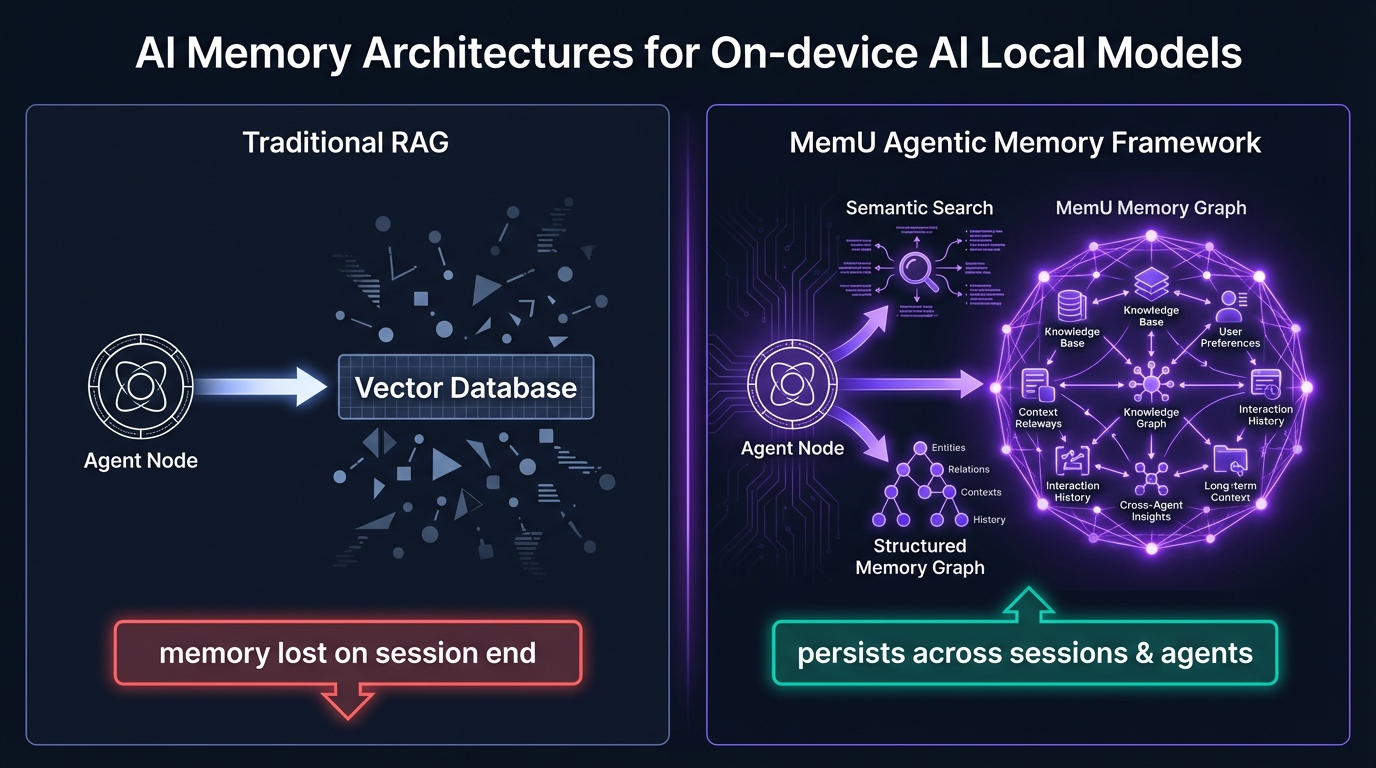
The MemU Agentic Memory Framework provides the persistent personal memory layer that transforms on-device AI from a generic assistant into a genuinely personalized system — while keeping all memory data local and private.
Imagine your on-device AI assistant with MemU. Over months, it learns your communication style, your project priorities, your meeting patterns, your writing preferences. When you ask it to draft an email, it doesn't just generate generic text — it writes in your voice, references relevant context from your recent projects, and anticipates the recipient's likely concerns based on past interactions. All of this runs entirely on your device, with memory stored locally.
The MemU Agentic Memory Framework enhances on-device AI through:
- Local-first memory storage: Memory data stays on-device, matching the privacy model of on-device inference. No server sync required. Your personal AI memory is as private as your photos and messages.
- Context-efficient retrieval: With limited context windows, every token matters. The MemU Agentic Memory Framework retrieves only the most relevant memories for each interaction, maximizing the value of constrained context capacity.
- Progressive personalization: Communication patterns, task preferences, domain expertise, and personal context accumulate over time. The agent becomes genuinely more useful with every interaction — not through model fine-tuning, but through structured memory accumulation.
On-device AI gives you private inference. MemU gives you private memory. Together, they create truly personal AI that knows you without anyone else knowing.
Head-to-Head: Stateless Privacy vs. Personalized Privacy
On-device AI alone: Private, low-latency inference with zero cloud dependency. Processes personal data without exposure. But each interaction starts from the model's generic training — no accumulated understanding of the user's preferences, context, or history.
On-device AI + MemU Agentic Memory Framework: Same privacy and latency benefits plus persistent personal memory stored locally. The model retrieves relevant context from previous interactions in sub-100ms, transforming generic assistance into personalized intelligence. Memory storage is lightweight enough for mobile devices.
Whether using Apple Intelligence, Gemini Nano, Ollama, or LM Studio — the MemU Agentic Memory Framework provides local persistent memory for any on-device inference stack.
Empowering On-Device AI: Better Together
MemU doesn't compromise the privacy of on-device inference — it completes the vision of truly personal AI by adding the memory dimension.
- Smart context management: On-device models with small context windows benefit enormously from intelligent memory retrieval. The MemU Agentic Memory Framework selects the most relevant context from potentially thousands of stored memories, making small windows perform like large ones.
- Cross-app continuity: Memories from email interactions inform calendar suggestions. Coding session insights inform documentation queries. MemU provides the connective tissue between on-device AI interactions across applications.
- Offline-first memory: Memory retrieval works without connectivity, matching the offline capability of on-device inference. Your AI assistant is fully capable whether you're online or in airplane mode.
Get Started with MemU
On-device AI delivers private, fast inference on consumer hardware. The MemU Agentic Memory Framework delivers the personal memory that makes that inference meaningful over time. The combination is AI that's genuinely yours — it runs on your device, stores memories on your device, and gets better at helping specifically you.
Visit memu.pro to explore the Agentic Memory Framework API, or check out the open-source repository on GitHub to start building persistent local memory into your on-device AI applications today.
Tags: on-device AI, local inference, Apple Intelligence, Gemini Nano, agentic memory, MemU AI, private AI, personal AI assistant