OpenAI Codex Security Scans for Vulnerabilities — But Every Audit Starts Without Memory of Past Patterns


OpenAI Codex Security just launched as a vulnerability detection and remediation tool baked into the Codex programming assistant. During its beta as "Aardvark," the system flagged over 11,000 critical and high-severity vulnerabilities across enterprise codebases. It analyzes repositories, builds threat models, identifies weaknesses, and generates fix recommendations — all autonomously. For security-conscious engineering teams, that is a meaningful step forward from manual SAST scanners and quarterly pen tests.
But there is a foundational layer that Codex Security, like every scanning tool before it, still depends on getting right — memory.
OpenAI Codex Security: What Everyone's Getting Right (And Missing)
Codex Security gets autonomous scanning right. It reads your codebase, understands project structure, maps dependencies, and applies LLM-powered reasoning to surface vulnerabilities that pattern-matching tools miss. The jump from rule-based SAST to reasoning-based security analysis is real — this is not just regex over source files.
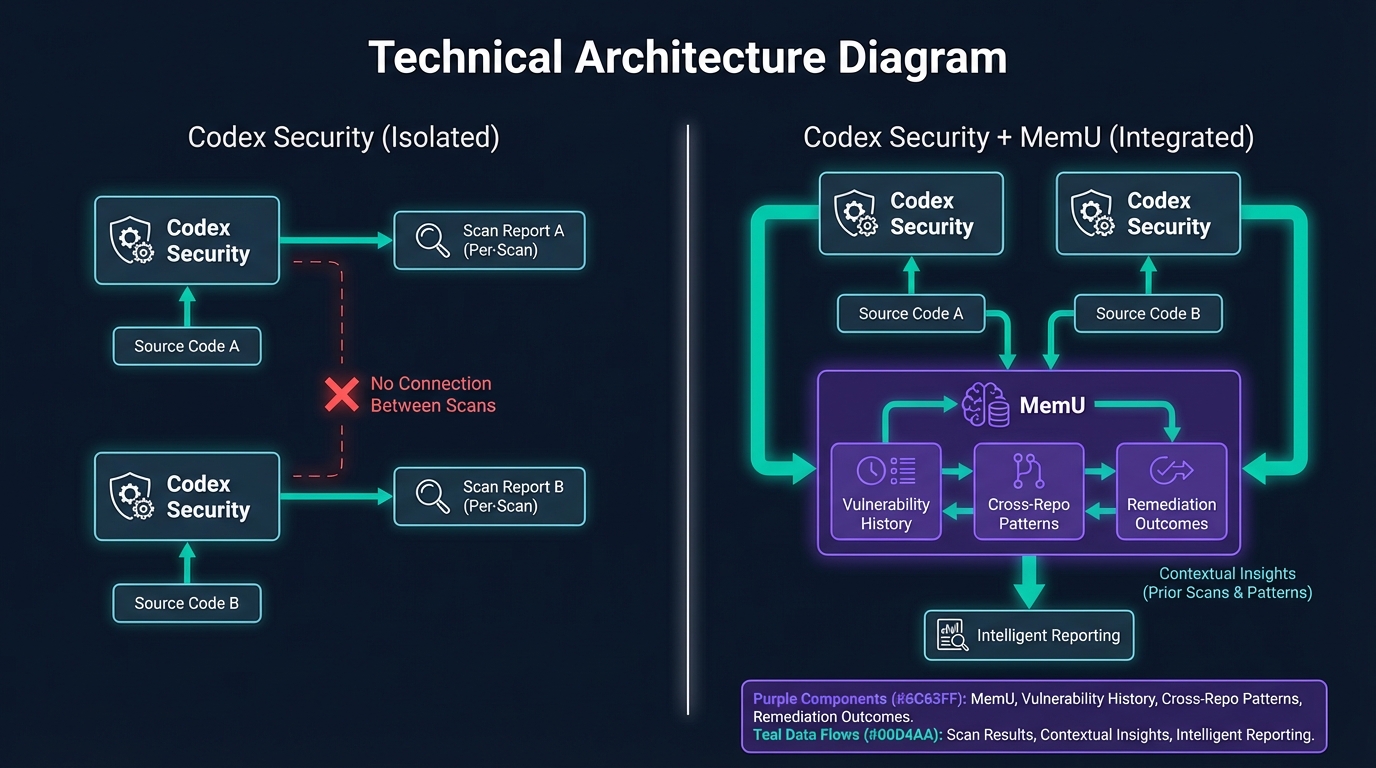
What Codex Security does not address is what happens between audits. Each scan starts fresh. The agent that discovered a SQL injection pattern in your authentication module last week has no memory of that finding today. Codex Security scans repositories, not security histories.
Other security analysis tools — Snyk Code, SonarQube, GitHub Advanced Security — share this same architectural limitation. They detect vulnerabilities in the current snapshot; none of them accumulate security intelligence across scans.
The MemU Agentic Memory Framework: Persistent Security Intelligence for Scanning Agents
The MemU Agentic Memory Framework adds the missing layer. Where Codex Security manages what to scan, MemU manages what the scanner has learned.
Consider a security scan that finds an insecure deserialization pattern in a payments service. With MemU, the scanning agent recalls that this exact pattern appeared in three other services last quarter, that two were fixed and one was deferred, and what the remediation approach was. Without MemU, it reports the finding as if seeing it for the first time.
The MemU Agentic Memory Framework provides:
- Drop-in integration: A simple API that works alongside any security scanning tool — Codex Security, Snyk, or custom pipelines. Add memory read/write calls; your scanner gains institutional security knowledge.
- Dual-mode retrieval: Semantic search for finding similar vulnerability patterns plus a structured memory graph for tracking relationships between findings, fixes, and affected services. Not just embeddings — actual vulnerability genealogy.
- Cross-scan persistence: Memory survives across audits, branches, and repositories. One scan's findings inform the next scan's prioritization automatically.
Scanning without memory is detection without learning. The MemU Agentic Memory Framework gives security agents the ability to accumulate vulnerability intelligence, not just flag issues.
Retrieval operates across 10,000+ memory entries with sub-100ms latency, so memory lookup never becomes the bottleneck in your security pipeline.
Head-to-Head: Codex Security Alone vs. Codex Security + MemU
Codex Security alone: Each audit scans the current codebase state. The agent finds vulnerabilities with impressive accuracy, but the hundredth scan of a repository carries the same context as the first. Recurring patterns, previously deferred risks, and cross-repository vulnerability trends are invisible.
Codex Security + MemU Agentic Memory Framework: Each scan reads from and writes to persistent security memory. The agent recalls past vulnerabilities, their resolution status, and which patterns tend to recur in specific teams or services. The hundredth scan benefits from ninety-nine scans of accumulated security intelligence.
Cross-repository threat mapping: With MemU, the security agent remembers that a dependency vulnerability found in the payments service also affects the billing service — because it tracked that dependency relationship three scans ago. Without MemU, each repository scan is an island.
Empowering Codex Security: Better Together
MemU does not replace Codex Security — it makes Codex Security dramatically more capable:
- Vulnerability triage: Codex Security identifies the vulnerability; MemU provides historical context — has this pattern appeared before, how was it resolved, what's the risk trajectory? Triage goes from "new finding" to "recurring pattern, high priority."
- Remediation acceleration: Codex Security generates fix recommendations; MemU remembers which remediation approaches worked for similar findings in this codebase. Fixes get more targeted over time.
- Compliance continuity: Codex Security scans for compliance gaps; MemU tracks the compliance posture across audits, so teams can demonstrate continuous improvement rather than point-in-time snapshots.
Get Started with MemU
Add persistent security memory to your scanning agents in minutes. The MemU Agentic Memory Framework works with any security tool — one API, zero lock-in, immediate vulnerability intelligence. Visit memu.pro to explore the Agentic Memory Framework API, or check out the GitHub repository to start building agents that remember.
Tags: OpenAI Codex Security, AI vulnerability scanning, agentic memory, security agents, LLM memory, MemU AI