OpenAI Frontier Gives Enterprises an Agent Platform — But Where Does Institutional Knowledge Live?


OpenAI just launched its most ambitious enterprise play yet. OpenAI Frontier, announced February 5, 2026, is a full platform for building, deploying, and managing AI agents across organizations. Think of it as the operating system for AI coworkers — agents that connect to CRMs, data warehouses, and internal tools, executing real business workflows in parallel with human teams.
The early results are striking. A manufacturer reduced production optimization from six weeks to one day. An investment firm freed 90% more time for its salespeople. An energy producer increased output by 5%, adding over $1 billion in revenue. HP, Intuit, Oracle, State Farm, Thermo Fisher, and Uber are among the first wave of adopters.
OpenAI Frontier solves the deployment and governance challenge — getting agents into production with proper access controls and security. But it surfaces a deeper question: how do enterprise AI agents accumulate institutional knowledge over time?
OpenAI Frontier: What Enterprise Agent Orchestration Delivers
Frontier provides four core capabilities. Business Context connects agents to existing enterprise systems so they work with the same data people use. Agent Execution enables AI agents to handle real workflows in parallel — not as single-turn chatbots but as persistent workers that complete multi-step processes. Evaluation and Optimization creates feedback loops for continuous improvement. Enterprise Security wraps everything in governance, access controls, and audit trails.
The platform is deliberately vendor-agnostic. OpenAI Frontier works with agents from any vendor using open standards — a strategic move that positions it as infrastructure rather than a walled garden. Organizations can deploy Frontier alongside existing Salesforce, Workday, or ServiceNow investments.
For individual workflows, the platform delivers. An agent processes a support ticket, pulls customer history, generates a resolution, and updates the CRM — all within the security boundaries the IT team configured. The gap appears across time. That agent handled the same type of ticket differently last month because the resolution approach evolved through experience. But where does that evolution live? Today's OpenAI Frontier provides the infrastructure for agent execution — not for agent learning.
How OpenAI Frontier Handles Agent Knowledge
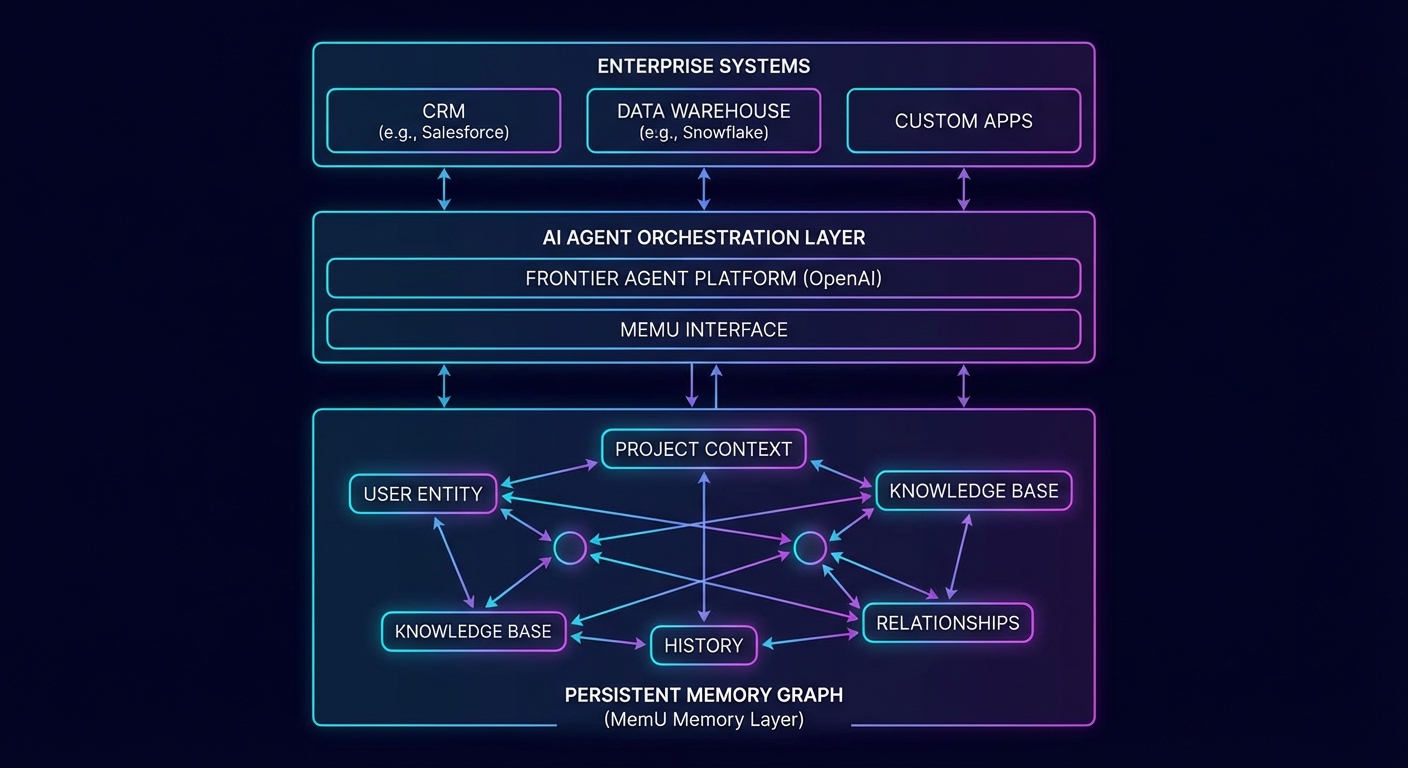
OpenAI Frontier connects agents to business context through system integrations. Agents access CRM records, database queries, document repositories, and API endpoints. This provides rich context for individual task execution — the agent knows the current state of affairs when processing any request.
The platform also provides evaluation tools that measure agent performance over time. Organizations can track accuracy, efficiency, and user satisfaction across workflows. These metrics help optimize agent configurations and identify areas for improvement.
What Frontier doesn't provide is experiential memory. The agent that handled a complex edge case brilliantly last Thursday has no mechanism to recall that approach when a similar situation arises next Tuesday. The insights gained from thousands of executed workflows don't accumulate into retrievable knowledge. Each execution draws on system data and model capabilities, but not on the organization's growing library of agent-derived insights.
This is the difference between connecting agents to data (which Frontier does well) and enabling agents to learn from experience (which requires persistent memory infrastructure).
The MemU Agentic Memory Framework: Enterprise Memory for Agent Platforms
The MemU Agentic Memory Framework provides the experiential memory layer that enterprise agent platforms need. Rather than agents that execute workflows from static context, MemU enables agents that learn and improve through accumulated operational experience.
Consider a customer success team using OpenAI Frontier to manage account health. Agents process renewal conversations, escalation patterns, and satisfaction signals across hundreds of accounts. With Frontier alone, each interaction uses current CRM data. With the MemU Agentic Memory Framework, agents also access accumulated relationship intelligence — this account responds better to proactive outreach, that segment's concerns typically escalate through a predictable pattern, these product features drive the strongest retention outcomes.
The architecture complements Frontier through three capabilities:
- Workflow memory: The MemU Agentic Memory Framework captures resolution patterns, decision rationale, and outcome data from executed workflows — building an institutional knowledge base that informs future agent actions.
- Cross-agent learning: When one Frontier agent discovers an effective approach, that knowledge becomes available to every agent in the organization. Individual learning becomes organizational intelligence.
- Context evolution: Enterprise knowledge isn't static. The MemU Agentic Memory Framework tracks how patterns evolve over time — what worked six months ago may need updating, and memory reflects that progression.
MemU adds the experiential dimension to OpenAI Frontier — agents that don't just execute workflows, but learn from every one they complete.
Head-to-Head: Execution Platform vs. Learning Platform
OpenAI Frontier alone: Enterprise-grade agent deployment with business context, security, and governance. Agents execute workflows using current system data. But operational experience doesn't compound — each workflow execution starts from the same baseline.
OpenAI Frontier + MemU: Same deployment infrastructure plus persistent operational memory. Workflows benefit from accumulated insights. Agent performance improves progressively as the organizational knowledge base grows. Retrieval across 10,000+ memory entries with sub-100ms latency keeps execution speed unaffected.
Get Started with MemU
OpenAI Frontier represents serious enterprise infrastructure for AI agents. The platform solves deployment, governance, and system integration — the critical barriers that have kept agents in pilot mode at most organizations.
The MemU Agentic Memory Framework provides the learning layer that turns deployed agents into continuously improving ones. Drop-in integration means adding persistent memory alongside your Frontier deployment without architectural changes.
Visit memu.pro to explore the Agentic Memory Framework API, or check out the open-source repository on GitHub to start building institutional memory into your enterprise agent platform today.