OpenAI Makes London Its Biggest Research Hub Outside the US — Global AI Teams, Fragmented Memory


OpenAI just elevated London to its most important research hub outside of San Francisco. The announcement, made on February 26, 2026, positions London-based researchers to "own key components of OpenAI's frontier model development" — including work on quality, reliability, alignment, and safety. The team is already contributing to Codex and GPT-5.2. With compensation designed to compete directly with Google DeepMind, OpenAI is making a clear statement: the future of frontier AI research is distributed, not centralized.
The UK government called it a "huge vote of confidence" in Britain's AI ecosystem. London's combination of world-class universities, deep talent pools, and a research culture shaped by decades of work at DeepMind makes it an obvious choice. OpenAI's London office already employs around 30 researchers, with significant expansion planned. The move follows a pattern: major AI labs are building distributed research organizations to access talent wherever it exists.
But distributed research introduces a fundamental challenge: when research teams span continents and time zones, how do they share not just results, but context, intuition, and accumulated understanding?
Why AI Labs Are Going Distributed
The AI talent shortage is the industry's most persistent constraint. The number of researchers capable of advancing frontier models is measured in thousands globally. They cluster in a handful of cities: San Francisco, London, Toronto, Beijing, Zurich. No single location has enough talent to staff a frontier lab's full research agenda.
OpenAI's London expansion follows Anthropic's distributed team structure, Google DeepMind's multi-city research organization, and Meta AI's global research labs. The pattern is clear: frontier AI research can't be done from a single office. The best researchers want to live where they want to live, and the labs that accommodate this preference access the deepest talent pools.
But distributed research creates coordination challenges that centralized teams don't face. When the San Francisco alignment team discovers that a particular training approach introduces subtle behavioral drift, that insight needs to reach the London quality team before they invest weeks pursuing a related approach. When the London safety researchers identify a new attack vector, the San Francisco deployment team needs that context immediately.
Research Knowledge Is More Than Papers
Formal research artifacts — papers, technical reports, experiment logs — capture a fraction of the knowledge generated during frontier AI research. The majority of research knowledge is informal: the intuition that a certain architecture modification "feels wrong," the observation that training runs on Tuesdays tend to be more stable (possibly correlated with batch job scheduling), the pattern recognition that identifies promising research directions before formal experiments begin.
In centralized labs, this informal knowledge spreads through hallway conversations, whiteboard sessions, and osmotic communication. Researchers overhear discussions that reframe their own thinking. They absorb context about the broader research agenda simply by being present. This ambient knowledge transfer is one of the primary advantages of co-located research teams.
Distributed teams lose this ambient channel. OpenAI's London researchers working on model quality might not be aware of the alignment team's latest findings until they're formally documented — which could be weeks or months after the initial discovery. The time zone difference between London and San Francisco means that real-time knowledge sharing is limited to a few overlapping hours each day.
The Memory Gap in Distributed AI Research
Traditional knowledge management tools — wikis, Slack channels, shared documents — help bridge the gap but don't solve it. They're pull-based systems: researchers must actively search for relevant information. In a fast-moving research environment where dozens of experiments run simultaneously, no researcher can keep up with the full breadth of ongoing work across multiple offices.
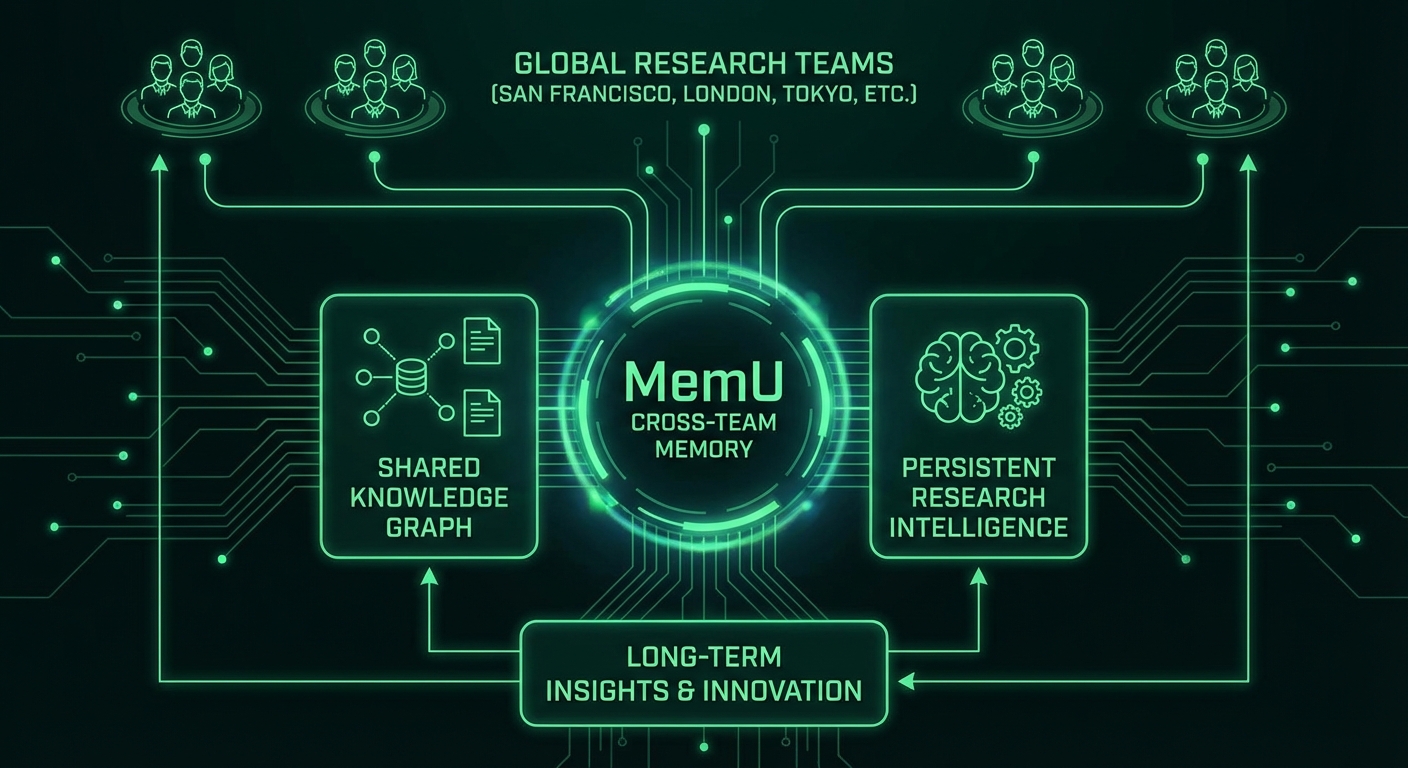
What distributed research teams need is push-based contextual memory: a system that automatically captures research insights, connects related findings across teams, and proactively surfaces relevant context when researchers are working on adjacent problems. Not a search engine for research documents, but a memory layer that understands the research landscape and knows what each researcher needs to see.
This is particularly critical for AI safety and alignment research, which OpenAI explicitly assigned to the London hub. Safety research generates findings that are relevant to every other research track — model quality, deployment, and product development all need to incorporate safety discoveries. Without persistent cross-team memory, safety insights are siloed in the safety team's documentation, reaching other teams only through scheduled meetings and formal reports.
How MemU Connects Distributed Research
MemU provides the persistent memory layer that distributed research organizations need. Research agents — the AI systems that assist researchers with experiment design, literature review, and analysis — write their accumulated knowledge to MemU. When a researcher in London starts an experiment, their AI assistant retrieves relevant memories from across the organization, including informal insights from the San Francisco team that were captured during their own research sessions.
The key insight is that MemU doesn't just store information — it stores context. An experiment result is stored alongside the reasoning that motivated it, the hypotheses it tested, and the implications the research team identified. When a related question arises in a different office, the full context is available, not just the bare result.
For distributed AI labs like OpenAI, MemU transforms the coordination challenge from a knowledge management problem into a memory architecture problem. Teams don't need better wikis or more meetings. They need AI systems that remember what the organization knows and surface that knowledge at the right moment for the right researcher.
Get Started
Connect your distributed teams through persistent AI memory. Explore MemU at memu.pro and on GitHub.