OpenAI Publishes Its Military Contract Red Lines — Safety Guardrails Work Per-Session, Not Across Deployment Lifetimes


OpenAI just published the contract language from its agreement with the Department of War, revealing specific "red lines" that its technology cannot cross. The guardrails prohibit mass domestic surveillance, autonomous weapons, high-stakes decision systems like social credit scores, and any deployment where OpenAI loses discretion over its safety stack. The company claims its agreement includes more safety protections than previous classified AI deployments, maintaining full control over how safety constraints are implemented and enforced.
The transparency is unprecedented for military AI contracts. By publishing the specific prohibitions, OpenAI is creating a public accountability mechanism — any violation of these red lines is now visible to researchers, journalists, and the public. The contract structure preserves OpenAI's ability to refuse specific deployments that cross safety boundaries, even within the broader agreement. It's a template for how AI companies can engage with government while maintaining safety commitments.
But contract language defines boundaries; enforcement requires monitoring. And monitoring AI behavior across the lifetime of a military deployment requires something current AI systems don't have: persistent memory of what the system was asked to do, what it actually did, and whether those actions stayed within the defined red lines.
Why Military AI Safety Is a Memory Problem
Safety guardrails in AI systems are typically implemented as per-request filters: each input is checked against safety criteria, and each output is screened before delivery. This works for chatbot interactions where each request is independent. Military deployments are fundamentally different — they involve persistent systems that operate across months or years, processing thousands of requests that can form patterns invisible in any single interaction.
A single data query is innocuous. A thousand data queries targeting specific demographic groups, accumulated over weeks, could constitute the mass surveillance that OpenAI's contract prohibits. A single tactical recommendation is appropriate. A sequence of recommendations that progressively removes human oversight from targeting decisions could cross the autonomous weapons red line. These violations are pattern-based, not request-based — they emerge from the cumulative behavior of the system over time.
Without persistent memory of the system's behavioral history, pattern-based violations are invisible. Each request passes the per-request safety filter. The pattern that constitutes a violation exists only in the aggregate — and no current AI system maintains the aggregate behavioral record needed to detect it.
Accountability Requires Auditable Memory
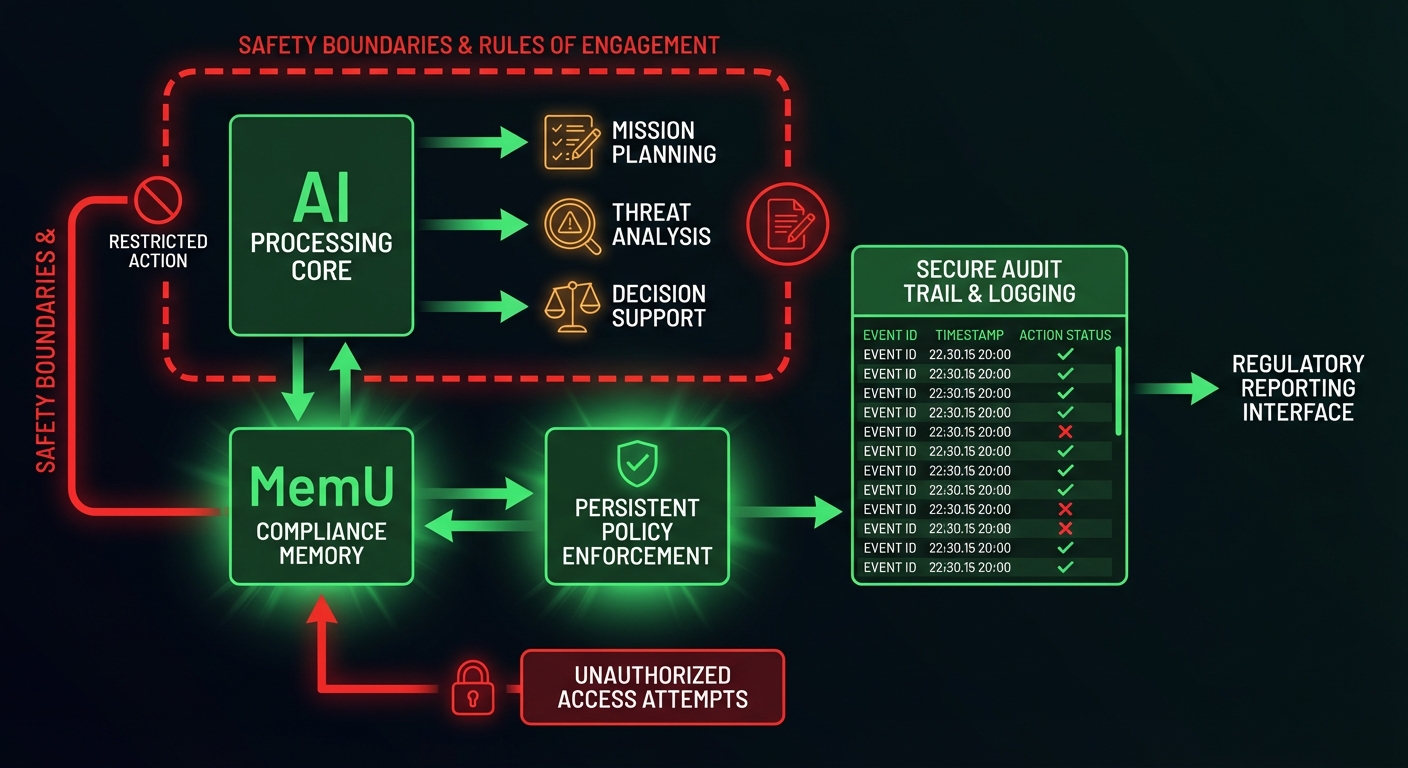
OpenAI's contract gives it "full discretion over its safety stack." Exercising that discretion responsibly requires understanding what the system has been doing — not just in the current session, but across the deployment lifetime. An audit trail that records requests and responses is a start. But meaningful accountability requires understanding intent, context, and cumulative impact.
The red line against autonomous weapons, for example, requires understanding whether human oversight is genuinely present in the decision loop — not just whether a human clicked "approve" on each recommendation, but whether the system's recommendations have been progressively narrowing human options to the point where the "approval" is nominal. Detecting this requires memory of how the system's recommendations have evolved over time.
For the public accountability mechanism that OpenAI created by publishing its contract, independent verification requires access to the system's behavioral history. Researchers and auditors need to analyze patterns, not just individual interactions. This kind of longitudinal analysis is only possible with persistent memory.
How MemU Enables Deployment-Lifetime Safety
MemU provides the persistent behavioral memory that military AI safety requires. Every interaction is stored with full context — the request, the response, the safety evaluation, and the operational context. Over the deployment lifetime, this creates a comprehensive behavioral record that supports pattern-level safety analysis, not just request-level filtering.
For organizations deploying AI in sensitive contexts, MemU provides the audit infrastructure that makes safety commitments verifiable. Red lines aren't just contract clauses — they're enforceable constraints backed by complete behavioral records. The safety stack operates not just per-request but across the full deployment lifetime.
OpenAI defined the red lines. MemU provides the memory to enforce them over time.
Get Started
Add deployment-lifetime safety memory to your AI systems. Explore MemU at memu.pro and on GitHub.