OpenClaw v2026.3.7 Ships Pluggable ContextEngine — But Pluggable Context Still Isn't Persistent Memory


OpenClaw ContextEngine: What Everyone's Getting Right (And Missing)
OpenClaw ContextEngine is the headline feature of OpenClaw v2026.3.7-beta.1 — a release backed by 89 commits and over 200 bug fixes. The OpenClaw ContextEngine introduces a pluggable plugin interface for context management that lets developers implement custom memory strategies without altering core framework code. RAG pipelines, summarization chains, sub-agent management modules — all can be wired in through a clean abstraction layer that separates context logic from agent execution logic.
The design reflects a real need in the agentic framework memory space. Developers building agents on OpenClaw previously had to fork core code or build brittle wrappers to customize how agents manage context. The new OpenClaw ContextEngine eliminates that friction with a standardized interface: implement the plugin contract, register the strategy, and the framework handles lifecycle management. The release also ships dual-engine routing with intelligent model fallback across OpenAI, Google, and Anthropic providers — a meaningful reliability improvement for production deployments.
But pluggable context management and persistent memory are fundamentally different problems. The OpenClaw ContextEngine gives developers extensible control over how context is assembled, compressed, and passed to models within a single session. What it doesn't address is memory that persists across sessions. An agent that learns effective summarization patterns for legal documents on Monday loses that knowledge entirely by Tuesday. Pluggable context management improves the quality of session-bounded context — it does not create memory that compounds over time.
What OpenClaw ContextEngine Does With Memory Today
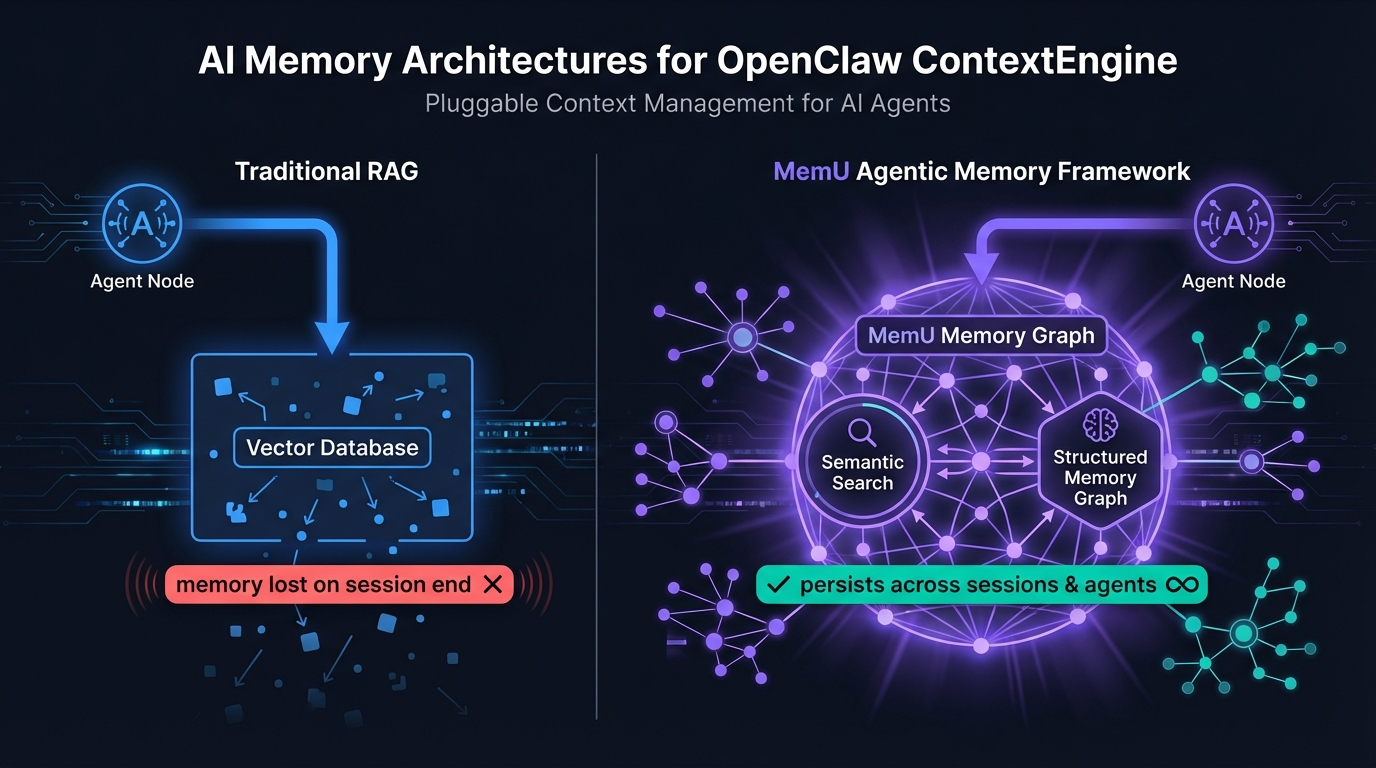
The OpenClaw ContextEngine operates as a middleware layer between agent execution and model inference. When an agent prepares a prompt, the ContextEngine applies the registered plugin pipeline — retrieving relevant documents through RAG, summarizing conversation history, managing sub-agent output aggregation — to assemble the context window that gets sent to the model. Developers control every stage of this pipeline through pluggable implementations.
This architecture handles session-level context management well. An agent processing a long customer support conversation can use a summarization plugin to compress earlier messages while preserving key details. A research agent can plug in a RAG pipeline that retrieves domain-specific documents relevant to the current query. The context engine architecture is clean, extensible, and solves real developer pain around customizing agent context behavior.
The gap appears at session boundaries. When the agent session ends, all assembled context — the RAG retrievals, the summarization state, the sub-agent outputs — disappears. The next session starts with a fresh ContextEngine pipeline and no knowledge of what the previous session processed. For agentic framework memory, this means developers must build their own persistence layer outside the ContextEngine to maintain continuity, defeating the purpose of having a pluggable framework in the first place.
The dual-engine routing feature compounds this limitation. With automatic fallback across OpenAI, Google, and Anthropic providers, agents may process the same workflow using different models across different sessions. Without persistent memory tracking which provider produced better results for specific task types, the routing engine can't learn from execution history.
The MemU Agentic Memory Framework: A Different Architecture
The MemU Agentic Memory Framework provides the persistence layer that pluggable context engines don't include natively. While the OpenClaw ContextEngine excels at assembling context within sessions, MemU captures, stores, and retrieves knowledge across sessions — creating a memory substrate that any context management pipeline can draw from.
Pluggable context management gives developers control over how agents process information in the moment. Persistent memory gives agents access to everything they've ever learned. The first is engineering flexibility; the second is accumulated intelligence.
The integration model is straightforward. The MemU Agentic Memory Framework can function as a plugin within the OpenClaw ContextEngine pipeline — a memory-retrieval stage that enriches session context with persistent knowledge before the agent processes a task. When the session ends, a complementary memory-write stage captures key outcomes, learned patterns, and contextual insights for future retrieval.
Three architectural advantages define the framework's approach to pluggable context management:
- Session-spanning persistence: Every context assembly outcome — what was retrieved, what was summarized, what the agent produced — is stored in a structured memory graph. Future sessions query this graph to start with accumulated context rather than empty pipelines.
- Cross-agent knowledge sharing: The MemU Agentic Memory Framework enables memory sharing across agents within an organization. When one agent's ContextEngine pipeline discovers an effective RAG configuration for financial document analysis, that knowledge becomes available to every agent handling similar tasks.
- Provider-aware memory: With OpenClaw's dual-engine routing sending requests to different model providers, persistent memory tracks which providers performed best for specific task types and context configurations. Routing decisions become data-informed rather than rule-based.
The MemU Agentic Memory Framework exposes REST APIs that conform to the ContextEngine plugin contract, making integration with OpenClaw a matter of registering the MemU plugin alongside existing context strategies. No framework modifications required — the pluggable architecture that OpenClaw provides becomes the integration surface for persistent memory.
Head-to-Head: MemU vs. OpenClaw ContextEngine
OpenClaw ContextEngine alone: Clean, extensible context engine architecture that gives developers full control over how agents assemble context. RAG pipelines, summarization, sub-agent management — all pluggable through a standardized interface. Dual-engine routing adds provider reliability. But context resets every session, and routing doesn't learn from execution history.
OpenClaw ContextEngine + MemU: The same pluggable architecture, now backed by persistent memory that captures context assembly outcomes across every session. Agents start each interaction with access to historical knowledge — effective retrieval patterns, optimized summarization strategies, provider performance data. The OpenClaw ContextEngine assembles context; the MemU Agentic Memory Framework ensures that assembly process improves continuously.
The performance difference scales with usage. A fresh deployment benefits from OpenClaw's extensible context management. After hundreds of sessions, a deployment with persistent memory operates with an accumulated intelligence layer that makes every context assembly decision more informed. For agentic framework memory, the combination delivers what developers actually need: extensible in-session context control and persistent cross-session knowledge that compounds over time.
Development teams using OpenClaw's 89-commit release get a significantly improved context engine architecture. Adding the MemU persistence layer transforms that architecture from a stateless pipeline into a learning system.
Empowering Context Management: Better Together
Combining OpenClaw's pluggable context engine with persistent memory creates capabilities that neither system provides in isolation:
- Self-tuning RAG pipelines: Persistent memory tracks which retrieval configurations produce the best agent outputs for different task types. The OpenClaw ContextEngine automatically applies optimized retrieval parameters based on accumulated performance data.
- Adaptive summarization: Agents that remember which summarization strategies preserved critical details for specific document types produce more relevant compressed context. Pluggable context management becomes self-optimizing through memory feedback.
- Intelligent model routing: Dual-engine routing backed by persistent provider performance data routes tasks to the model that historically produces the best results for the given context type. Cost optimization and quality improvement happen simultaneously.
- Plugin performance analytics: The MemU Agentic Memory Framework tracks how each ContextEngine plugin contributes to overall agent performance, enabling developers to iterate on their context strategies with data rather than intuition.
Persistent memory turns pluggable context management from a development convenience into a compounding intelligence layer that improves every context assembly operation across an organization's agent fleet.
Get Started with MemU
OpenClaw v2026.3.7 delivers a meaningful architectural improvement for the agentic framework ecosystem. The OpenClaw ContextEngine gives developers the extensibility they need to customize agent context management without fighting framework internals. Dual-engine routing and 200+ bug fixes make this a production-ready release for teams building serious agent deployments.
What completes the architecture is persistent memory. Context pipelines that learn from previous sessions. RAG configurations that self-optimize through accumulated retrieval data. Model routing that improves with every execution.
The MemU Agentic Memory Framework provides that persistence — and it integrates directly as a ContextEngine plugin. No framework forks, no custom persistence code, no separate infrastructure. Register the MemU plugin, and every agent session benefits from the accumulated intelligence of every session that came before it.
Visit memu.pro to explore the Agentic Memory Framework API, or check out the GitHub repository to build agents with persistent, cross-session memory.
Tags: OpenClaw ContextEngine, pluggable context management, agentic framework memory, context engine architecture, MemU Agentic Memory Framework, persistent memory, dual-engine routing