OpenClaw Is Everywhere — But Its Memory Layer Has a Gap


OpenClaw has taken the AI agent world by storm. With over 217,000 GitHub stars and a thriving open-source community, this agentic framework has become the go-to solution for developers building personal AI assistants that actually do things — managing inboxes, booking flights, controlling smart homes, all through messaging apps like WhatsApp and Telegram.
The momentum is undeniable. Meta recently acquired Manus, an autonomous agent platform, for over $2 billion. Anthropic, OpenAI, and Google are racing to ship agent capabilities. Agent skill marketplaces are emerging where users install new capabilities like apps. We're witnessing AI move from suggesting and drafting to actually executing real-world tasks.
But there's a foundational layer that even the most capable agents depend on getting right — AI agent memory.
OpenClaw: What Everyone's Getting Right (And Missing)
This framework solves a real problem: it treats AI assistants as infrastructure, not just prompt engineering. The architecture connects large language models to the messaging platforms people already use, running 24/7 on self-hosted infrastructure. Its plugin ecosystem spans over 100 extensions, and the SOUL.md configuration system makes agent behavior remarkably customizable.
The open-source AI agents community has embraced this approach because it prioritizes privacy (your data never leaves your environment), supports multiple LLM providers (Claude, GPT-4o, Gemini, Ollama), and offers genuine extensibility. For developers tired of building agent scaffolding from scratch, the framework delivers.
Yet for all its strengths in orchestration and channel integration, the memory approach reveals a structural limitation shared across most agentic frameworks today.
How Does OpenClaw Handle Memory Today?
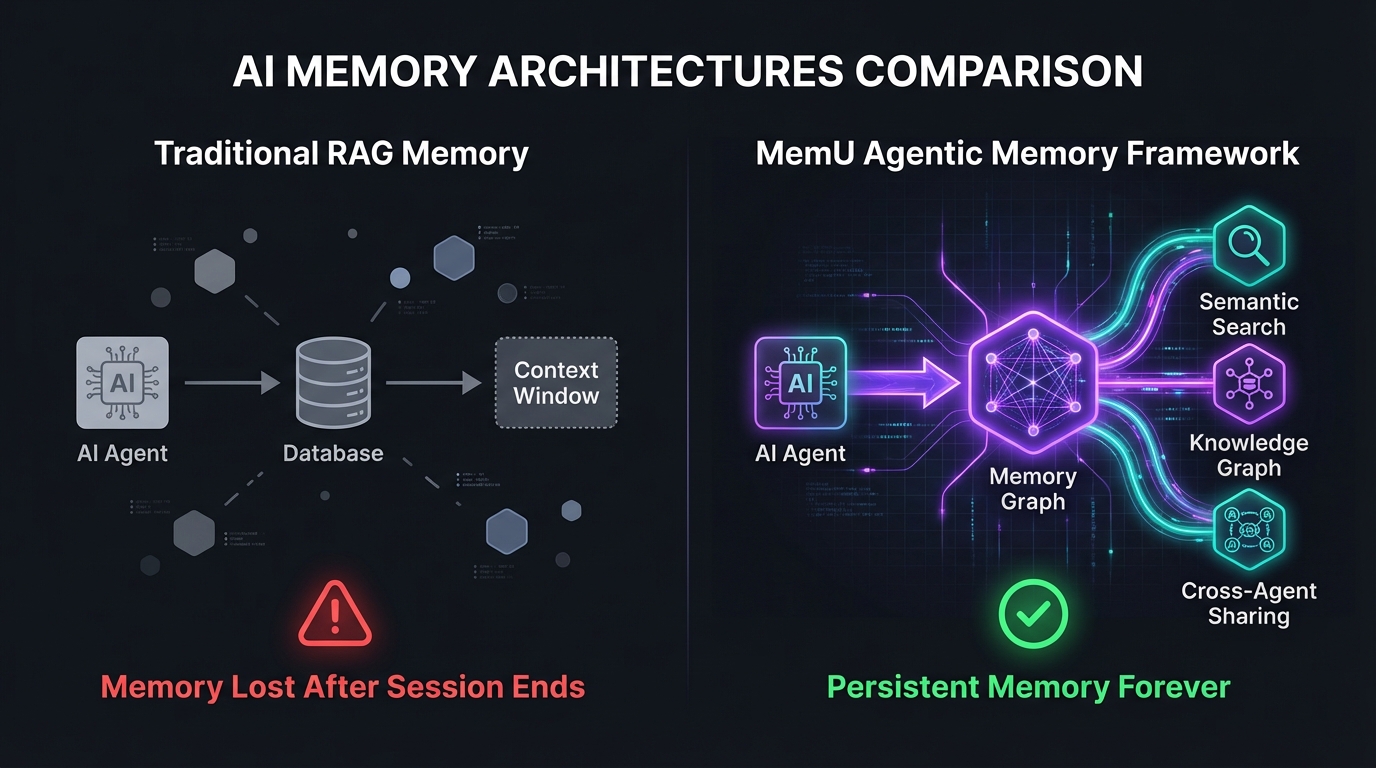
The framework implements a multi-layer memory system using Markdown files and SQLite databases. Conversations are logged to daily files (memory/YYYY-MM-DD.md), curated facts go to MEMORY.md, and vector embeddings enable semantic search through memory.sqlite. This approach keeps everything local and transparent — you can literally read your agent's memories in a text editor.
Context window constraints are managed through automatic compaction. When a session approaches the model's token limit, older conversation history gets summarized into compact entries. A pre-compaction flush reminds the model to write durable memories before truncation. It's a clever solution to the fundamental constraint that every LLM faces: limited context windows.
The core limitation: this memory architecture is fundamentally session-scoped and compaction-dependent. When context windows fill up, information gets summarized — and summarization means detail loss. The specific restaurant you mentioned three months ago, the exact wording of that important decision, the nuanced preference you expressed once — these details fade into compressed summaries.
There's no structured relationship graph connecting memories across sessions, agents, or users. Each agent maintains its own isolated memory silo. This isn't a knock on OpenClaw specifically. CrewAI, AutoGen, and LangGraph face similar constraints. The entire category treats memory as a local storage problem rather than a knowledge architecture problem.
The MemU Agentic Memory Framework: A Different Architecture
The MemU Agentic Memory Framework approaches agent memory from a fundamentally different angle. Rather than storing conversations as flat files that get compacted when context windows overflow, MemU builds a structured memory graph that persists across sessions, agents, and even users.
Imagine your personal agent booking a flight for you today. Three months later, a different agent — perhaps a travel planning assistant — needs to know your airline preferences, seat choices, and frequent flyer details. With session-scoped memory, that knowledge is either lost to compaction or trapped in an unrelated agent's storage. With the MemU Agentic Memory Framework, it's instantly retrievable.
The architecture difference comes down to three pillars:
- Dual-mode retrieval: The MemU Agentic Memory Framework combines semantic search (vector similarity) with a structured memory graph that captures relationships, not just embeddings. "User prefers aisle seats" connects to "User frequently flies United" connects to "User's home airport is SFO" — as a graph, not a list.
- Cross-session persistence: Memory doesn't get compacted away. The framework maintains full-fidelity knowledge that evolves over time without lossy summarization.
- Agent-to-agent memory sharing: Multiple agents can read from and contribute to shared memory pools, enabling true multi-agent collaboration without data silos.
MemU doesn't store what the AI said — it captures what the AI learned, structured for retrieval at any future moment.
Integration is straightforward: the MemU Agentic Memory Framework provides a drop-in API compatible with any LLM and any orchestration layer. Your agents can call MemU's memory endpoints alongside their existing tools, adding persistent memory without rewriting their core logic.
Head-to-Head: Native Memory vs. MemU
The traditional approach: Markdown files + SQLite + compaction. Works well for single-session continuity and keeps everything transparent and debuggable. But this architecture breaks down when you need to recall a specific detail from six months ago, share knowledge between agents, or query structured relationships across your entire interaction history. The compaction process, while necessary for context management, inherently trades precision for space.
MemU Agentic Memory Framework: A structured memory graph with dual-mode retrieval. The system maintains retrieval across 10,000+ memory entries with sub-100ms latency. No compaction loss. Cross-agent memory sharing works out of the box. The framework handles the complexity of memory evolution — merging, linking, and organizing knowledge automatically as your agents learn more about users and contexts.
OpenClaw excels at execution: taking actions, managing channels, orchestrating tools. The MemU Agentic Memory Framework excels at remembering: building durable knowledge that makes every future execution smarter. They solve different problems — and they're dramatically better together.
Empowering Your Agents: Better Together
The MemU Agentic Memory Framework isn't a replacement for your agent orchestration layer — it's the memory foundation that makes any agentic framework dramatically more capable.
- Personal assistant continuity: Most frameworks handle your tasks session by session. With MemU underneath, your assistant remembers your preferences, past decisions, and evolving context across months of interaction — without manual memory curation.
- Multi-agent workflows: Running specialized agents for travel, finance, and health? MemU lets them share relevant context. Your health agent knows your travel schedule without duplicating data or building custom integrations.
- Enterprise deployments: Organizations using OpenClaw or similar frameworks for team assistants gain institutional memory. Onboarding a new team member? The agent already knows project history, past decisions, and accumulated context.
Adding persistent memory takes a single API integration. The MemU Agentic Memory Framework handles storage, retrieval, and evolution — your agents just get smarter over time.
Get Started with MemU
OpenClaw has proven that open-source AI agents can match and exceed commercial offerings in execution capability. The framework's 217K stars represent real developer adoption, real production deployments, and real problems being solved. But execution is only half the equation.
The next frontier is memory — building agents that don't just act, but learn. Agents that accumulate knowledge over months and years. Agents that share context without manual integration work. Agents that remember the details that matter, even when those details were mentioned once, six months ago, in a different conversation.
The MemU Agentic Memory Framework provides that foundation. Drop-in integration means you can add persistent memory to existing agents without rewriting your codebase. Structured knowledge graphs capture relationships, not just embeddings. Cross-agent memory sharing enables true multi-agent collaboration. And retrieval scales to hundreds of thousands of memories while maintaining sub-100ms latency.
The infrastructure for truly intelligent agents exists. The open-source community has proven that execution can be democratized. Now it's time to democratize memory.
Visit memu.pro to explore the Agentic Memory Framework API, or check out the open-source repository on GitHub to dive into the code and start building persistent memory into your agents today.