OpenRouter Routes Agents Across 400+ AI Models — But Smart Model Selection Without Persistent Memory Means Agents Can't Learn Which Models Actually Work Best


OpenRouter has become the connective tissue of multi-model AI architectures. A single API endpoint provides access to over 400 models from every major provider — OpenAI, Anthropic, Google, Meta, Mistral, and dozens of specialized vendors — through one unified interface. The Auto Router analyzes each prompt and automatically selects the optimal model based on task characteristics, balancing quality, speed, and cost. Body Builder generates parallel multi-model requests, enabling agents to query multiple models simultaneously and select the best response. With approximately 25-40ms of latency overhead thanks to edge caching, the platform adds negligible delay while providing extraordinary model flexibility. Native integrations with LangChain, LlamaIndex, OpenAI SDK, PydanticAI, Vercel AI SDK, and MCP support make it framework-agnostic.
But the platform routes intelligently in the moment without learning from routing outcomes over time. An agent that used Claude for legal analysis last week and received excellent results has no way to recall that success when encountering a similar task today. Smart model routing without persistent routing memory means agents re-discover optimal model selections from scratch every session.
What the Industry Gets Right (And What Routing Alone Can't Solve)
The architecture solves a genuine infrastructure pain point. As the model landscape fragments — hundreds of models with different strengths, pricing tiers, and capabilities — developers face an integration nightmare. The platform abstracts this complexity behind a single API with a unified request format. Switching from GPT-4o to Claude Sonnet to Gemini Pro requires changing a model identifier string, not rewriting integration code.
The Auto Router is particularly compelling for agentic workflows. Rather than hardcoding model selections that become stale as new models launch, agents can delegate selection to routing intelligence that evaluates prompt complexity, required capabilities, and cost constraints. Body Builder extends this: for critical decisions, agents fan out to multiple models simultaneously and synthesize the best response.
What the platform does not provide is routing intelligence that improves over time for your specific use cases. The Auto Router uses general performance benchmarks, but has no awareness of how models performed on your particular workloads in previous sessions. An agent that discovered Mistral Large outperforms GPT-4o on your company's contract analysis tasks cannot carry that insight forward. Each request is routed independently — optimizing for the general case, not your specific case.
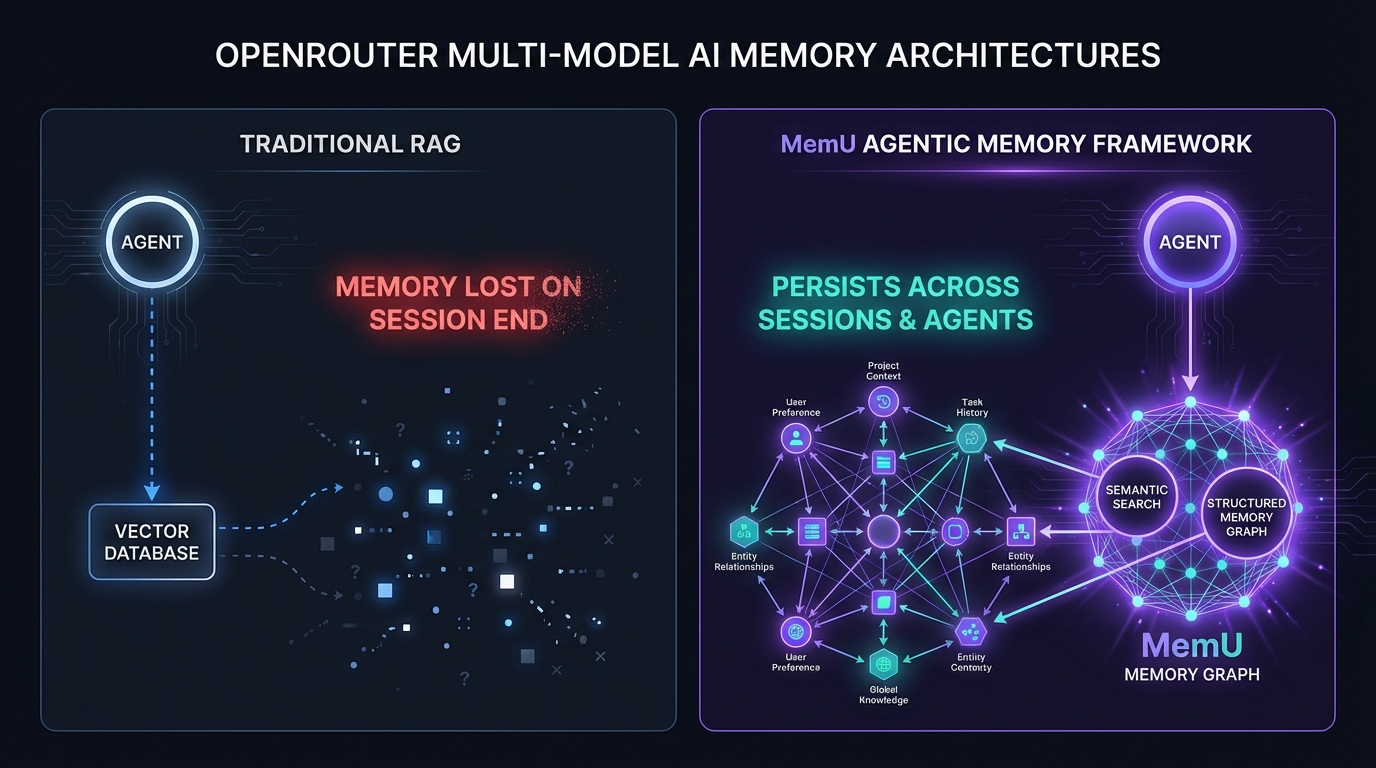
The MemU Agentic Memory Framework: Routing Intelligence That Compounds
The MemU Agentic Memory Framework provides the persistent memory layer that model routing platforms do not include natively. Instead of treating each model selection as an independent decision, MemU captures routing context — which model was selected, what task it performed, how output quality was assessed, and the cost-performance ratio — storing these outcomes in a structured memory graph that persists across sessions and organizational use cases.
Consider an AI research agent using the platform to route requests across models. Without persistent memory, the Auto Router selects models based on general benchmarks. With the MemU Agentic Memory Framework, the agent recalls routing intelligence: Claude Sonnet produced the most accurate literature summaries for molecular biology papers with 95% factual accuracy. GPT-4o generated the best structured data extraction from financial filings. Gemini Pro handled multi-language patent analysis most effectively. Mistral Large delivered comparable quality to Claude on contract review at 40% lower cost. That accumulated routing intelligence transforms generic selection into experience-informed optimization.
The framework addresses three key limitations of memoryless multi-model routing:
- Task-specific model performance memory: Every routing decision and its quality outcome are stored — building a performance history per model per task type that enables agents to override generic routing with domain-specific intelligence from actual results on your workloads.
- Cost-quality optimization tracking: Persistent memory tracks not just which model is cheapest but which delivers the best value — cost per unit of quality for each task category. Agents learn that the cheapest model for code generation produces output requiring 3x more revision, making the mid-tier option more cost-effective overall.
- Organizational routing profiles: The MemU Agentic Memory Framework enables cross-team routing intelligence, ensuring that a marketing agent benefits from engineering's discovery that a particular model excels at technical writing.
Routing across 400 models without remembering which ones worked is like having a restaurant guide that recommends new places every night but never records whether you liked them. The MemU Agentic Memory Framework turns model routing from smart guessing into informed selection.
Integration with routing workflows uses MemU's REST APIs. Before each routing decision, the agent queries stored routing history for task-specific model performance data. After receiving the response, quality assessment and cost metrics are stored alongside routing context. The memory layer enriches decisions with accumulated intelligence without modifying the underlying model access infrastructure.
Head-to-Head: Stateless Model Routing vs. Memory-Enhanced Model Selection
OpenRouter alone: Unified access to 400+ models with intelligent auto-routing, parallel multi-model queries, and edge-cached low-latency delivery. But every routing decision draws only on general benchmarks — no historical performance data from your use cases, no learned preferences, no cost-quality optimization from accumulated experience.
OpenRouter + MemU: The same expansive model access, now informed by persistent routing intelligence. Model selection considers how each model performed on similar tasks in your environment. Cost optimization reflects actual value-per-dollar from historical usage — creating routing decisions that improve with every request.
For organizations processing thousands of requests daily across diverse task types, even small improvements in model selection — routing 10% of requests to a model delivering equivalent quality at 30% lower cost — compound into significant savings across the full request volume.
OpenRouter + MemU: Better Together
The combination of this routing infrastructure and persistent memory creates capabilities neither achieves independently:
- Adaptive model selection: As new models launch, agents with persistent memory evaluate them against established baselines — comparing performance on your workloads against stored outcomes, enabling informed adoption rather than hype-driven switching.
- Failure-aware routing: When a model produces poor output — hallucinated references, broken code, inconsistent data — persistent memory records the failure context. Future routing avoids models with documented failure patterns without manual rule configuration.
- Strategic model intelligence: Over time, persistent memory builds a performance profile specific to your use cases — showing which models deliver best results for your task mix, enabling cost forecasting and vendor negotiations based on actual usage.
Persistent memory transforms the platform from a model routing layer into a model intelligence system — where every request processed improves every future routing decision.
Get Started with MemU
OpenRouter provides essential multi-model infrastructure — unifying access to 400+ models through a single API with intelligent routing. As the model landscape fragments, unified routing becomes foundational.
The next step is giving agents routing memory that compounds — agents where model selection is informed by historical performance on your workloads, where routing decisions improve as more requests are processed, and where every API call contributes to the intelligence driving the next one.
The MemU Agentic Memory Framework provides that foundation. Drop-in API integration alongside routing workflows, dual-mode retrieval with semantic search and structured memory graphs, and cross-session persistence that turns model routing into compounding intelligence.
Visit memu.pro to explore the Agentic Memory Framework API, or check out the GitHub repository to start building agents with routing memory.
Tags: OpenRouter, multi-model routing, AI agent memory, agentic AI, MemU AI, LLM memory, model selection