ORO Labs Raises $100M for Agentic Procurement Orchestration — But Procurement Agents Need Memory Across Engagement Cycles


ORO Labs closed a $100M Series C on March 12, 2026, led by Brighton Park Capital and Goldman Sachs Alternatives, validating its position as the leading agentic procurement orchestration platform. The numbers tell the story: 300% revenue growth, a 150% revenue retention rate indicating customers expand deployments aggressively, and a Fortune 500 client roster including Coca-Cola, Siemens Energy, Novartis, Pfizer, Thermo Fisher, and Booking.com. The platform serves 15 of the top 25 life sciences companies and 2 of the top 4 US banks. It automates intake, approvals, sourcing, supplier management, risk assessment, and compliance across more than 100 countries.
But procurement operates in cycles — quarterly reviews, annual contract renewals, multi-year supplier relationships — and agents that orchestrate today's procurement event cannot recall patterns from the last engagement cycle. A sourcing agent that negotiated favorable terms with a supplier six months ago starts the renewal conversation without memory of what worked. A risk assessment agent that identified a supply chain vulnerability during last quarter's review cannot connect it to the emerging pattern in this quarter's data. Agentic procurement orchestration without memory across engagement cycles means re-learning supplier dynamics the organization has already navigated.
ORO Labs: What Everyone's Getting Right (And Missing)
ORO Labs gets procurement orchestration right at unprecedented scale. Automating intake through compliance across 100+ countries requires deep understanding of regional regulations, local supplier ecosystems, currency dynamics, and cultural procurement practices. The 150% revenue retention rate demonstrates that organizations do not just maintain their implementation — they expand aggressively, adding new procurement categories, regions, and use cases. When Novartis and Pfizer trust it for procurement orchestration, pharmaceutical-grade compliance and audit requirements have been met.
The breadth of automation is equally impressive. The platform handles the full procurement lifecycle: intake captures requirements with structured data extraction, approval workflows route decisions through appropriate authority chains, sourcing identifies and evaluates potential suppliers, supplier management maintains ongoing relationship oversight, risk assessment monitors financial health and compliance status, and compliance verification ensures regulatory adherence across jurisdictions.
What the platform does not maintain across procurement cycles is the supplier relationship intelligence that makes experienced procurement professionals invaluable. A human procurement director approaching a contract renewal recalls the negotiation dynamics from the last three renewals — which terms were flexible, which were non-negotiable, what competitive alternatives created leverage, and how seasonal demand affected pricing. That accumulated relationship intelligence enables a 12% cost reduction on the fourth renewal that was impossible on the first. The platform orchestrates each engagement effectively; it does not compound supplier intelligence across cycles.
Other procurement platforms — Coupa, Jaggaer, SAP Ariba — share this limitation. They automate workflows. None persist the supplier relationship patterns that transform transactional procurement into strategic sourcing.
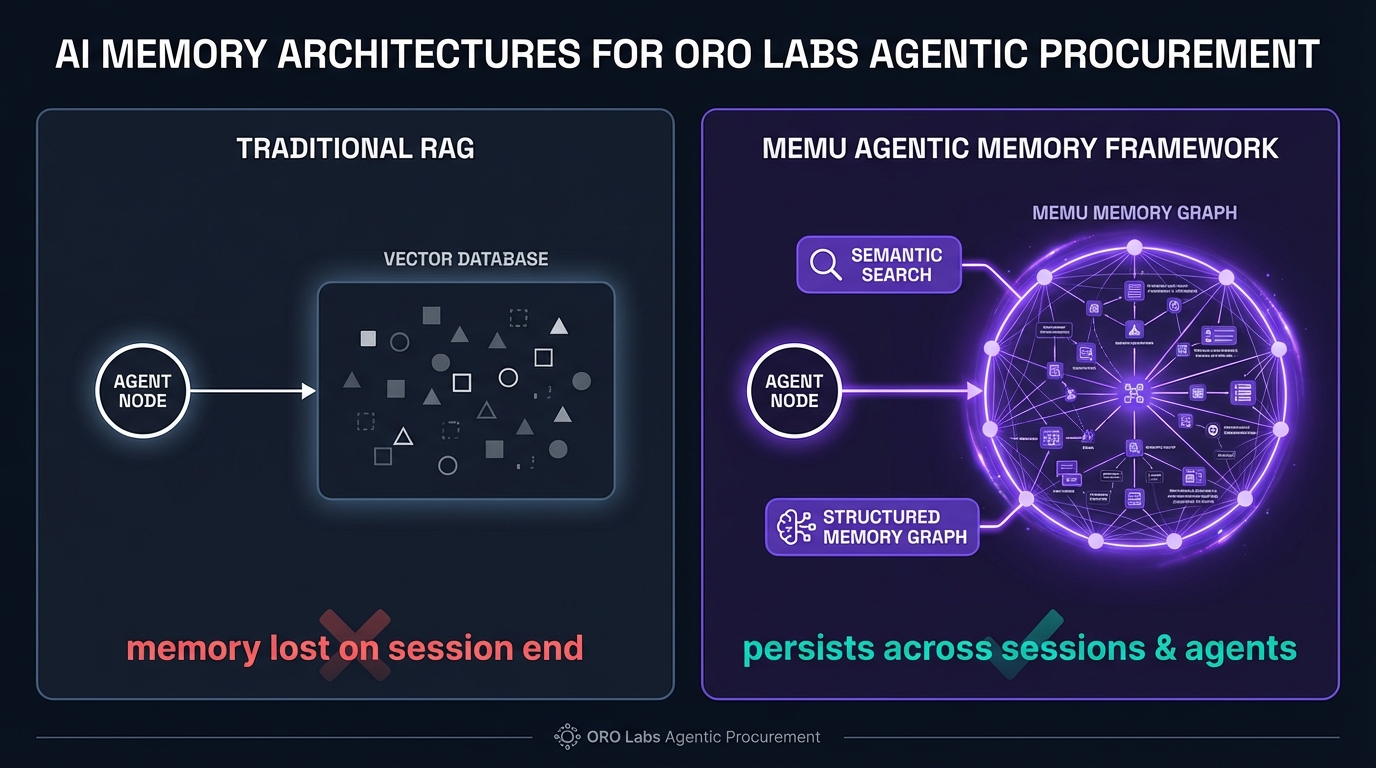
The MemU Agentic Memory Framework: Procurement Intelligence That Compounds Across Cycles
The MemU Agentic Memory Framework provides the persistent procurement memory layer that enables agentic orchestration platforms like ORO Labs to accumulate supplier intelligence across engagement cycles. Instead of treating each procurement event as an isolated transaction, MemU captures negotiation patterns, supplier behavior profiles, pricing dynamics, risk indicators, and compliance resolution strategies in a structured memory graph that persists across quarters, years, and organizational changes.
Consider a deployment at a global pharmaceutical company. The sourcing agent for active pharmaceutical ingredients engages with suppliers across India, China, and Europe. Without persistent memory, each sourcing event evaluates suppliers against current qualifications and pricing. With the MemU Agentic Memory Framework, the agent retrieves procurement history: this supplier consistently delivers ahead of schedule but quality scores dip during their fiscal Q4 when production volume peaks, that supplier offered a 15% discount on the last renewal when presented with a competing bid, and regulatory inspections in this region follow a predictable annual cycle that affects lead times. The sourcing decision incorporates institutional procurement intelligence rather than current data alone.
The MemU Agentic Memory Framework addresses three limitations of cycle-bounded procurement orchestration:
- Supplier relationship continuity: Negotiation dynamics, delivery patterns, quality trends, and responsiveness profiles persist across engagement cycles. Agents approaching a renewal retrieve the complete relationship history — not just contract terms, but behavioral patterns that inform negotiation strategy.
- Cross-category procurement intelligence: Supplier patterns in one procurement category inform decisions in another. A reliability issue with a logistics provider discovered by the raw materials team becomes available to the finished goods team before they engage the same provider.
- Strategic sourcing evolution: Persistent memory transforms transactional procurement into strategic sourcing by accumulating market intelligence, pricing trends, and competitive dynamics that inform long-term supplier portfolio decisions.
A veteran procurement director's value comes from decades of supplier relationships and market intuition. The MemU Agentic Memory Framework gives procurement agents that same compounding intelligence — supplier by supplier, cycle by cycle.
Head-to-Head: Cycle-Bounded Orchestration vs. Memory-Enhanced Strategic Procurement
ORO Labs alone: The leading agentic procurement orchestration platform with end-to-end lifecycle automation across 100+ countries, trusted by Fortune 500 companies across life sciences, banking, manufacturing, and hospitality. Agents orchestrate intake through compliance with sophisticated workflow coordination. But each procurement cycle starts without memory of supplier behavior patterns, negotiation dynamics, or market intelligence from previous engagements.
ORO Labs + MemU: The same comprehensive procurement orchestration, now backed by persistent supplier intelligence. Agents approach renewals with complete relationship memory. Sourcing decisions incorporate pricing trends across multiple cycles. Risk assessments connect current indicators to historical patterns predicting supplier reliability. The procurement function gets measurably more strategic with every engagement cycle.
For organizations operating across global procurement portfolios — where Coca-Cola manages thousands of supplier relationships and Pfizer navigates pharmaceutical supply chain compliance across dozens of countries — the compounding value of persistent procurement memory is enormous.
Empowering ORO Labs: Better Together
The combination of the procurement orchestration platform and MemU's persistent memory creates capabilities that neither achieves independently:
- Predictive supplier risk: Persistent memory tracks supplier behavior patterns across engagement cycles — delivery variability, quality score trends, financial health indicators, and compliance status changes. Agents identify emerging risks before they manifest by recognizing patterns that current-cycle metrics alone cannot reveal.
- Negotiation intelligence accumulation: Each negotiation generates insights about supplier flexibility, competitive dynamics, and pricing boundaries. Persistent memory captures not just terms but dynamics — what arguments were effective, what concessions were available, and what competitive alternatives created leverage.
- Portfolio optimization: Across hundreds of supplier relationships, persistent memory reveals portfolio-level patterns: concentration risks, geographic diversification opportunities, category spend trends, and cross-category synergies that transform event-level execution into strategic portfolio management.
Get Started with MemU
ORO Labs has built the procurement orchestration platform that Fortune 500 companies trust — end-to-end lifecycle automation, global compliance, and the 300% growth that proves enterprise procurement transformation is real.
The next step is giving that orchestration persistent supplier intelligence. Renewals where agents recall negotiation dynamics from three previous cycles. Sourcing events where market intelligence compounds across years. Organizations where every supplier interaction strengthens collective procurement expertise.
The MemU Agentic Memory Framework provides that persistence layer. Supplier relationship memory graphs, cross-cycle procurement intelligence, and strategic sourcing patterns that transform transactional procurement into compounding organizational advantage.
Visit memu.pro to explore the Agentic Memory Framework API, or check out the GitHub repository to start building agents that remember.
Tags: ORO Labs, agentic procurement, procurement orchestration, supplier intelligence, agent memory, MemU AI, LLM memory, strategic sourcing