Perplexity AI Hits $656M ARR by Replacing Google — But Every Search Still Starts From Scratch


Perplexity AI is proving that AI search is a business, not just a feature. The company projects $656 million in annualized recurring revenue for 2026 — up 800% from 2024. By ditching advertising in favor of a subscription-first model ($20/month Pro tier), Perplexity has built a sustainable engine for AI-powered search that serves everyone from developers to CEOs. Enterprise sales are ramping aggressively, with Perplexity positioning itself against workplace AI search solutions like Glean.
The product delivers synthesized answers rather than link lists. Ask a complex research question, and Perplexity pulls from multiple sources, cites everything, and presents a coherent answer with follow-up suggestions. For professionals who spend hours researching, this is genuinely time-saving.
But as users rely on Perplexity AI for deeper, recurring research workflows, a fundamental limitation surfaces: every search starts with zero context about what you've already researched.
Perplexity AI: What AI Search Does Better Than Google
Traditional search returns links. Perplexity AI returns answers. The difference is profound for research-heavy workflows. A lawyer researching case precedents gets synthesized analysis with citations rather than a page of links to skim. A developer evaluating frameworks gets comparative analysis rather than scattered blog posts. A product manager researching competitors gets structured intelligence rather than raw search results.
The Pro tier adds access to more powerful models, unlimited file uploads, and enhanced search depth. For the $20/month price point, professionals report recouping the cost within the first day of use through time savings.
The limitation is research continuity. A finance analyst who spent three hours researching a market segment on Monday returns Thursday to explore a related question — and Perplexity AI has no context from Monday's deep dive. The sources already evaluated, the conclusions already drawn, the threads already pulled — all must be re-established. Perplexity excels at answering questions but can't build on its own previous answers.
How Perplexity AI Handles Research Context
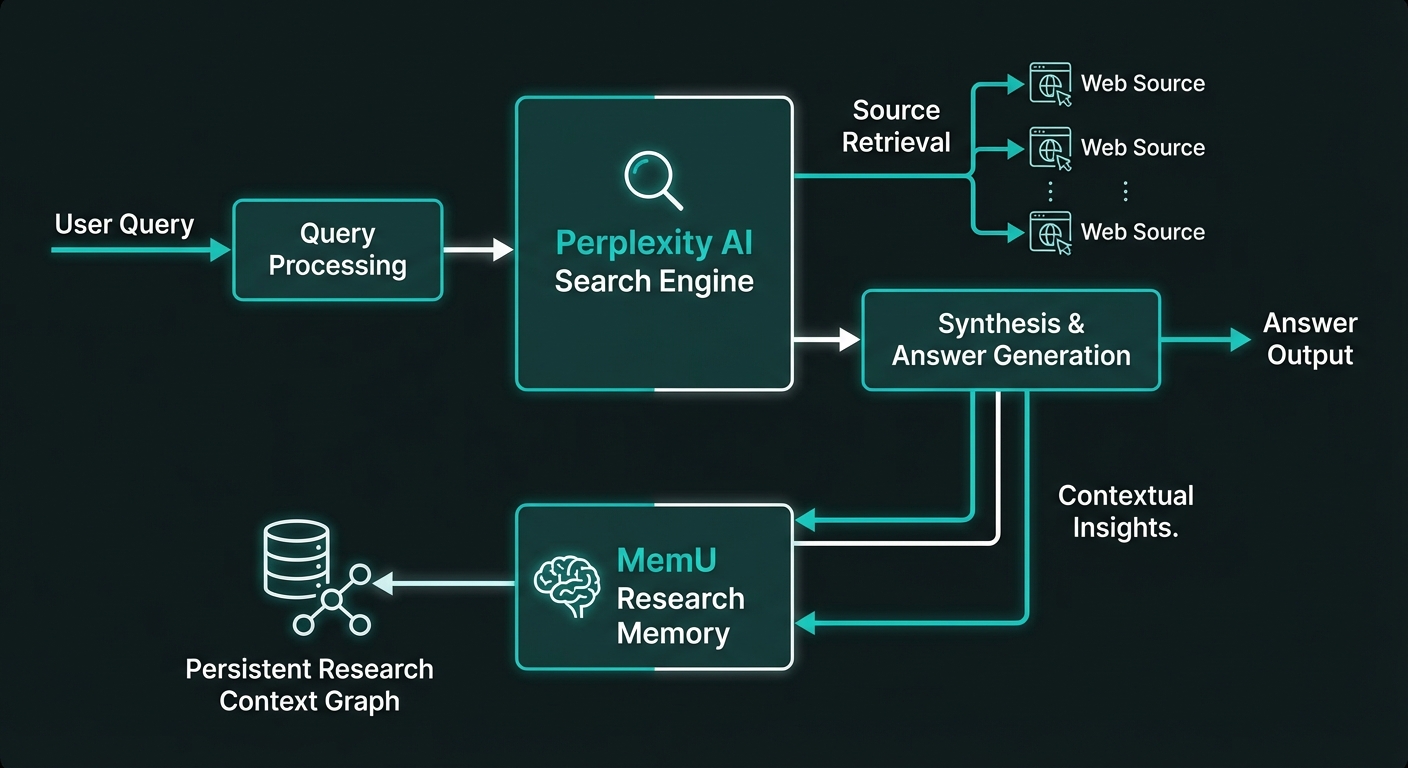
Within a search session, Perplexity AI maintains conversational context. Follow-up questions build on previous answers. The system remembers what sources were cited and can drill deeper into specific aspects. Collections let users organize searches by topic for later reference.
The Pro search feature performs multi-step research, asking clarifying questions before diving deep. This produces more targeted results within a session. Source citations provide transparency about where information originated.
Cross-session research intelligence doesn't accumulate. Monday's three-hour research session produced nuanced understanding of a market — source credibility assessments, contradictory information identified, key data points extracted. Thursday's follow-up session can reference saved Collections (essentially bookmarks) but not the analytical understanding that emerged. The difference between notes and memory is synthesis — and Perplexity provides notes.
The MemU Agentic Memory Framework: Research That Compounds
The MemU Agentic Memory Framework provides the research memory that transforms Perplexity AI from a powerful search tool into a cumulative knowledge system.
Consider a venture capitalist using Perplexity AI to evaluate AI infrastructure investments. Over weeks, they research compute providers, model hosting platforms, and inference optimization startups. With Perplexity alone, each session requires re-establishing the analytical framework. With the MemU Agentic Memory Framework, accumulated research intelligence carries forward — "based on your previous analysis of compute margins, this new startup's pricing model faces the same challenges you identified in Company X's approach."
The architecture enhances Perplexity AI through three capabilities:
- Research trajectory memory: The MemU Agentic Memory Framework captures not just answers but the research process — questions asked, sources evaluated, conclusions drawn. Future sessions start from accumulated understanding rather than blank context.
- Source credibility learning: Over time, the system learns which sources proved reliable for which topics. Research quality improves as source evaluation becomes informed by experience.
- Cross-topic synthesis: Research domains often intersect. MemU connects insights across different research threads, surfacing relevant context from one investigation when it becomes useful for another.
MemU transforms Perplexity AI from answering today's question to building on everything you've ever researched.
Head-to-Head: Search Sessions vs. Research Memory
Perplexity AI alone: Best-in-class AI search with source synthesis, citations, and conversational refinement. But each session is independent — no accumulated research context, no source credibility learning, no cross-session analytical continuity.
Perplexity AI + MemU: Same search quality plus persistent research memory. Previous investigations inform current ones. Source evaluation improves over time. Sub-100ms memory retrieval means research context is available instantly alongside fresh search results.
Get Started with MemU
Perplexity AI's $656M ARR proves that AI search is becoming a primary research tool for professionals. The synthesis quality, source transparency, and subscription model create genuine value.
The MemU Agentic Memory Framework ensures that research value accumulates. Every search session builds on previous ones. Research gets progressively more efficient as context compounds.
Visit memu.pro to explore the Agentic Memory Framework API, or check out the open-source repository on GitHub to start building persistent memory into your research workflows today.