Perplexity Computer Orchestrates 19 AI Models — But Multi-Model Agents Without Shared Memory Fragment Intelligence

Perplexity Computer represents the most ambitious multi-model agent orchestration system launched to date. Rather than relying on a single AI model, Perplexity Computer deploys 19 frontier models simultaneously — Claude Opus 4.6 for core reasoning, Gemini for deep research, Veo 3.1 for video generation, Grok for lightweight tasks, ChatGPT 5.2 for long-context recall, and Nano Banana for image generation. The platform creates and executes entire workflows that can run for hours or months, breaking user requests into tasks and subtasks with specialized sub-agents handling each component. Each task runs in an isolated compute environment with access to real filesystems, browsers, and integrated tools. Available to Max subscribers at $200/month with per-token billing, Perplexity Computer marks the platform's most significant move beyond search into autonomous agent execution.
But Perplexity Computer's multi-model architecture creates a unique memory challenge. Nineteen models operating on the same workflow generate intelligence across different modalities and reasoning approaches — but that intelligence isn't shared between models or preserved across workflow executions. Multi-model agents without shared memory fragment intelligence across models, losing the compound benefits of coordinated execution.
Perplexity Computer: What Everyone's Getting Right (And Missing)
Perplexity Computer's architectural approach is sophisticated. Instead of forcing one model to handle everything — from deep research to video generation to mathematical reasoning — the platform routes each subtask to the model best suited for it. This specialization means each component of a complex workflow benefits from frontier-level capability in its specific domain. The asynchronous execution model allows multiple workflows to run in parallel, and the system can spawn additional sub-agents dynamically when problems arise or additional research is needed.
The Agent API extends this capability to developers. With built-in tools including web search at $5 per 1,000 calls and URL fetching for real-time information retrieval, the API provides multi-provider model access through a unified interface. Pro Search, now generally available for Sonar Pro, enables automated multi-step reasoning with intelligent tool orchestration. For power users who need sophisticated AI workflows that span research, creation, and execution, Perplexity Computer provides infrastructure that no single-model system can match.
What the platform does not address is the intelligence fragmentation inherent in multi-model orchestration. When Gemini conducts deep research for a workflow, the insights it generates are consumed by the next step but not stored as persistent knowledge. When Claude Opus 4.6 reasons through a complex planning task, the reasoning trace is used once and discarded. A workflow that runs weekly never benefits from what previous runs discovered. Other multi-model platforms — including AutoGen, MetaGPT, and OpenAI's Swarm — face the same structural limitation. They coordinate models within a session; none persist the collective intelligence that multi-model collaboration generates.
The MemU Agentic Memory Framework: Unified Memory for Multi-Model Intelligence
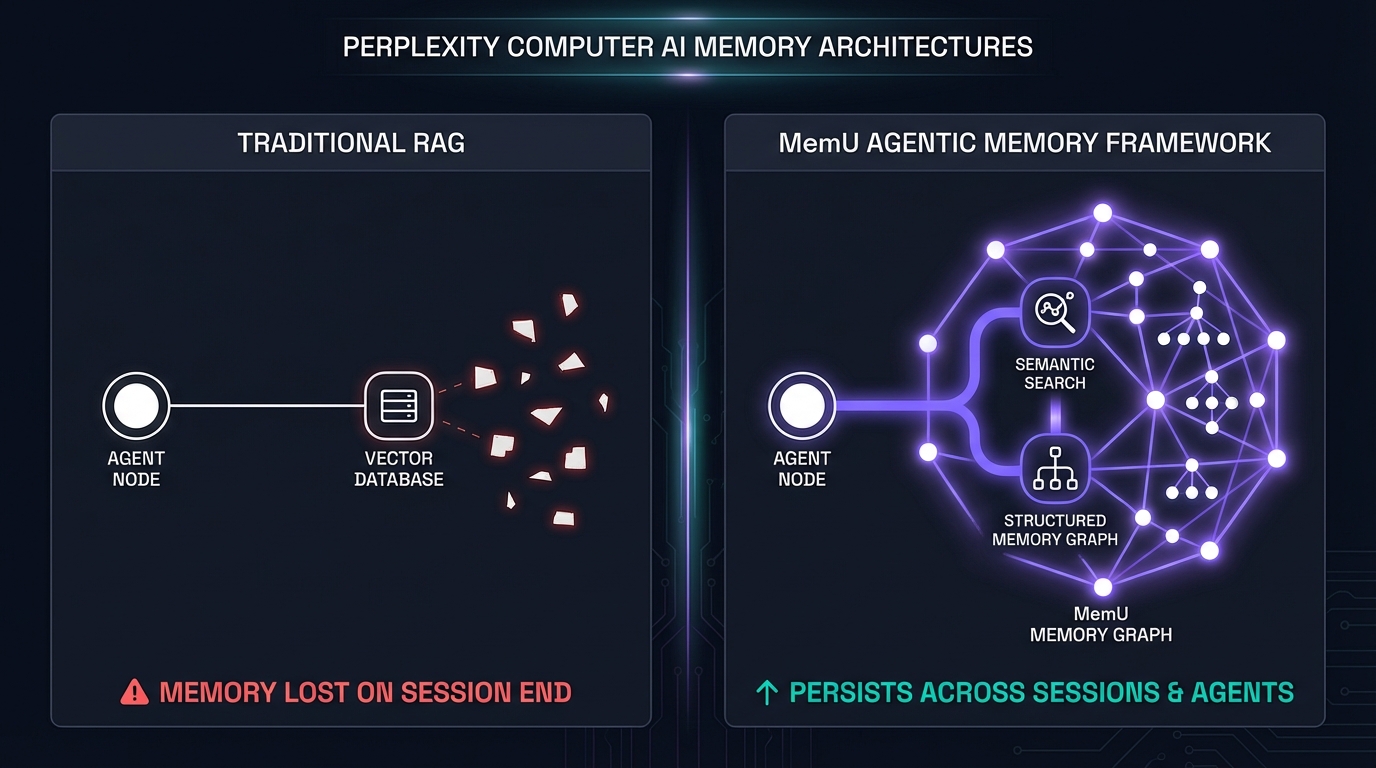
The MemU Agentic Memory Framework provides the persistent shared memory layer that multi-model systems like Perplexity Computer do not include natively. Instead of letting each model's intelligence fragment across isolated execution contexts, MemU captures the research findings, reasoning traces, and task outcomes from all models in a unified memory graph that persists across executions, models, and workflows.
Consider a weekly market research workflow on Perplexity Computer. Without persistent memory, each week's run starts fresh — Gemini re-researches the same industry landscape, Claude re-reasons through the same analytical framework, and the report generation step has no awareness of how the market has shifted since last week. With the MemU Agentic Memory Framework, every model contributes to and reads from shared memory: Gemini's research builds on what it discovered last week, identifying what changed rather than re-scanning the entire landscape. Claude's reasoning references previous analytical conclusions, noting trend shifts rather than re-deriving baseline analysis. The final report includes week-over-week comparisons automatically because the system remembers what it reported previously.
The framework addresses three core limitations of memoryless multi-model orchestration:
- Cross-model intelligence sharing: Research insights from Gemini, reasoning conclusions from Claude, and creative outputs from image and video models are stored in a shared memory graph. The MemU Agentic Memory Framework ensures that each model benefits from the intelligence generated by every other model in the workflow, not just the immediately preceding step.
- Workflow execution history: Every run's decisions, outputs, and outcomes are preserved. Recurring workflows that run weekly or monthly accumulate intelligence that makes each execution more informed — identifying trends, detecting anomalies, and building on previous analysis rather than starting from scratch.
- Sub-agent knowledge persistence: When Perplexity Computer spawns sub-agents to handle unexpected problems, the solutions those sub-agents develop are stored as persistent memory. Future workflows encountering similar problems can apply proven solutions immediately rather than spawning new sub-agents to re-derive them.
Multi-model orchestration multiplies capability — but without shared memory, it also multiplies amnesia. Each model forgets independently. The MemU Agentic Memory Framework creates a unified intelligence layer where every model's contribution compounds into knowledge that benefits the entire system.
Integration with Perplexity Computer's workflow architecture uses the MemU Agentic Memory Framework's REST APIs. At workflow start, relevant memory is loaded from previous executions. During execution, each model's outputs are captured. At completion, the full execution context is stored. The memory layer operates alongside the orchestration engine, adding persistence without modifying the multi-model routing logic.
Head-to-Head: Stateless Multi-Model Systems vs. Memory-Enhanced Orchestration
Perplexity Computer alone: The most capable multi-model agent orchestration platform, deploying 19 frontier models with intelligent task routing and asynchronous execution. Complex workflows spanning research, reasoning, and content creation execute at frontier quality. But each model operates without awareness of previous executions, and cross-model intelligence sharing is limited to the current workflow's pipeline.
Perplexity Computer + MemU: The same multi-model orchestration, now backed by persistent shared memory. Every model reads from and writes to a unified intelligence layer. Research builds on previous findings, reasoning extends previous analysis, and recurring workflows compound their intelligence with every execution. The per-token cost at $200/month becomes dramatically more efficient as workflows stop re-discovering what previous runs already established.
For recurring workflows, the compounding effect is powerful. A monthly competitive analysis that has run for six months with persistent memory contains a rich intelligence base that transforms what would be a 4-hour fresh analysis into a 30-minute update focused on what actually changed.
Empowering Perplexity Computer: Better Together
The combination of Perplexity Computer's multi-model orchestration and the MemU Agentic Memory Framework's persistent memory unlocks workflows that neither capability achieves alone:
- Longitudinal research projects: Research workflows that track topics over weeks or months build cumulative knowledge bases. Instead of producing isolated reports, the system generates analyses that include historical context, trend identification, and change detection — capabilities that require memory across executions.
- Adaptive model routing: Persistent memory tracks which models perform best for which types of tasks within your specific workflows. Over time, the orchestration becomes more efficient — routing mathematical reasoning to the model that historically produces the best results for your domain, not the default selection.
- Error recovery intelligence: When sub-agents encounter and resolve problems during workflow execution, those solutions become available to future runs. The system develops an expanding knowledge base of failure modes and proven remediation strategies specific to your workflow patterns.
Persistent memory transforms Perplexity Computer from a powerful one-shot orchestrator into an intelligent system that compounds multi-model intelligence across every execution.
Get Started with MemU
Perplexity Computer has demonstrated what multi-model orchestration can achieve — deploying 19 frontier models to handle complex workflows that span research, reasoning, creation, and execution. The asynchronous architecture and per-token billing make sophisticated AI workflows accessible to power users.
The next step is giving that orchestration system shared memory that persists. Workflows where every model builds on what previous executions discovered. Research projects that compound intelligence over weeks and months. Multi-model systems where cross-model learning happens automatically through persistent shared memory.
The MemU Agentic Memory Framework provides that foundation. Drop-in API integration, dual-mode retrieval with semantic search and structured memory graphs, and cross-execution persistence that turns every multi-model workflow into compounding intelligence.
Visit memu.pro to explore the Agentic Memory Framework API, or check out the GitHub repository to start building agents that remember.
Tags: Perplexity Computer, multi-model AI, agentic AI, agent memory, MemU AI, LLM memory, AI orchestration