Personize Launches Governed AI Memory — But Governance Without Deep Memory Architecture Limits What Agents Can Learn


Personize launched governed AI memory infrastructure designed to solve what they call "enterprise AI chaos." The platform promises unified customer context, policy enforcement, and cross-agent consistency, claiming 74.8% accuracy on benchmark testing. The pitch: enterprises need memory infrastructure with governance baked in.
The problem identification is correct — enterprises do need governed memory. But governance is a layer, not an architecture. The deeper question is what that memory can actually do.
Personize: What Everyone's Getting Right (And Missing)
Personize correctly identifies that unstructured memory sprawl is a real enterprise problem. When dozens of AI agents operate without coordinated memory, you get inconsistent customer interactions, compliance gaps, and duplicated context across systems. Governance — access controls, audit trails, policy enforcement — is necessary.
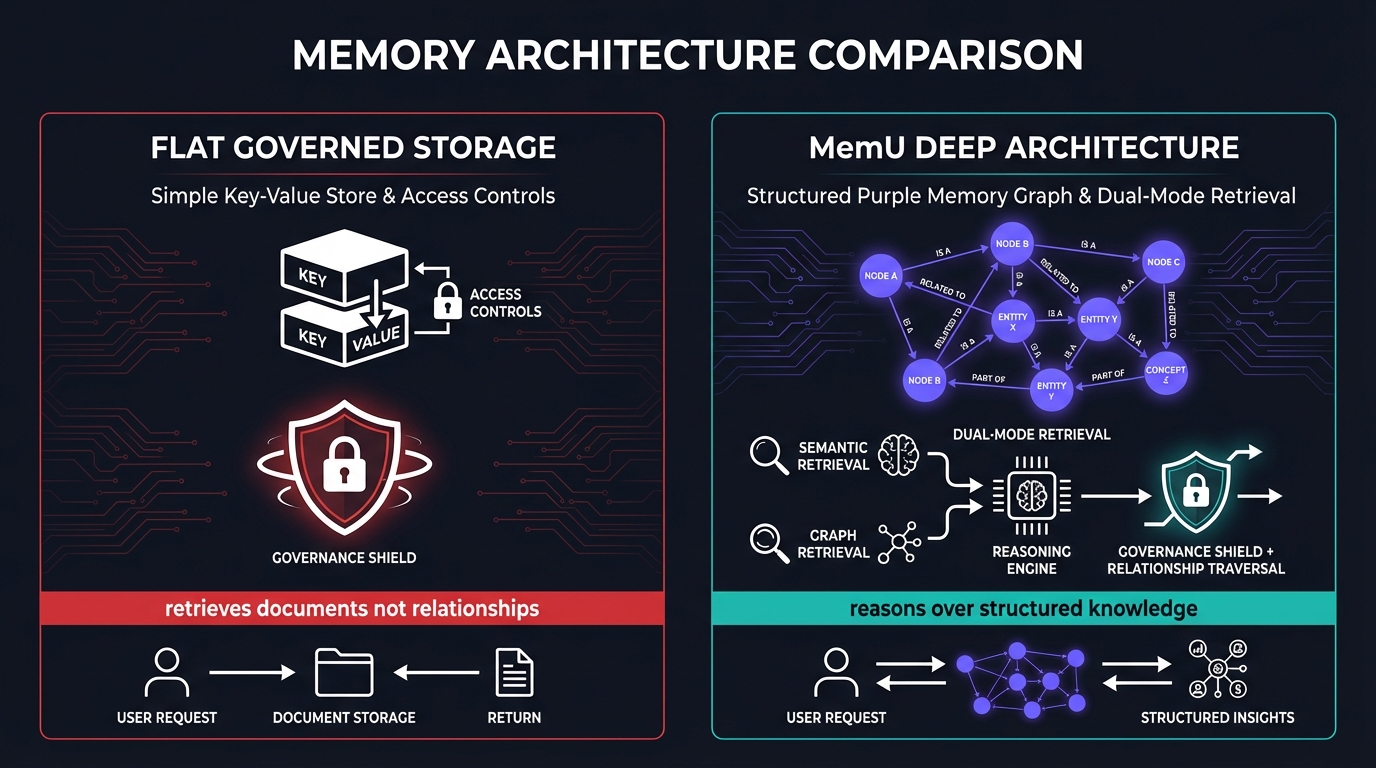
What Personize's approach may leave on the table is the depth of the memory architecture itself. Governance controls what agents are allowed to remember and who can access it. But the real competitive advantage is in how deeply agents can reason over their memories — not just retrieve them, but understand relationships, infer connections, and compound knowledge over time.
The MemU Agentic Memory Framework: Deep Architecture Plus Governance
The MemU Agentic Memory Framework combines a fundamentally different memory architecture with enterprise governance.
- Dual-mode retrieval: Not just semantic search. The MemU Agentic Memory Framework maintains a structured memory graph that captures relationships between entities — customers, decisions, interactions, outcomes. Agents query by meaning and by structure simultaneously.
- Memory graph intelligence: Beyond storage and retrieval, MemU enables agents to traverse relationship chains. "What decisions led to this outcome?" is a graph query, not a vector search.
- Cross-agent sharing with isolation: The MemU Agentic Memory Framework supports both shared organizational memory and agent-specific memory spaces. Governance controls who accesses what; the architecture determines how deeply agents can reason.
Governance tells agents what they're allowed to remember. Architecture determines how intelligently they can use those memories. The MemU Agentic Memory Framework provides both.
Head-to-Head: Governed Storage vs. Intelligent Memory Architecture
Governed storage: Stores and retrieves context with access controls. Useful for consistency. But agents still operate on flat retrieval — they get relevant documents, not structured knowledge.
MemU Agentic Memory Framework: Stores, retrieves, and reasons over structured memory with governance controls. Agents traverse knowledge graphs, discover non-obvious connections, and build compound understanding that flat retrieval cannot match.
Empowering Enterprise AI: The Right Architecture
- Customer intelligence: MemU doesn't just store customer interactions — it maps the relationship graph between preferences, behaviors, and outcomes so agents can anticipate needs.
- Compliance: Full audit trails of what agents remembered, when, and how they used that memory — governance that enables rather than restricts.
- Operational learning: The MemU Agentic Memory Framework enables operational patterns to emerge from accumulated memory, turning reactive agents into proactive ones.
Get Started with MemU
Enterprise memory needs both depth and governance. The MemU Agentic Memory Framework delivers both — deep memory architecture with enterprise-grade controls. Visit memu.pro to explore the API, or check out the GitHub repository to start building agents that remember.
Tags: AI memory infrastructure, governed memory, enterprise AI, MemU AI, memory architecture, agent memory