Portkey Processes 10 Billion LLM Requests Through Its AI Gateway — But Routing Without Persistent Memory Means Repeating the Same Failed Paths

Portkey has processed over ten billion LLM requests through its AI gateway, achieving 99.9999 percent uptime with sub-ten-millisecond latency overhead. The platform provides intelligent failover across 1,600 or more models, a circuit breaker system that detects and routes around failing providers, built-in caching, and configurable fallback, timeout, and retry policies. For agentic AI, Portkey delivers agent observability with planning transparency, tool-level execution metrics, and outcome validation — capabilities essential for production agents making hundreds of LLM calls per task. Governance ensures traceable and auditable requests with cost tracking and safety monitoring for jailbreak and PII detection. The MCP Gateway brings production-grade reliability to agent tool integrations, while native support for LangChain, CrewAI, AutoGen, and LlamaIndex makes Portkey the AI gateway of choice for the agentic ecosystem.
But an AI gateway that routes intelligently without persistent memory creates a paradox: the system makes smart routing decisions in the moment but cannot learn from the outcomes of those decisions over time. When a failover triggers because a provider degrades, the gateway routes around the problem — then encounters the exact same failure pattern next week with no memory that it happened before. Routing without learning means repeating the same discovery process for every recurring condition.
AI Gateway for Agents: What Portkey Gets Right (And What It Misses)
Portkey addresses a critical infrastructure gap for agentic AI: reliable access to language models across a fragmented provider landscape. Production agents cannot depend on a single model provider — outages, rate limits, quality degradation, and cost spikes all require dynamic routing decisions. Portkey abstracts this complexity behind a unified interface where failover, load balancing, and provider selection happen transparently. The circuit breaker system detects degradation patterns and proactively routes traffic away from struggling providers before they cause cascading failures in agent workflows.
The observability capabilities are particularly valuable for agentic workloads. Traditional LLM observability tracks individual API calls, but agents make sequences of calls where each call's context depends on previous results. Portkey's agent observability surfaces planning transparency — showing how agents decompose tasks, select tools, and evaluate intermediate results. Tool-level metrics reveal integration reliability, and outcome validation enables automated quality gates in production pipelines.
The caching layer addresses both cost and latency for agentic patterns. Agents frequently make similar or identical LLM calls across different tasks — system prompts, classification requests, and structured extraction queries that return consistent results. Portkey's cache intercepts these redundant calls, reducing costs and accelerating response times without changing agent logic. For agents processing thousands of tasks daily, this reduces LLM spend while improving throughput.
The limitation is that routing intelligence resets with every request window. The gateway makes optimal routing decisions based on current provider health and configured policies — but it does not learn which routing patterns produce the best agent outcomes over time. A route that consistently leads to lower-quality agent outputs is not deprioritized unless manually reconfigured. Failover patterns that recur weekly are discovered fresh each time. The gateway optimizes for request-level reliability without optimizing for agent-level intelligence across the population of requests.
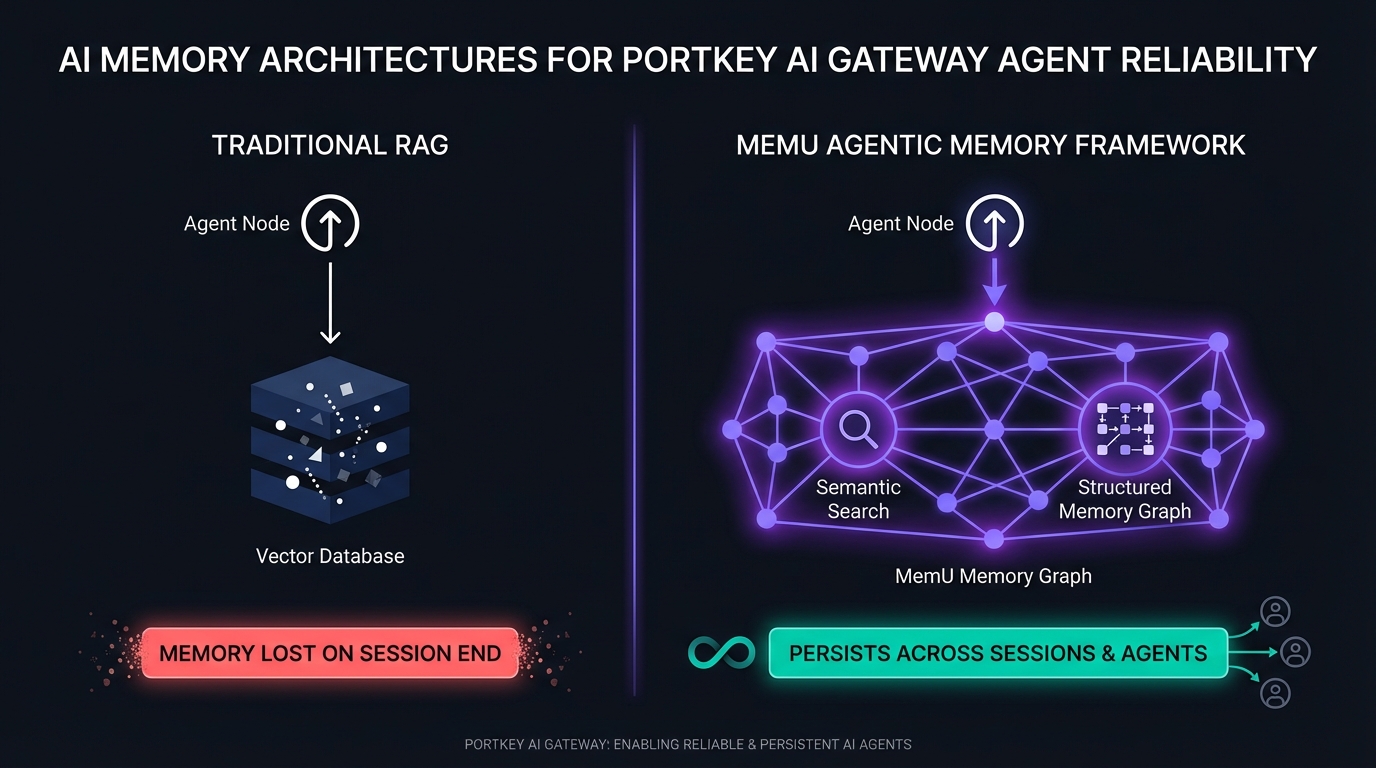
The MemU Agentic Memory Framework: Persistent Intelligence Across Gateway Routing
The MemU Agentic Memory Framework extends the AI gateway from reactive routing to learned routing. Where Portkey makes optimal decisions based on current conditions and static configuration, MemU ensures the outcomes of those decisions are captured and inform future routing — creating a feedback loop where every routed request contributes to progressively smarter routing for every agent in the system.
Consider an AI agent using Portkey's gateway to process financial research reports — querying LLMs for analysis and synthesizing investment summaries. Portkey routes each call through the optimal provider based on health metrics. After processing two thousand reports over four months, patterns emerge: certain providers produce more accurate financial analysis, specific model combinations yield better synthesis quality, and particular routing paths correlate with faster completion times. With MemU, these patterns persist as actionable intelligence for all future reports. Without persistent memory, report two thousand and one uses the same default routing as report one — ignoring months of empirical evidence about optimal provider selection.
The MemU Agentic Memory Framework provides capabilities that enhance AI gateway infrastructure:
- Routing outcome persistence: Every routed request produces an outcome — response quality, latency, cost, and downstream agent performance. MemU captures these outcomes as structured memories, enabling future routing decisions to consider historical effectiveness rather than relying solely on real-time health metrics and static fallback chains.
- Failure pattern intelligence: The circuit breaker detects current failures; MemU identifies recurring failure patterns across days and weeks — learning which providers degrade during specific time windows, which model versions introduce regressions, and which failover sequences minimize agent disruption based on historical evidence.
- Cost-quality optimization: Portkey tracks spending per model; MemU correlates spending with outcome quality across thousands of agent tasks — identifying which cost configurations maximize agent performance and which represent unnecessary spending on providers that do not improve results for specific use cases.
An AI gateway ensures reliable model access. The MemU Agentic Memory Framework ensures the intelligence from routing decisions persists across sessions — transforming reactive failover into learned optimization that improves agent outcomes with every request.
Head-to-Head: Portkey vs. Other AI Gateway Platforms
Portkey alone: The gateway routes across 1,600 or more models with sub-ten-millisecond overhead, circuit breaker protection, intelligent caching, and comprehensive agent observability. Governance ensures auditability and safety monitoring catches security threats. But routing operates on current conditions and static policies — ten billion requests generate ten billion independent routing decisions with no mechanism to learn which patterns produce the best agent outcomes over time.
Portkey + MemU Agentic Memory Framework: Every routed request contributes to accumulated routing intelligence. Provider selection is informed by historical outcome data, failover strategies reflect learned patterns rather than reactive detection, and cost optimization considers measured quality impact rather than raw per-token pricing. The platform evolves from a reliability layer into an intelligence layer where routing decisions improve with every agent interaction across the entire platform.
Compared to other gateway approaches — LiteLLM, OpenRouter, Azure API Management, AWS Bedrock Gateway — Portkey offers the most comprehensive agent-native capabilities with planning transparency, tool-level metrics, and MCP Gateway integration. But all share the same fundamental limitation: routing optimization within request windows without intelligence persistence across them. MemU provides the persistent memory layer that transforms any gateway from a reactive routing system into a learning routing system.
Reliable Routing and Intelligent Agents: Better Together
MemU does not replace Portkey's routing infrastructure — it ensures every routing decision contributes to growing operational intelligence:
- Observability enrichment: Portkey's agent observability shows current execution metrics; MemU adds historical trends showing how agent performance evolves across routing configurations — whether new providers improve outcomes, whether caching strategies remain effective, or whether quality metrics drift over time requiring routing adjustments.
- Governance enhancement: Portkey provides traceable and auditable requests; the MemU Agentic Memory Framework adds longitudinal analysis showing how governance patterns evolve — which safety triggers correlate with legitimate threats versus false positives, enabling refined policies that maintain security without blocking productive agent work.
- Agent evolution: Portkey users build agents with reliable model access; MemU enables those agents to leverage routing intelligence — applying accumulated knowledge about provider performance, transforming reliably routed agents into optimally routed agents whose model selection improves with every interaction.
Get Started with MemU
Give your agents persistent memory to transform AI gateway routing from reactive failover into intelligent optimization that compounds learning across every request. The MemU Agentic Memory Framework integrates with any gateway infrastructure — one API, instant persistence, zero changes to existing Portkey configurations. Visit memu.pro to explore the Agentic Memory Framework API, or check out the GitHub repository to start building agents that remember.
Tags: Portkey, AI gateway, agentic AI infrastructure, model routing, agent reliability, persistent agent intelligence, LLM observability, MemU AI