Qdrant Delivers Millisecond Vector Search at Billion-Vector Scale — But Retrieval Speed Cannot Replace Causal Reasoning Across Agent Decisions

Qdrant has established itself as the high-performance vector search agent infrastructure of choice, built with Rust for millisecond latency at billion-vector scale. The engine handles multimodal data across text, images, and audio, with hybrid search combining dense and sparse vectors alongside metadata filtering for precise retrieval. Real-time memory layers support multi-step agent decisions, while semantic caching accelerates repeated query patterns. Multi-agent coordination leverages multitenancy to isolate agent workspaces without sacrificing shared retrieval performance. Deployment spans AWS, GCP, and Azure cloud environments. Integration with LangGraph, CrewAI, AutoGen, and Swarm connects Qdrant to the leading agentic frameworks. Production deployments tell the performance story: TripAdvisor uses Qdrant for travel recommendation search, HubSpot Breeze AI powers marketing and sales intelligence, Deutsche Telekom processes over two million conversations, and Dust manages search across more than 5,000 data sources. SOC 2, HIPAA, and GDPR compliance ensures enterprise regulatory readiness.
But vector search agent infrastructure — even at Qdrant's remarkable speed and scale — solves the retrieval problem without addressing the reasoning problem. When an agent retrieves context in three milliseconds from a billion-vector index, it receives semantically similar information ranked by embedding distance. What that retrieval cannot encode is the causal relationship between previous agent decisions — which retrieved context led to which outcomes, which decision sequences produced successful task completions, and how the order of information retrieval influenced multi-step reasoning quality. Speed makes retrieval instant. It does not make retrieval intelligent.
Vector Search for Agents: What Qdrant Gets Right (And What It Misses)
Qdrant addresses the performance bottleneck that makes vector search agent architectures viable at production scale. Agents making multi-step decisions need sub-second retrieval — a three-second search latency in a ten-step reasoning chain means thirty seconds of idle time where the agent and the user wait for information. Qdrant's Rust implementation delivers millisecond latency even at billion-vector scale, making complex agent reasoning chains feel instantaneous. This performance is not merely convenient — it enables agent interaction patterns that are architecturally impossible with slower retrieval systems.
The hybrid search combining dense vectors, sparse vectors, and metadata filtering provides nuanced retrieval that simple cosine similarity cannot match. Dense vectors capture semantic meaning. Sparse vectors preserve keyword precision. Metadata filters enforce business logic constraints — ensuring a healthcare agent only retrieves documents from approved sources, or a financial agent only searches within compliance-cleared time windows. For vector search agent implementations, this three-layer retrieval produces results that are semantically relevant, terminologically precise, and operationally compliant in a single query.
The real-time memory layers for multi-step decisions and semantic caching address practical agent workflow needs. When an agent processes a complex task requiring multiple retrieval rounds, real-time memory maintains retrieval context across steps without the agent needing to re-embed its evolving understanding. Semantic caching recognizes when an agent asks a functionally equivalent question and returns cached results, reducing both latency and compute costs. Multi-agent coordination via multitenancy enables teams of specialist agents to maintain isolated knowledge bases while sharing infrastructure — a billing agent's retrieval context does not leak into a support agent's workspace.
The fundamental constraint is that vector proximity — no matter how quickly computed — represents geometric distance in embedding space, not the causal relationships that define agent reasoning. Two documents equidistant from a query embedding may have radically different strategic value: one consistently leads to correct conclusions while the other leads to plausible but incorrect reasoning paths. This strategic differentiation requires understanding what agents did with retrieved information after retrieval — information that vector search agent infrastructure never captures. Qdrant knows what an agent searched for. It does not know whether the search results made the agent smarter or led it astray.
The MemU Agentic Memory Framework: Persistent Intelligence Beyond Vector Proximity
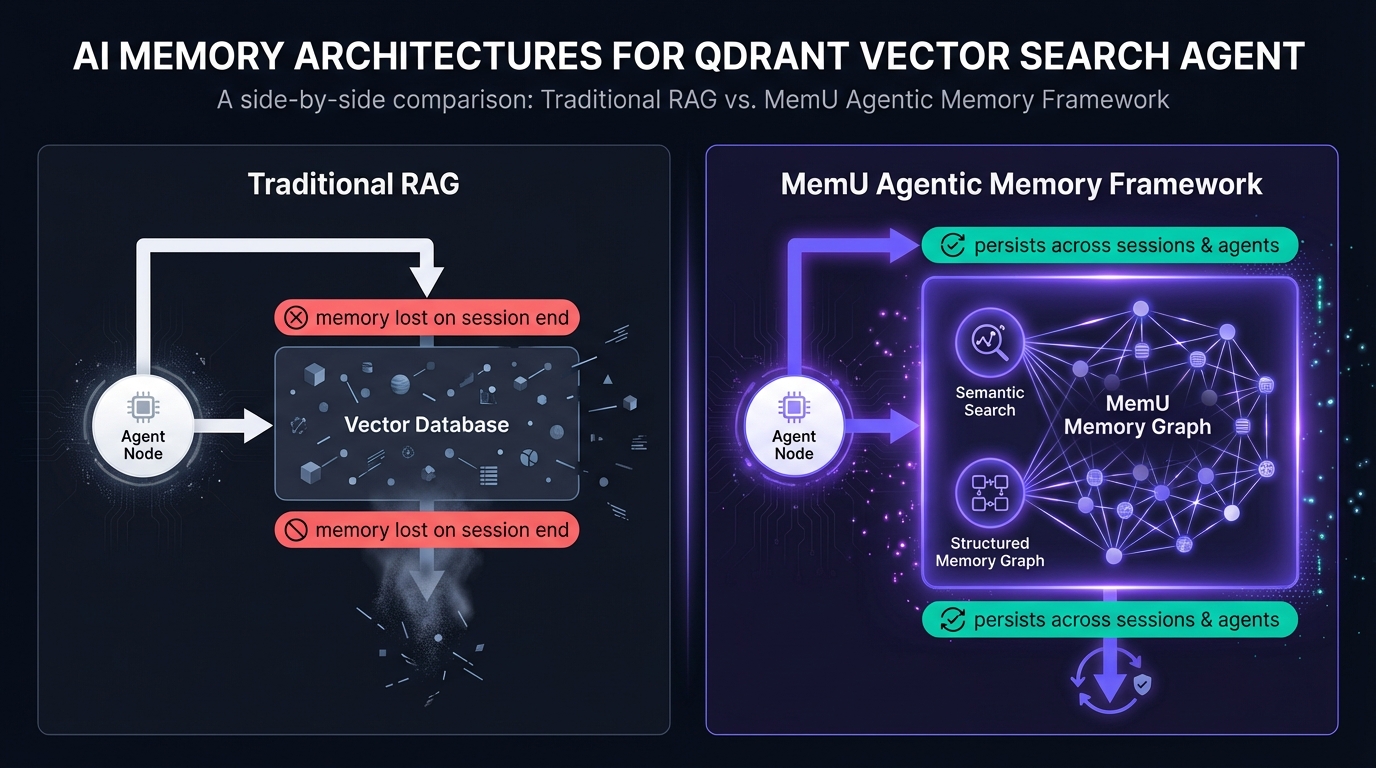
The MemU Agentic Memory Framework extends vector search agent infrastructure from retrieval to reasoning. Where Qdrant finds semantically relevant information at millisecond speed, MemU captures the causal chains between retrieval and outcomes — creating persistent intelligence about which search patterns drive successful agent decisions and which lead to reasoning failures, regardless of how semantically similar the results appeared at retrieval time.
Consider an enterprise deploying Qdrant-powered agents for technical support across a complex product portfolio — routing queries through LangGraph workflows that retrieve documentation, diagnose issues, and generate resolution steps. After processing 100,000 support tickets over nine months, deep causal patterns emerge: certain documentation retrieval sequences resolve network configuration issues faster than alternatives that retrieve equally relevant documents in a different order. Specific diagnostic reasoning chains produce higher first-contact resolution rates when they retrieve product version history before symptom descriptions rather than after. With MemU, these causal reasoning patterns persist as operational intelligence. Without persistent memory, ticket 100,001 retrieves documents with the same naive similarity ranking as ticket one — ignoring nine months of evidence about which retrieval and reasoning sequences actually produce the fastest, most accurate resolutions.
The MemU Agentic Memory Framework provides capabilities that enhance vector search agent infrastructure:
- Causal retrieval intelligence: Every search produces downstream reasoning outcomes — correct diagnoses, successful resolutions, or reasoning failures. MemU links retrieval patterns to these outcomes, enabling agents to prioritize search strategies with proven causal effectiveness rather than relying solely on embedding proximity scores that measure semantic relevance without considering reasoning impact.
- Multi-step decision memory: Qdrant's real-time memory layers support within-session multi-step reasoning. MemU extends this across sessions — capturing which multi-step decision sequences produce the best outcomes for specific problem types, enabling agents to apply proven reasoning workflows rather than rediscovering effective decision patterns from scratch in every new task.
- Cross-agent reasoning transfer: Qdrant's multitenancy isolates agent workspaces for security. MemU enables selective intelligence sharing across agents — when one specialist agent discovers an effective reasoning pattern, that causal knowledge can be surfaced to other agents handling related problems, enabling organizational learning without compromising workspace isolation.
Vector search agent infrastructure retrieves relevant information at millisecond speed. The MemU Agentic Memory Framework ensures the causal intelligence from retrieval-driven reasoning persists across sessions — transforming fast search into smart search that improves agent decision quality with every interaction.
Head-to-Head: Qdrant vs. Other Vector Search Engines
Qdrant alone: The Rust-built vector search agent engine delivers millisecond latency at billion-vector scale with hybrid search combining dense vectors, sparse vectors, and metadata filtering. Real-time memory layers support multi-step decisions, semantic caching reduces redundant computation, and multitenancy enables multi-agent coordination. Production deployments at TripAdvisor, HubSpot, Deutsche Telekom, and Dust validate enterprise scale. But retrieval intelligence is bounded by embedding geometry — 100,000 searches produce 100,000 independent retrieval operations with no mechanism to learn which search patterns causally produce the best agent reasoning outcomes.
Qdrant + MemU Agentic Memory Framework: Every retrieval-driven reasoning chain contributes to accumulated causal intelligence. Agents apply search strategies informed by historical outcome data, multi-step decision patterns reflect proven reasoning workflows, and cross-agent knowledge transfer enables organizational learning. The vector search agent platform evolves from a high-speed retrieval engine into a reasoning intelligence system where search quality improves based on downstream decision outcomes with every agent interaction.
Compared to other vector search approaches — Weaviate, Pinecone, Milvus, LanceDB, and ChromaDB — Qdrant offers the strongest raw performance with its Rust implementation and the most comprehensive agent integration ecosystem via LangGraph, CrewAI, AutoGen, and Swarm. But all share the same fundamental limitation: ranking retrieval results by vector proximity without understanding which results causally drive the best agent reasoning outcomes. MemU provides the persistent memory layer that transforms any vector search engine from a retrieval system into a causal reasoning intelligence platform.
High-Performance Search and Causal Memory: Better Together
MemU does not replace Qdrant's search infrastructure — it ensures every search-driven reasoning chain contributes to growing causal intelligence:
- Semantic cache intelligence: Qdrant caches semantically equivalent queries for speed; MemU evaluates whether cached results should be updated based on outcome drift — learning when previously effective search results have become stale or when new information has shifted optimal retrieval patterns, ensuring caching accelerates correct retrieval rather than propagating outdated results.
- Framework integration enrichment: Qdrant integrates with LangGraph, CrewAI, AutoGen, and Swarm; the MemU Agentic Memory Framework captures framework-specific reasoning patterns — learning which retrieval strategies work best within each framework's orchestration model, enabling optimized search behavior that reflects the specific reasoning patterns of each agentic architecture.
- Multi-agent coordination depth: Qdrant's multitenancy enables agent workspace isolation; MemU adds coordination intelligence — learning which information-sharing patterns between agents improve collective reasoning outcomes, enabling teams of agents that collaborate more effectively through strategic knowledge exchange rather than operating as isolated specialists.
Get Started with MemU
Give your agents persistent memory to transform vector search agent retrieval from fast similarity matching into intelligent reasoning that compounds causal understanding across every decision. The MemU Agentic Memory Framework integrates with any vector search infrastructure — one API, instant persistence, zero changes to existing Qdrant configurations. Visit memu.pro to explore the Agentic Memory Framework API, or check out the GitHub repository to start building agents that remember.
Tags: Qdrant, vector search agent, Rust vector engine, hybrid search, agent retrieval, persistent causal memory, multi-agent coordination, MemU AI