Qwen 3.5 Rivals Claude Opus With 397B Parameters Under Apache 2.0 — Open-Source Multimodal AI Still Forgets Between Sessions


Alibaba's Qwen 3.5 just redefined what open-source AI can do. The flagship 397B-parameter model uses a sparse Mixture-of-Experts architecture with only 17 billion active parameters per forward pass, delivering 8-19x faster inference than its predecessor while matching Claude Opus 4.5 on key benchmarks. It scores 87.8 on MMLU-Pro, 76.4 on SWE-Bench Verified, and 78.6 on BrowseComp. The model is natively multimodal — text, images, audio, video — supports 201 languages, handles 1 million token contexts, and runs on consumer GPUs with 4-bit quantization. All under Apache 2.0.
The architecture is innovative: Gated Delta Networks provide linear attention that dramatically reduces memory requirements for long contexts. Early text-vision fusion during training produces superior multimodal understanding compared to models that bolt on vision capabilities after text training. The smaller variants — 35B, 122B, and 27B — make frontier-competitive AI accessible on hardware that costs a fraction of cloud API pricing.
But open-source accessibility doesn't solve the memory problem: Qwen 3.5 can process a million tokens in a single session, yet it remembers nothing from the session before.
Why Qwen 3.5 Changes the Open-Source Landscape
The performance gap between open-source and proprietary models has been shrinking for two years. Qwen 3.5 closes it further. On IFBench (instruction following), it outperforms GPT-5.2 at 76.5 versus 75.4. On MathVision, it scores 88.6 compared to GPT-5.2's 83.0. On MultiChallenge, it leads the comparison at 67.6. These aren't "close enough" results — on multiple benchmarks, the open-source model is simply better.
The 35B variant running on a 32GB consumer GPU with 4-bit quantization represents a democratization milestone. Developers in regions without reliable cloud access, organizations with data sovereignty requirements, and researchers with limited budgets can now access multimodal AI capabilities that were exclusively available through API subscriptions six months ago. The Apache 2.0 license means commercial deployment with no restrictions.
For the open-source AI ecosystem, Qwen 3.5 validates the Mixture-of-Experts approach: massive parameter counts for knowledge capacity, sparse activation for efficiency, and careful architecture design to match or exceed proprietary alternatives. The 397B total with 17B active creates a model that knows as much as the largest models but runs at the cost of a mid-size one.
Million-Token Context vs. Cross-Session Memory
Qwen 3.5's million-token context window is its most impressive technical feature. It can process entire codebases, complete books, or hours of conversation in a single session. The Gated Delta Networks architecture makes this computationally feasible on reasonable hardware. For single-session tasks, the context length eliminates the truncation and summarization that plagued earlier models.
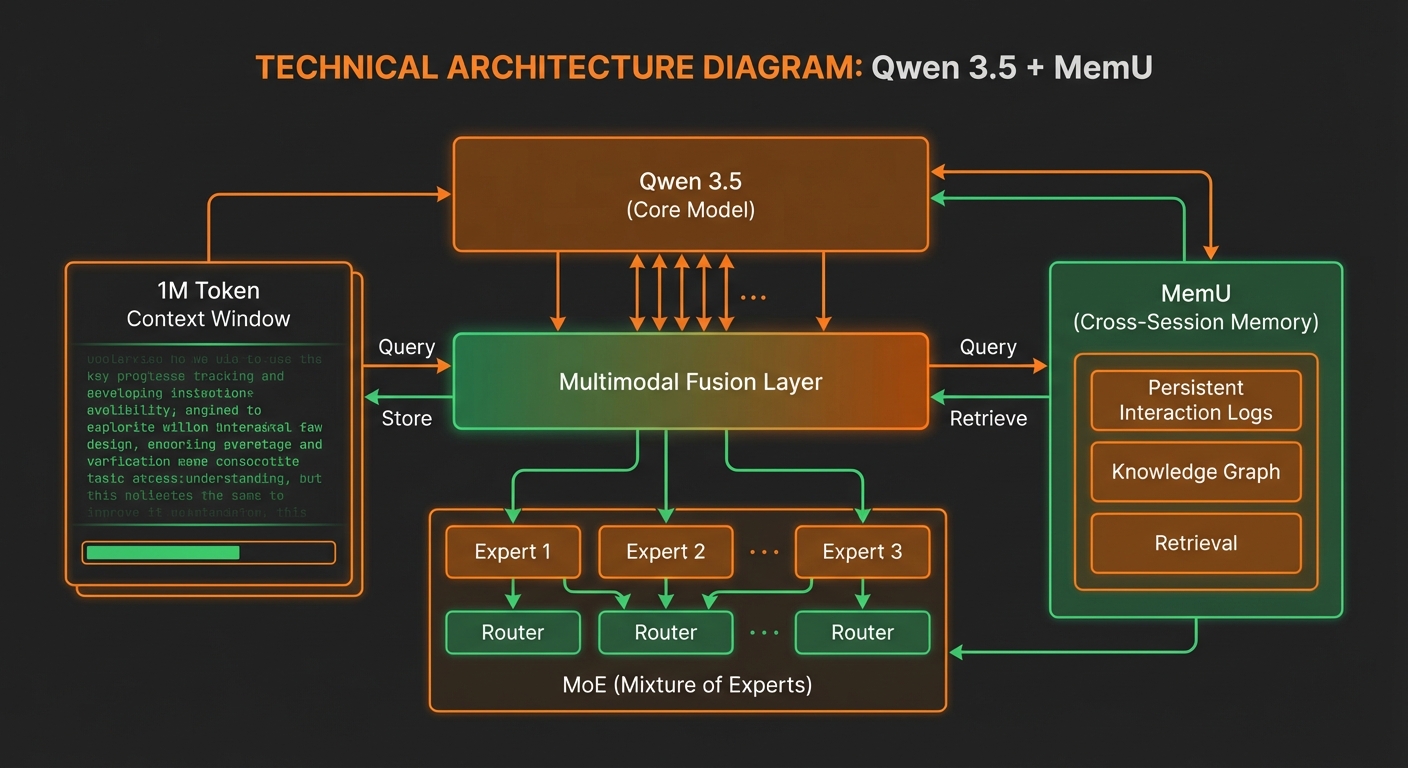
But context length and memory are fundamentally different. A million-token context window is a larger scratchpad for the current session. When that session ends, the scratchpad is wiped. Tomorrow's session starts with a blank million-token window, regardless of what was processed yesterday. For users who interact with Qwen 3.5 daily — developers working on projects, researchers analyzing data, teams collaborating through AI — the lack of cross-session memory means repeating context setup every time.
The multimodal capabilities amplify the loss. A session that analyzed images, processed audio, and synthesized video insights generated rich multimodal understanding — understanding that's gone when the session ends. The next session with the same images starts from scratch, re-analyzing what was already understood.
How MemU Adds Memory to Open-Source Models
MemU provides persistent memory that works with any model, including self-hosted Qwen 3.5 deployments. Every session's interactions — text analyses, multimodal insights, user preferences — are persisted to MemU. Before each new session, relevant memories are retrieved, filling the context window with accumulated knowledge rather than requiring manual re-establishment.
For self-hosted deployments, MemU runs alongside Qwen 3.5 on the same infrastructure. The memory operations consume negligible compute compared to model inference. The result: an open-source, self-hosted AI system that costs nothing in API fees, runs on consumer hardware, and gets smarter with every session.
Alibaba democratized AI capabilities. MemU democratizes AI memory. Together, they deliver the full promise of open-source AI.
Get Started
Give your open-source AI persistent memory. Explore MemU at memu.pro and on GitHub.