Red Hat AI Enterprise Spans Metal to Agents — The Full Stack Still Missing a Memory Layer

Red Hat just launched Red Hat AI Enterprise — a unified platform that spans from GPU hardware to AI agents, deployed on OpenShift. Co-engineered with NVIDIA, the platform delivers high-performance inference via Red Hat's vLLM engine, model tuning, agent deployment, and lifecycle management across any environment. It's the most complete enterprise AI infrastructure stack available, designed to rescue organizations from the "pilot purgatory" that traps 94% of AI deployments.
The timing is strategic: enterprises have spent two years experimenting with AI but struggling to reach production scale. Red Hat AI Enterprise provides the standardized infrastructure that moves AI from isolated proof-of-concepts to enterprise-grade systems. Pre-configured models from IBM Granite and NVIDIA Nemotron are available out of the box. The familiar Kubernetes-based tooling means existing DevOps teams can manage AI workloads without learning entirely new systems.
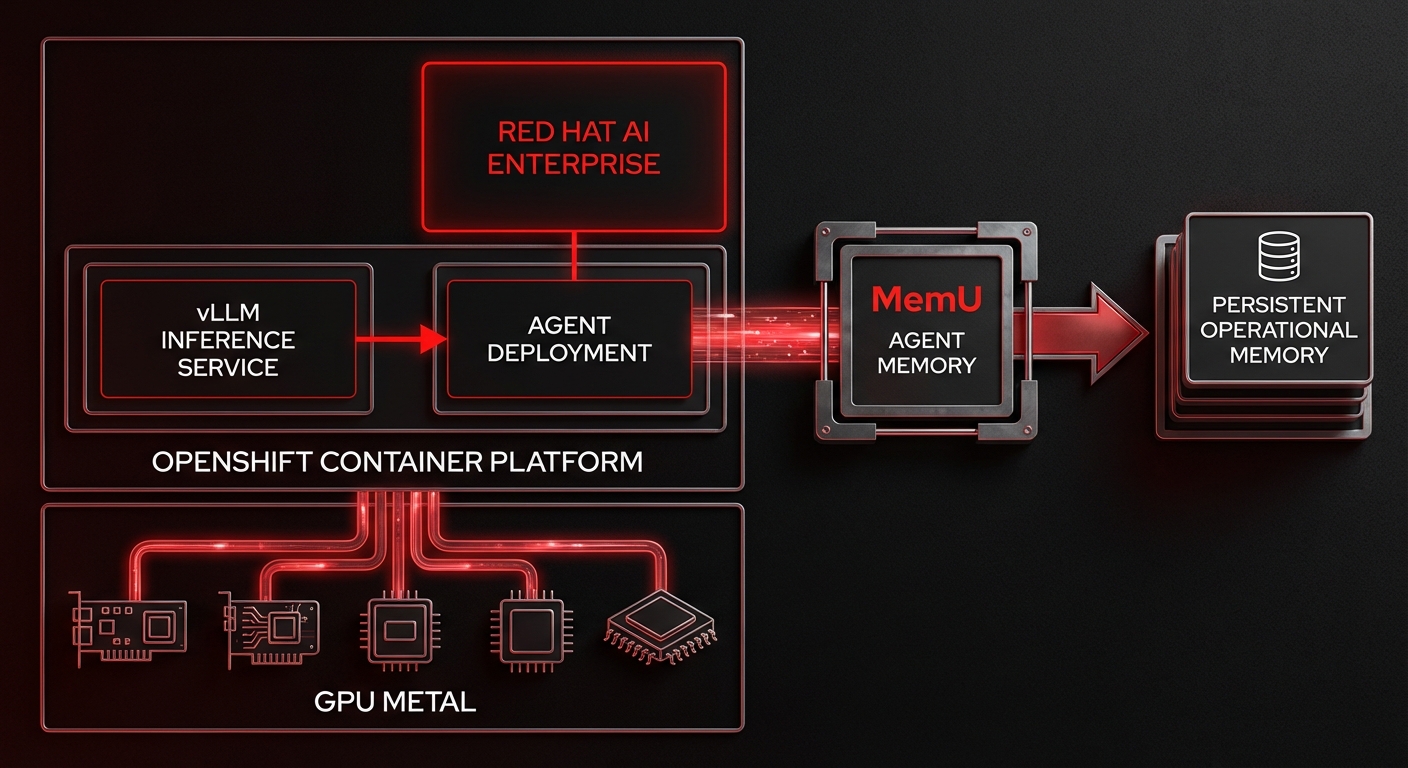
Red Hat built the stack from metal to agents. But there's a gap between the agent deployment layer and production effectiveness: agents running on enterprise infrastructure need persistent memory to operate as institutional knowledge workers, not just stateless inference endpoints.
What Metal-to-Agent Actually Means
Red Hat's stack covers every layer of AI infrastructure. At the metal layer: GPU-accelerated hardware optimized for AI workloads. At the platform layer: OpenShift provides container orchestration, scaling, and resource management. At the inference layer: vLLM delivers high-throughput model serving. At the model layer: pre-configured foundation models and fine-tuning capabilities. At the agent layer: deployment and management of AI agents that interact with enterprise systems.
Each layer addresses a real enterprise pain point. The metal layer eliminates GPU procurement complexity. The platform layer provides the operational discipline that enterprises expect. The inference layer delivers performance at scale. The model layer reduces time-to-value with pre-configured options. The agent layer makes AI actionable rather than merely conversational.
But the stack treats agents as stateless services: deploy, serve requests, return responses. This is the traditional web services model applied to AI — and it inherits the same limitation. Web services are stateless by design because they serve independent requests. AI agents are fundamentally different: they build understanding over time, and that understanding should persist.
Enterprise AI's Real Production Barrier
The pilot purgatory problem isn't primarily about infrastructure — it's about value delivery. Organizations can deploy models on OpenShift. They can serve inference at scale with vLLM. They can even build agent pipelines. What they can't do is make those agents effective enough to justify enterprise-scale investment. And agent effectiveness depends on accumulated knowledge.
Consider an enterprise deploying customer service agents on Red Hat AI Enterprise. The infrastructure is production-grade: highly available, scalable, observable. But the agents themselves start every interaction with zero context about the customer, the organization's service patterns, or the resolution strategies that have worked in the past. The infrastructure is enterprise-ready. The agent intelligence is pilot-grade.
This gap explains why 94% of enterprises fail to achieve meaningful ROI from AI. It's not that the infrastructure doesn't work — Red Hat's engineering ensures it does. It's that stateless agents on excellent infrastructure still deliver stateless results. The infrastructure investment is necessary but not sufficient. Memory is the missing layer that transforms infrastructure investment into business value.
Adding Memory to the Enterprise Stack
MemU integrates as a memory layer in the enterprise AI stack — sitting between the agent deployment layer and the business logic. Agents running on Red Hat AI Enterprise write experiences to MemU: customer interactions, resolution patterns, discovered workflows. Before each new interaction, agents retrieve relevant memories, bringing accumulated knowledge to every request.
The deployment model aligns with enterprise expectations. MemU runs as a service alongside agent workloads on OpenShift, managed through the same lifecycle tools. The operational overhead is minimal — memory operations consume a fraction of the compute that inference requires. But the impact on agent effectiveness is transformational: agents that remember become institutional knowledge workers rather than sophisticated calculators.
Red Hat built the infrastructure. MemU provides the memory. Together, they deliver enterprise AI that justifies the investment — agents that improve over time, accumulate organizational knowledge, and deliver compounding returns.
Get Started
Add persistent memory to your enterprise AI infrastructure. Explore MemU at memu.pro and on GitHub.