Reflection AI Raises $130M for Fully Autonomous Coding — Autonomous Agents Without Accumulated Experience


Reflection AI emerged this week with $130 million in funding — $25M seed led by Sequoia Capital and $105M Series A led by Lightspeed. Founded by former Google DeepMind researchers, Reflection is building fully autonomous coding systems that read, write, test, and deploy code with minimal developer intervention. The ambition is clear: move beyond AI-assisted coding to AI-autonomous coding.
Full autonomy is the right direction. But there is a foundational capability that autonomous agents depend on — memory.
Reflection AI: What Everyone's Getting Right (And Missing)
Reflection's thesis is sound. Most AI coding tools still operate as sophisticated autocomplete — the developer drives, the AI suggests. Reflection wants the agent to own entire tasks end-to-end: understand the requirement, navigate the codebase, write the implementation, create tests, and deploy. The DeepMind pedigree suggests they have the technical depth to pull it off.
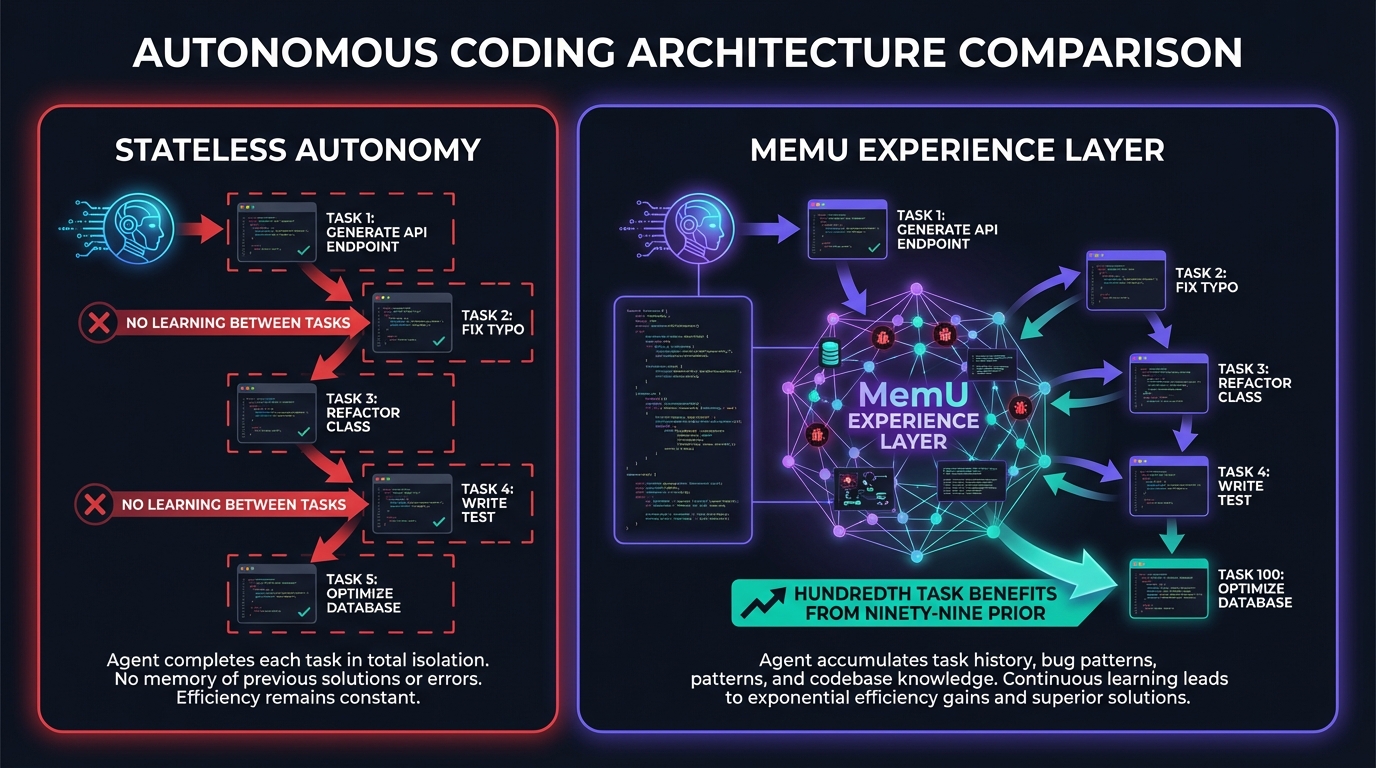
The gap is in learning continuity. An autonomous agent that completes a hundred tasks in your codebase but starts each one with no memory of the previous ninety-nine is autonomous but not experienced. Autonomy without accumulated experience is the difference between a senior engineer and a brilliant intern who resets every morning.
Devin, Codex, and other autonomous coding tools face the same constraint. Each task is an independent execution, not a step in a learning journey.
The MemU Agentic Memory Framework: Experience for Autonomous Agents
The MemU Agentic Memory Framework gives autonomous coding agents the experience layer they need.
An autonomous agent using MemU doesn't just complete ticket #147 — it recalls that tickets #23, #67, and #112 touched the same service, remembers the architectural constraints it discovered, and applies those lessons. The hundredth task executes with the accumulated wisdom of ninety-nine prior completions.
- Task memory: Every completed task — what worked, what failed, what the developer changed — becomes a memory entry that informs future autonomous work.
- Codebase learning: The MemU Agentic Memory Framework stores discovered patterns, hidden dependencies, and architectural decisions as structured knowledge, not just code embeddings.
- Deployment history: Memory of past deployments, rollbacks, and production incidents so autonomous deployment decisions are informed by operational reality.
Autonomous execution is a capability. Accumulated experience is an asset. The MemU Agentic Memory Framework turns capability into a compounding asset for autonomous coding agents.
Head-to-Head: Stateless Autonomy vs. MemU-Backed Autonomy
Stateless autonomous agent: Reads codebase per task. Capable but amnesiac. The hundredth task gets the same context exploration as the first. Repeats mistakes. Re-discovers constraints.
MemU-backed autonomous agent: Reads codebase plus accumulated experience. Recalls past decisions, known pitfalls, and team preferences. Each task is faster and more accurate than the last.
Empowering Reflection: Better Together
- Requirement understanding: Reflection parses the task; MemU provides context about how similar requirements were implemented before and what edge cases emerged.
- Code quality: Reflection writes the code; MemU flags patterns that caused bugs in previous tasks and suggests alternatives based on team experience.
- Progressive autonomy: As MemU accumulates more project experience, the autonomous agent can handle increasingly complex tasks with less human oversight.
Get Started with MemU
Make your autonomous coding agents progressively smarter. The MemU Agentic Memory Framework adds experience memory that compounds with every task. Visit memu.pro to explore the API, or check out the GitHub repository to start building agents that remember.
Tags: Reflection AI, autonomous coding, AI agents, developer tools, MemU AI, coding agent memory