Relevance AI Powers Self-Driving Agent Workforces — But Without Persistent Memory, Agents at Level 4 Autonomy Cannot Truly Self-Optimize


Relevance AI has built one of the most ambitious platforms in the agentic AI space: a no-code workforce builder that lets organizations deploy multi-agent teams on a visual canvas. The Workforce Builder provides drag-and-drop agent creation, trigger-based workflows, and full orchestration control. The platform defines a four-level adoption framework — L1 Assisted, L2 Copilot, L3 Autopilot, and L4 Self-Driving — giving organizations a clear path from human-supervised agents to fully autonomous workforces. With SOC 2 Type II certification, GDPR compliance, and enterprise-grade SSO and RBAC, the platform targets the most demanding deployments. Over 1,000 app connections, pre-built agents for BDR, research, inbound qualification, and customer support, and enterprise customers including Canva, Autodesk, KPMG, and Lightspeed validate production readiness.
But there is a fundamental tension at the heart of the self-driving vision. The platform defines L4 as "Self-Driving" — agents that operate autonomously, optimize their own workflows, and improve without human intervention. Self-optimization requires memory. An agent that cannot remember what it tried, what worked, and what failed cannot meaningfully optimize itself. Without persistent memory, L4 is a label rather than a capability.
Relevance AI: What the Workforce Builder Gets Right (And What Self-Driving Agents Need)
The visual workforce canvas is a genuinely powerful abstraction. Drag-and-drop agent placement, trigger configuration, and inter-agent workflow definition on a single canvas gives teams a clear view of their entire agent workforce. Version control and monitoring dashboards bring software engineering practices to agent management — critical for enterprise deployments where auditability and rollback capability are non-negotiable. Single-tenant and private cloud deployment options address data sovereignty requirements for regulated industries.
The four-level autonomy framework provides a practical adoption path. L1 Assisted agents answer questions with human oversight. L2 Copilot agents draft responses for review. L3 Autopilot agents execute independently with exception handling. L4 Self-Driving agents operate fully autonomously, optimizing workflows without human intervention. This graduated approach lets organizations increase autonomy as trust builds. The company has studied enterprise buyer psychology alongside agent architecture.
What the platform does not provide is the memory infrastructure that L4 autonomy demands. Self-driving agents need to remember which workflow configurations produced better outcomes, which prospect segments responded to which approaches, and which exceptions resolved without escalation. Without persistent memory, an agent at L4 executes autonomously but cannot learn from its own execution history. It operates independently without operating intelligently — self-driving without self-optimizing.
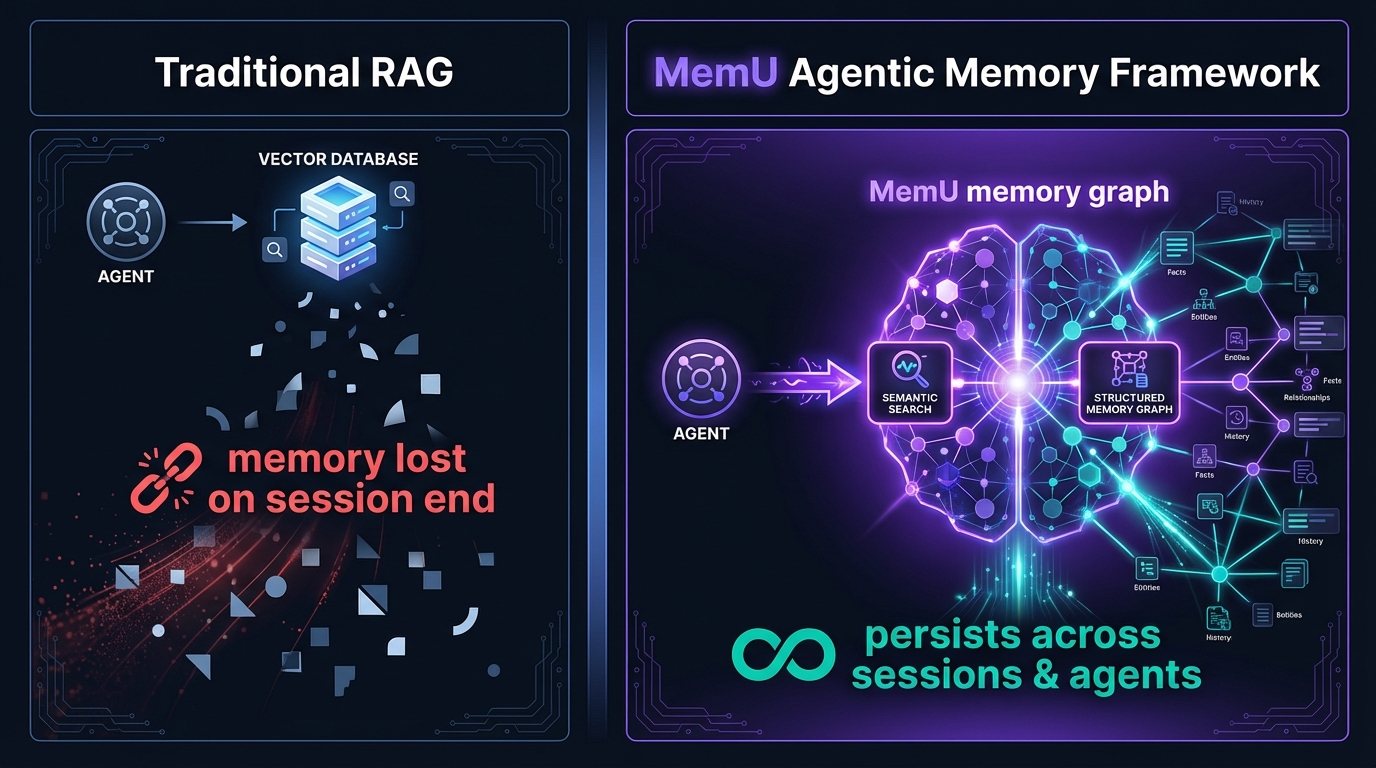
The MemU Agentic Memory Framework: Persistent Intelligence for Self-Driving Agent Workforces
The MemU Agentic Memory Framework provides the persistent memory layer that self-driving agent workforces require to fulfill their autonomy promise. Instead of treating each execution cycle as independent, MemU captures workflow outcomes, optimization decisions, inter-agent communication patterns, and performance insights in a structured memory graph that persists across sessions and deployment environments.
Consider an agent workforce managing inbound lead qualification. The BDR agent receives leads, the research agent enriches them, the qualification agent scores and routes them. Without persistent memory, each agent performs effectively in isolation — but the workforce cannot learn that leads from a specific channel require different qualification criteria, or that one data source produces higher-quality scores than another. With the MemU Agentic Memory Framework, those cross-agent patterns are captured. The BDR agent adjusts handling based on channel patterns, the research agent prioritizes data sources that historically produced better outcomes, and the qualification agent refines scoring based on downstream conversion data.
The framework addresses three critical requirements for true L4 autonomy:
- Execution memory: Every workflow execution — inputs, outputs, timing, outcomes — is stored persistently. L4 agents analyze their own performance history to identify optimization opportunities rather than executing the same configuration repeatedly.
- Cross-agent learning: Multi-agent workforces produce emergent intelligence no single agent possesses. The MemU Agentic Memory Framework captures inter-agent patterns and cross-workflow performance data, enabling workforce-level optimization.
- Self-correction persistence: When a self-driving agent identifies an error pattern and corrects its approach, that correction must persist. Without persistent memory, self-corrections evaporate on restart — the agent re-discovers and re-fixes the same issues in a perpetual loop.
Self-driving requires more than autonomous execution — it requires autonomous learning from accumulated experience. The MemU Agentic Memory Framework gives agent workforces the persistent intelligence to actually self-optimize rather than merely self-execute.
Integration with Relevance AI workforces uses MemU's REST APIs. Before each execution, the agent queries persistent memory for relevant history and learned optimizations. After execution, outcomes and new patterns are stored. The MemU Agentic Memory Framework supports both semantic search and structured graph queries — critical for the flexible reasoning that L4 autonomy demands.
Head-to-Head: Autonomous Execution vs. Autonomous Learning
Relevance AI alone: Powerful no-code workforce builder with visual canvas, four-level autonomy, enterprise-grade security, and 1,000+ app connections. Pre-built agents cover BDR, research, qualification, and support. L4 agents execute autonomously. But without persistent memory, they cannot learn from execution history — self-driving without self-optimizing.
Relevance AI + MemU: The same workforce builder with persistent intelligence across the entire agent workforce. L4 agents genuinely self-optimize based on accumulated execution history. Cross-agent learning enables workforce-level intelligence emerging from thousands of coordinated interactions.
For enterprise customers deploying at scale — organizations like Canva, Autodesk, and KPMG — persistent memory transforms the L4 promise from aspirational to operational. Self-driving agents that accumulate intelligence deliver compounding returns on the workforce investment.
Relevance AI + MemU: Better Together
The combination of visual workforce orchestration and persistent agent memory unlocks capabilities neither achieves alone:
- True self-driving agents: L4 agents backed by persistent memory analyze their own execution history, identify performance patterns, and adjust behavior autonomously — achieving the self-optimization the framework envisions.
- Workforce-level intelligence: Multi-agent teams build shared memory capturing emergent patterns across interactions — insights no individual agent could discover alone, creating institutional knowledge that strengthens the entire workforce.
- Progressive autonomy acceleration: Organizations moving agents from L1 to L4 benefit from persistent memory at every level — each stage accumulates intelligence that accelerates promotion to the next, reducing time from assisted to self-driving.
Persistent memory transforms the platform from a workforce builder into a workforce intelligence platform — where self-driving agents genuinely learn and improve based on accumulated operational experience.
Get Started with MemU
Relevance AI has built an enterprise-grade platform for deploying multi-agent workforces — with the visual tooling, security compliance, and graduated autonomy that large organizations require. As agent workforces scale from assisted copilots to self-driving teams, persistent memory becomes the infrastructure that makes true autonomy possible.
The MemU Agentic Memory Framework provides that foundation. Drop-in API integration with any agent workflow, dual-mode retrieval combining semantic search and structured memory graphs, and cross-session persistence that ensures self-driving agents accumulate the intelligence they need to genuinely self-optimize.
Visit memu.pro to explore the Agentic Memory Framework API, or check out the GitHub repository to start building agent workforces that learn from every execution.
Tags: Relevance AI, AI workforce builder, self-driving agents, AI agent memory, agentic AI, MemU AI, multi-agent systems, persistent memory