Replicate API Deploys AI Models at Scale — But Model Hosting Without Agent Memory Limits Intelligent Applications

Replicate has transformed how developers deploy machine learning models in production. The platform provides a pay-as-you-go API for running open-source models — from image generation with FLUX to language models and video synthesis — without managing GPU infrastructure. Developers push a model using Cog containers, and Replicate handles scaling from zero to thousands of GPUs across A100s, H100s, and B200s. Popular models on the platform have accumulated tens of millions of runs, and the recent Cloudflare partnership extends its reach into edge inference. For teams that want to ship AI-powered features without building MLOps pipelines, Replicate removes the infrastructure barrier entirely.
But there is a structural limitation that affects every application built on model hosting platforms: the models run statelessly. Each API call executes in isolation. The application that called the same model a thousand times yesterday has no accumulated intelligence from those interactions today. Model deployment without agent memory means every inference starts from zero context.
Replicate: What Everyone's Getting Right (And Missing)
Replicate's value proposition is well-executed. The platform abstracts away GPU provisioning, container orchestration, and autoscaling. Developers define a model with a Cog configuration, push it to the registry, and get an API endpoint that scales automatically. The pricing model — pay per second of compute — aligns costs with actual usage. For teams building AI applications that need to call models on demand, this is a genuine infrastructure unlock.
The platform also excels at model discovery. The public model registry lets developers browse, test, and deploy community models without building from scratch. A developer can prototype with a public SDXL model, then fine-tune and deploy their own version — all within the same API surface. Combined with webhook-based async processing, Replicate handles both real-time and batch workloads effectively.
What the platform does not address is what happens between model calls. Consider an agentic application that uses Replicate to run a code generation model. The agent calls the model, gets a response, and acts on it. The next time the agent encounters a similar coding task, it calls the model again — with no awareness of what worked or failed in previous invocations. The model itself is stateless by design, and the hosting platform provides no mechanism for the calling agent to accumulate experience across runs. Other model hosting platforms — including Modal, RunPod, and Banana — share this same architectural gap. They solve compute; none solve continuity.
The MemU Agentic Memory Framework: Persistent Intelligence for Model-Calling Agents
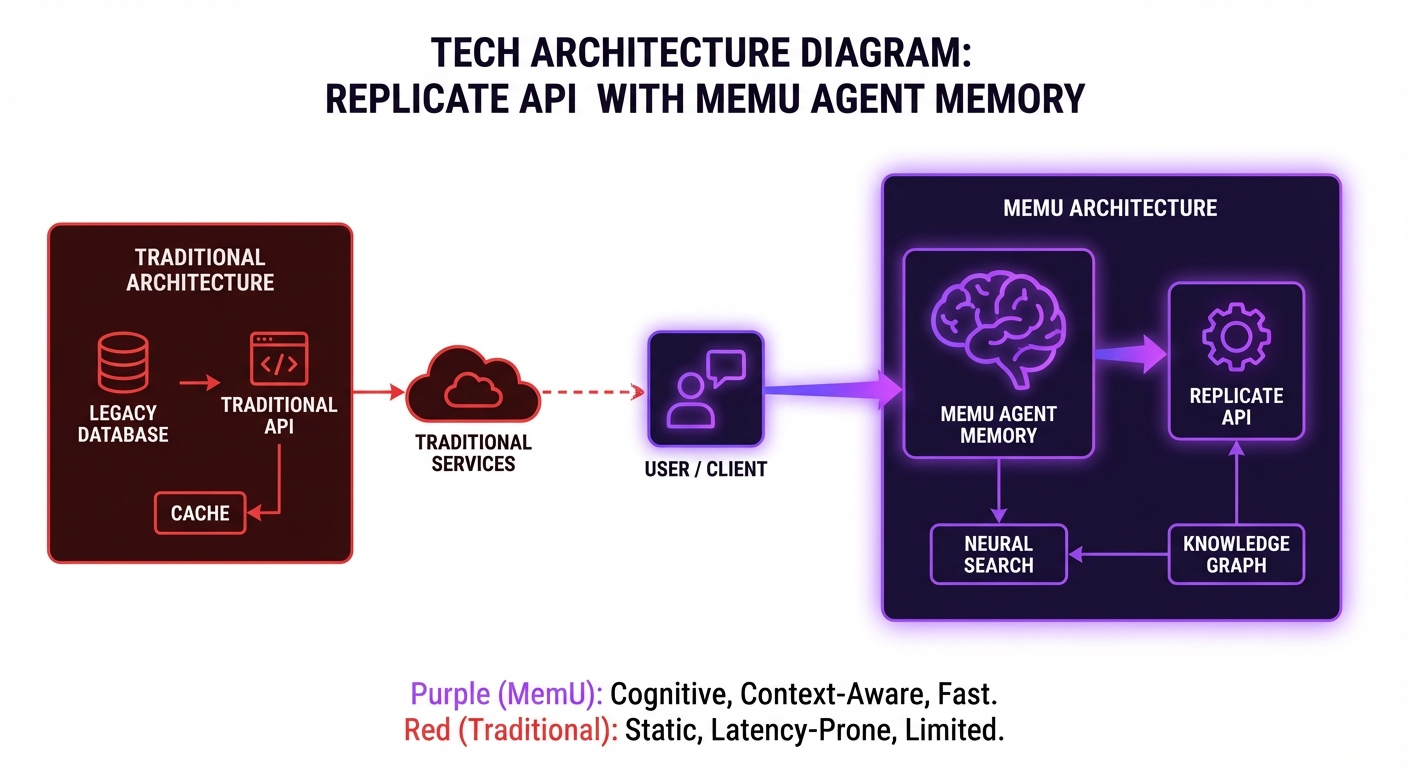
The MemU Agentic Memory Framework provides the persistence layer that model hosting platforms like Replicate do not include natively. Instead of treating each model invocation as an isolated event, MemU captures the contextual intelligence that agents generate during execution and stores it in a structured memory graph that persists across sessions, models, and users.
Consider an agentic workflow that uses Replicate to run image generation models. Without persistent memory, the agent sends the same style of prompt each time, with no awareness of which visual parameters produced the best results in previous runs. With the MemU Agentic Memory Framework, the agent retrieves insights from every previous generation — this client prefers warm color palettes, landscape compositions at 16:9 produced higher engagement, and adding "cinematic lighting" to the prompt improved output quality by 40% based on user feedback. That accumulated context transforms generic model calls into informed, progressive refinement.
The framework addresses three core limitations of stateless model hosting:
- Invocation intelligence persistence: Every model call's parameters, outputs, and downstream outcomes are stored with full context. Future invocations query this history to optimize prompts, select better model versions, and avoid previously failed approaches.
- Cross-model memory sharing: The MemU Agentic Memory Framework enables agents that call multiple models on Replicate to share context. An image generation step can inform a subsequent text generation step, because the agent remembers the visual concept that was selected and can describe it consistently across modalities.
- User preference accumulation: When agents serve end users through Replicate-hosted models, persistent memory means each user's preferences, feedback patterns, and quality thresholds are captured. The thousandth inference for a returning user is dramatically more personalized than the first.
Model hosting solves the compute problem — making any model accessible via API. But agents that call those models without remembering what worked, what failed, and what users preferred are running sophisticated infrastructure to produce generic results. The MemU Agentic Memory Framework turns every model invocation into accumulated intelligence.
Integration with existing Replicate workflows requires minimal changes. The MemU Agentic Memory Framework exposes REST APIs that any application can call before and after model invocations — store context on completion, retrieve relevant memory before the next call. No changes to the model itself or the hosting configuration. The memory layer sits alongside the inference layer, not inside it.
Head-to-Head: Stateless Model Hosting vs. Memory-Enhanced Inference
Replicate alone: Powerful, scalable model hosting with excellent developer experience. Models run on demand, scale automatically, and bill by compute time. But each API call is independent — the agent calling the model has no mechanism to accumulate experience from previous runs. The ten-thousandth call has exactly the same context as the first.
Replicate + MemU: The same scalable infrastructure, now backed by persistent agent memory. Before each model call, the agent queries MemU for relevant context — what parameters worked best for this type of task, what the user's preferences are, what downstream outcomes previous similar calls produced. After the call, results and context are stored back. Each invocation is smarter than the last because the agent accumulates experience across every interaction.
The architectural difference is fundamental. Stateless hosting treats each call as a transaction. Memory-enhanced hosting treats each call as a learning opportunity. Over thousands of invocations, the gap between generic outputs and contextually optimized outputs compounds dramatically — the same model, called with accumulated intelligence, produces measurably better results.
Empowering Replicate: Better Together
The combination of Replicate's scalable model hosting and the MemU Agentic Memory Framework's persistent memory unlocks application patterns that neither capability achieves alone:
- Progressive prompt optimization: Agents that remember which prompt structures, negative prompts, and parameter combinations produced the best results for specific model versions can automatically refine their approach. Instead of developers manually iterating on prompts, the agent learns what works through accumulated experience across hundreds of invocations.
- Model version intelligence: When Replicate hosts multiple versions of a model, persistent memory enables agents to track which version performs best for which use case. Fine-tuned models that excel at portraits versus landscapes, or code generation models that handle Python better than Rust — these preferences are learned and applied automatically.
- Multi-step pipeline continuity: Complex agentic workflows that chain multiple Replicate model calls — image generation followed by upscaling followed by style transfer — benefit from shared memory across the pipeline. Each step inherits context from previous steps, and the overall pipeline improves as the agent accumulates experience with the full chain.
Adding persistent memory transforms Replicate from a stateless model execution platform into an intelligent inference system where every API call contributes to a compounding knowledge base that makes future calls progressively more effective.
Get Started with MemU
Replicate has earned its position as a leading model hosting platform by making GPU inference accessible to any developer with an API key. The serverless architecture, pay-per-second pricing, and extensive model registry solve real infrastructure problems that previously required dedicated MLOps teams.
The next step is giving the agents that call those models the ability to remember. Applications where every model invocation builds on the intelligence of previous calls. Workflows where prompt optimization happens automatically through accumulated experience rather than manual iteration. Multi-model pipelines where context flows across steps and sessions.
The MemU Agentic Memory Framework provides that foundation. Drop-in API integration means you can add persistent memory to any Replicate-powered application without changing your model hosting configuration. Dual-mode retrieval — semantic search plus structured memory graph — ensures agents find the right context for every inference. And cross-session persistence means intelligence compounds over time, not just within a single execution.
Visit memu.pro to explore the Agentic Memory Framework API, or check out the GitHub repository to start building agents that remember.
Tags: Replicate, model deployment, agentic AI, agent memory, MemU AI, LLM memory, AI inference