Replit Agent Builds Full-Stack Apps From a Single Sentence — Without Learning From the Last Hundred Apps It Built


Replit Agent has turned "build me an app" into a literal command. Describe what you want in natural language, and Replit Agent scaffolds the full-stack application — frontend, backend, database, authentication, deployment — in minutes. The agent provisions infrastructure, installs dependencies, writes application code, and deploys to a live URL, all from a conversational interface that requires zero technical setup.
This isn't code generation — it's application generation. Replit Agent handles the architectural decisions that typically require senior engineering judgment: choosing frameworks, structuring the database schema, implementing authentication flows, and wiring API endpoints. For prototyping, MVPs, and internal tools, it eliminates the gap between idea and working software.
But Replit Agent builds each application in isolation. The patterns it discovers — which architectures work for which use cases, which dependencies cause deployment issues, which database schemas scale better — don't carry forward to the next project.
Replit Agent: What Everyone's Getting Right (And Missing)
The democratization of software development is real. Replit Agent enables product managers, designers, entrepreneurs, and domain experts to create working applications without writing code or managing infrastructure. The barrier from concept to deployed application has dropped from weeks to minutes.
For developers, Replit Agent accelerates prototyping dramatically. Instead of spending hours on boilerplate setup — configuring build tools, setting up databases, writing authentication middleware — the agent handles infrastructure so developers can focus on business logic.
The gap emerges over time. A human developer who builds 100 applications accumulates deep architectural intuition: which patterns serve which requirements, which frameworks pair well, which database choices cause scaling problems. Replit Agent's 100th application benefits from no more accumulated wisdom than its 1st. Every architectural decision is made from the model's training knowledge alone.
What Replit Agent Does With Project Context Today
Within a project session, Replit Agent maintains coherent understanding of the application being built. It tracks file structure, dependency state, database schema, and deployment configuration. The agent can iterate on an application across multiple conversation turns, understanding how changes to the backend affect the frontend.
Replit also maintains project history within its platform — previous deployments, code versions, and configuration snapshots persist in the Replit workspace. This provides version control and rollback capability.
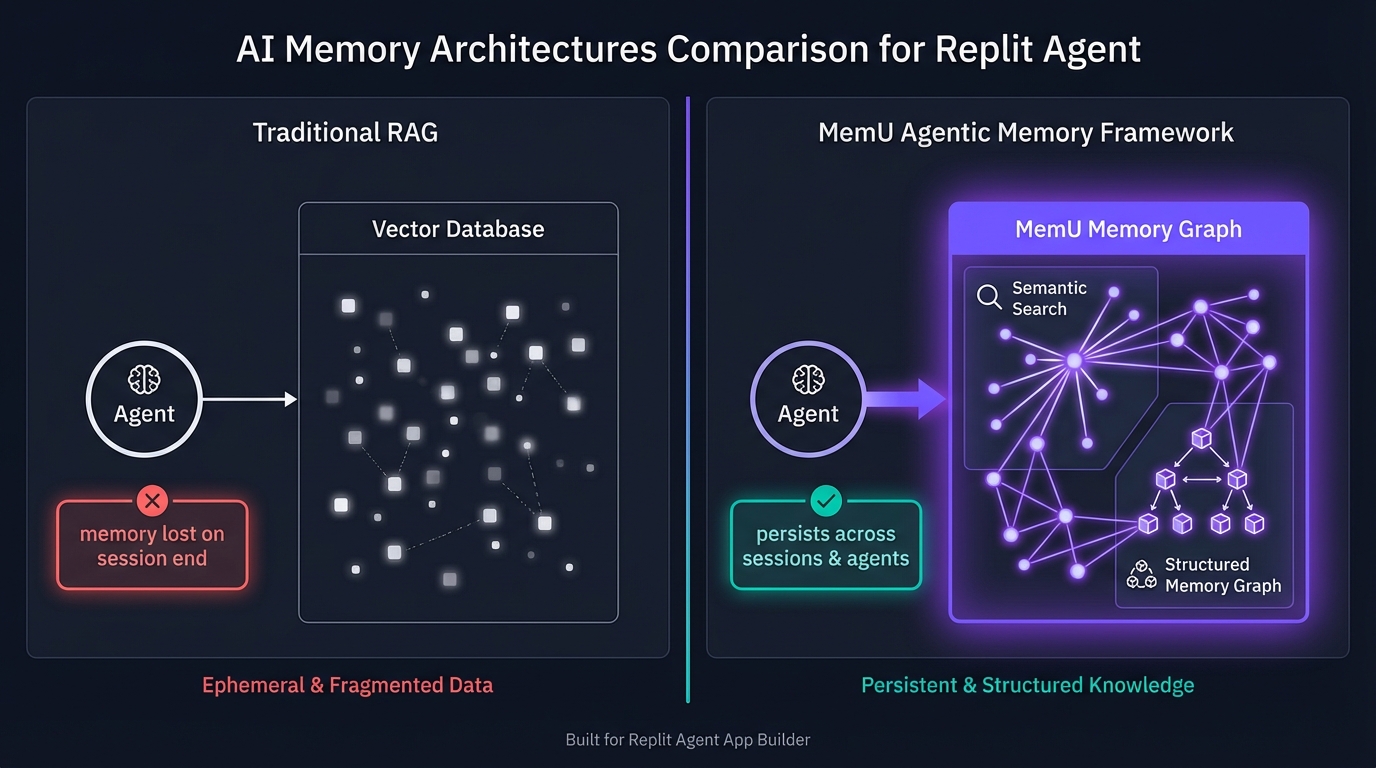
What doesn't persist is the agent's architectural understanding. The reasoning behind why it chose PostgreSQL over MongoDB, why it structured the API with that specific pattern, why it implemented authentication that particular way — this decision context evaporates between sessions. Competing app builders — Vercel's v0, Bolt.new, Lovable — face identical limitations.
The MemU Agentic Memory Framework: App Building That Gets Smarter
The MemU Agentic Memory Framework gives application-building agents persistent architectural memory. Each project's decisions, outcomes, and patterns feed into a growing knowledge base that informs future projects.
Imagine building a series of SaaS applications with Replit Agent. Project 1 is a CRM — the agent picks a tech stack, builds the app, and discovers during deployment that the chosen ORM doesn't handle the required relationship complexity well. Project 3 is a project management tool with similar relationship patterns. Without MemU, the agent makes the same ORM choice and hits the same limitation. With the MemU Agentic Memory Framework, the agent retrieves the lesson from Project 1 and selects a more appropriate solution from the start.
The framework enables three forms of accumulated intelligence:
- Architectural pattern memory: Which tech stacks, frameworks, and design patterns produced successful outcomes for which types of applications. The MemU Agentic Memory Framework builds a structured map of architectural decisions and their results.
- Failure avoidance: Dependency conflicts, deployment issues, scaling bottlenecks, and performance problems encountered in previous projects persist as warnings. The agent avoids known pitfalls rather than rediscovering them.
- User preference learning: Code style preferences, framework choices, deployment targets, and architectural philosophies accumulate so the agent increasingly builds applications that match the user's expectations without explicit instruction.
The difference between a junior developer's first app and a senior architect's hundredth isn't talent — it's accumulated experience. MemU gives app-building agents that same advantage.
Head-to-Head: Isolated Projects vs. Learning Projects
Replit Agent alone: Full-stack application generation from natural language with automated deployment. Each project built from the model's general training knowledge. No cross-project learning — the same architectural mistakes can repeat across projects.
Replit Agent + MemU Agentic Memory Framework: Same rapid app generation plus persistent project memory. Architectural decisions from previous projects inform new ones. Technology choices improve based on actual outcomes. Sub-100ms memory retrieval means the agent checks its experience base before making architectural decisions without adding noticeable latency.
This advantage applies to every AI app builder in the market — v0, Bolt.new, Lovable, and Cursor Composer all generate applications without cross-project learning. MemU provides the experience layer that any builder can use.
Empowering Replit Agent: Better Together
MemU doesn't change how Replit Agent builds apps — it provides the experience that makes each successive app better than the last.
- Portfolio optimization: Teams building multiple applications through Replit Agent develop a shared architectural memory. Lessons from one project automatically inform all future projects for the entire team.
- Iteration acceleration: When revisiting an existing project, the MemU Agentic Memory Framework provides full decision context — why the agent made each architectural choice — enabling faster, more informed iteration.
- Cross-platform learning: Build with Replit Agent today and Vercel v0 tomorrow — MemU maintains your project experience across any app-building platform.
Get Started with MemU
Replit Agent makes application development accessible to everyone. The MemU Agentic Memory Framework makes that accessibility compound — each application built makes the next one better. Integration is a single API layer that captures architectural decisions and surfaces relevant experience.
Visit memu.pro to explore the Agentic Memory Framework API, or check out the open-source repository on GitHub to start building persistent memory into your AI application development workflow today.
Tags: Replit Agent, AI app builder, agentic memory, no-code development, MemU AI, application generation, persistent memory, full-stack AI