Retell AI Builds Human-Like LLM Voice Agents for Real Phone Calls — But Inbound and Outbound Fluency Without Memory Still Feels Like a First Date Every Time


Retell AI focuses on a concrete product surface many teams underestimate until they hear it live: large language model voice agents that sound human enough for real telephone conversations. The platform supports inbound and outbound calling patterns, with Node and Python SDKs that let engineers embed call orchestration into backends they already maintain. Typical deployments span AI receptionists that answer and route, lead qualification flows that ask discovery questions without sounding scripted, and customer support lines where natural turn-taking reduces hang-ups compared to rigid IVR trees.
The differentiation the product pursues is conversational quality under phone constraints—barge-in, background noise, and the social expectation that a voice on the line “gets” context quickly. That is hard engineering. What remains outside the core product boundary is durable memory of the relationship behind the voice. A fluent agent that forgets yesterday’s appointment preference or the fact that this lead already declined a demo slot performs like a talented actor handed a new script on every ring.
Node and Python SDKs lower integration friction for the majority of SaaS backends, yet SDK convenience does not imply cross-call recall. Teams still must decide where persistent memory lives and how agents query it before the opening greeting.
Human-like phone agents without persistent memory maximize polish per sentence while minimizing continuity per customer.
Retell AI: What Goes Right on the Wire (And What Breaks Across Sessions)
Strengths of the Retell AI approach map cleanly to go-to-market motions. Inbound receptionist scenarios need reliable handoffs and calm pacing; outbound qualification needs persistent curiosity without sounding invasive. SDKs in Node and Python match how most SaaS teams integrate telephony providers, CRMs, and scheduling APIs.
Where teams feel friction is not usually the first minute—it is the fifth call from the same number, the return after a partial resolution, or the outbound retry after a polite “not now.” Static variables in a single session help, but they evaporate when the carrier drops the leg or the job restarts. CRM notes help humans; they are often too coarse for an LLM to retrieve under latency pressure unless distilled into structured memory.
Competing voice stacks face the same wall: session state is not organizational memory. The platform gives you the voice; your architecture must decide whether conversations compound.
Outbound campaigns especially expose the memory gap: a polished script sounds cheap when it ignores prior objections. Inbound support exposes it when customers must re-audit their environment on every call. Memory is the difference between sounding human and behaving thoughtfully.
The MemU Agentic Memory Framework: Phone Memory That Outlasts the Call
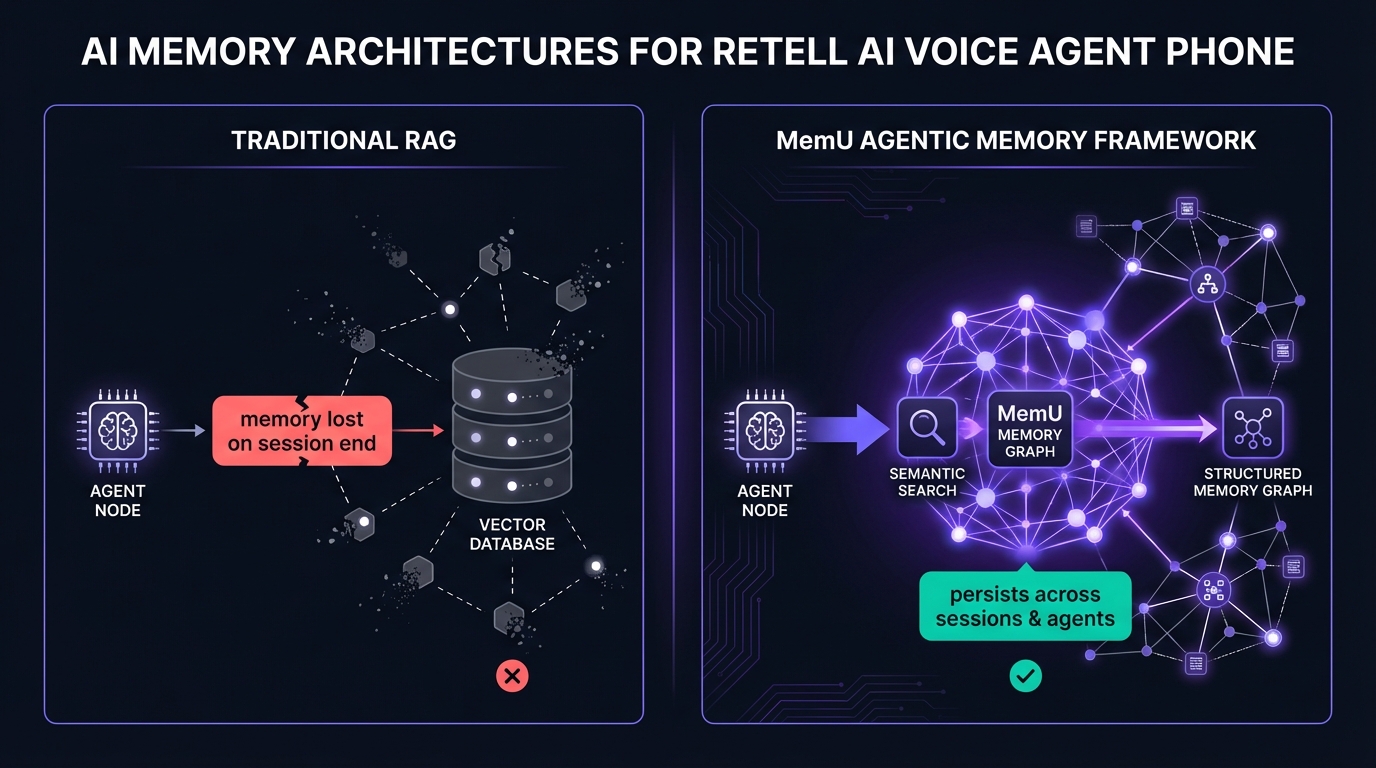
The MemU Agentic Memory Framework stores caller- or account-scoped memories—preferences, objections that mattered, successful resolution paths—that assistants retrieve before answering or dialing. Memory is structured for machine retrieval, not just human scrolling through call logs.
Consider outbound lead qualification. Without memory, every dial repeats the same discovery arc. With MemU, the agent recalls that this prospect prefers afternoon callbacks, responded well to a concise ROI framing, and asked for a security FAQ last time—opening with continuity that respects their time.
Pairings that matter for Retell AI deployments in production:
- Receptionist continuity: Remember frequent callers’ routing preferences and spelling quirks so the AI receptionist feels like a familiar desk, not a generic attendant.
- Support recurrence: Encode which troubleshooting path worked, which failed, and what was promised for follow-up—retrieved automatically on the next inbound leg.
- Outbound discipline: Track cadence, consent nuances, and do-not-ask-again topics to keep human-like tone aligned with compliant practice.
The MemU Agentic Memory Framework gives voice programs something telephony alone cannot: a story that persists when the line goes quiet.
Hook MemU into your call lifecycle using the same webhooks or server processes that already drive Node or Python flows. At session start, hydrate prompts with retrieved memories; at session end, write verified summaries. The MemU Agentic Memory Framework supports semantic and structured retrieval so both vague preferences and precise identifiers remain accessible.
Compliance teams often require consent logs and opt-out flags; pair those records with MemU memories so outbound agents never re-ask prohibited topics. The guardrail is stronger when memory and policy systems agree.
For AI receptionists, memory means returning callers hear recognition cues that feel earned—“welcome back, should I route you to billing again?”—without exposing sensitive details aloud. For support lines, memory means the agent proposes the next step that last time moved the ticket forward instead of repeating a checklist the customer already completed. These are product decisions as much as ML decisions, and they require a memory substrate designed for agents, not only for supervisors reading transcripts after the fact.
Head-to-Head: Running Retell AI With and Without MemU
Voice agents alone: Strong LLM voice agents for inbound and outbound phone workloads, human-like delivery, and pragmatic SDKs for Node and Python integrations—ideal for receptionist, lead qualification, and support entry points when you build on Retell AI. Weak when your KPI is repeat-call resolution or outbound yield on nurtured leads, without custom databases you maintain yourself.
Retell AI plus MemU: Same voice quality with cross-call intelligence. Agents sound human and behave consistently with prior interactions, shrinking repetition and increasing conversion on follow-ups.
Empowering the Retell AI Stack: Better Together
Implementation patterns:
- Memory-aware prompts: Inject top-k memories into system instructions for voice agents while keeping token budgets controlled via MemU ranking.
- QA-linked updates: When supervisors mark a call excellent, promote its tactic summary into MemU for peers to reuse.
- Escalation handoff packets: Store concise memory bundles human agents receive when AI escalates, populated automatically from the MemU Agentic Memory Framework.
Together, Retell AI handles lifelike phone conversation mechanics; MemU handles the narrative capital those conversations should build. That division of labor lets product teams iterate on prompts and call flows without losing the cumulative intelligence that makes each iteration smarter than the last.
Get Started with MemU
If you run Retell AI for inbound receptionist, outbound qualification, or support calls via Node or Python, add the MemU Agentic Memory Framework so fluency compounds into familiarity instead of resetting each ring.
Start with one high-volume scenario—returns, scheduling, or tier-one triage—and instrument memory writes only for outcomes you trust. Expand namespaces as you validate quality, mirroring how you roll out new intents in the dialer. Incremental adoption keeps risk bounded while still capturing the cross-call gains that motivated the project, and it gives your QA team a narrow surface to review before you broaden scope.
Visit memu.pro to explore the Agentic Memory Framework API, and open the GitHub repository to connect persistent memory to your phone agents.
Tags: Retell AI, voice agents, phone AI, inbound outbound, lead qualification, agent memory, MemU AI