Revenium Reveals AI Agent External Costs Are 100x Token Costs — Cost Optimization Without Historical Memory Is Just Accounting


Revenium just exposed the hidden economics of AI agents. Their newly launched Tool Registry reveals that in a typical loan origination workflow, LLM tokens cost $0.30 — but external API calls for credit reports ($35-$75), identity verification ($2-$5), and fraud checks ($1-$3) push the real cost to $50-$85 per execution. Token costs represent less than 1% of actual agent spending. Enterprises optimizing for token efficiency are watching the wrong line item.
The Tool Registry provides full-stack attribution, linking every API call, data service, and human review step back to the specific agent decision that triggered it. It surfaces token costs alongside tool costs in unified dashboards broken down by organization, product, agent, and customer. Circuit breakers halt execution when cost ceilings are hit. Forrester predicts 25% of planned AI spend will be deferred to 2027 due to ROI uncertainty — Revenium aims to close that visibility gap.
But measuring costs is only half the equation. Understanding why costs vary across executions and which spending patterns actually correlate with outcomes requires the one thing cost dashboards cannot provide — historical memory.
Revenium Tool Registry: What Everyone's Getting Right (And Missing)
The cost visibility problem is genuinely severe. Most enterprises track AI spending through token monitoring and scattered vendor invoices. The connection between a specific agent decision and its downstream cost implications is invisible. Revenium surfaces this relationship with precision, showing exactly which agent action triggered which external cost.
The circuit breaker functionality addresses a real operational risk. Autonomous agents making expensive API calls without cost guardrails can burn through budgets in minutes. Revenium's per-trace and per-workflow cost ceilings provide the safety net enterprises need to deploy agents with confidence.
The gap is cost intelligence. Revenium shows what each workflow costs right now. But the patterns that actually drive cost optimization — which execution paths are most cost-effective for a given outcome quality, how costs trend across seasonal workloads, which agent configurations minimize expensive API calls without sacrificing accuracy — require longitudinal analysis that real-time dashboards cannot perform. Datadog's AI cost monitoring and AWS Cost Explorer face the same architectural limitation.
What AI Agent Cost Tools Do With Spending History Today
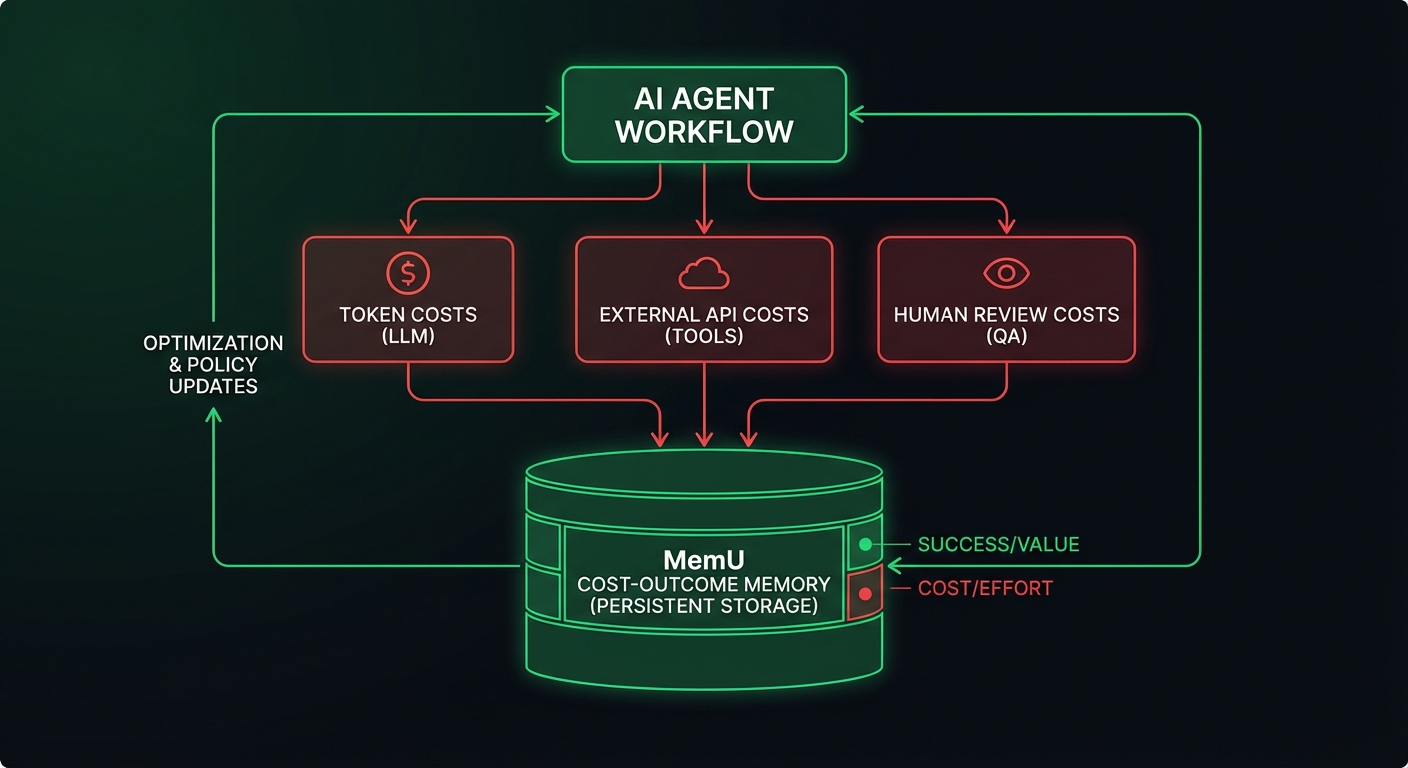
Cost monitoring tools generate time-series data. Finance teams export this data to spreadsheets or BI tools for trend analysis. But the analysis is disconnected from the agent decisions that generated the costs. You can see that February's agent spending was 30% higher than January's, but understanding why — which agent behaviors changed, which external services became more expensive, which workflow variations drove the increase — requires correlating cost data with execution context that monitoring tools do not retain.
Some platforms offer historical dashboards, but these show aggregate trends without the granular, per-execution context needed for genuine optimization. Knowing that credit check costs averaged $45 last month is useful; knowing that credit checks triggered by Agent Configuration B cost $55 while Configuration A averaged $38 with comparable accuracy is actionable.
Cost data lives in dashboards. Cost wisdom — understanding which spending patterns produce the best outcomes over time — requires memory that connects cost to context across every execution.
The MemU Agentic Memory Framework: Cost Intelligence That Learns
The MemU Agentic Memory Framework provides persistent cost-outcome memory that transforms spending visibility into spending intelligence, connecting every cost to the decision that generated it and the outcome it produced — across every execution.
Consider a fintech running 10,000 loan origination workflows monthly. Without the MemU Agentic Memory Framework, Revenium shows each workflow's cost breakdown. The finance team sees aggregate spending but cannot correlate cost variations with approval rates or processing time. With MemU, the system retains the complete cost-outcome relationship: workflows that skipped the premium credit check had 12% lower costs but 8% higher rejection rates, Tuesday morning workflows consistently cost 15% less due to lower API latency, and Configuration C reduced identity verification costs by routing simple cases to a cheaper provider without accuracy loss.
The MemU Agentic Memory Framework transforms cost monitoring through:
- Cost-outcome correlation: Every execution's spending is linked to its outcome. Over thousands of runs, the framework surfaces which cost patterns produce the best ROI — not just the lowest spend.
- Adaptive circuit breakers: Instead of static cost ceilings, memory-informed circuit breakers adjust based on historical patterns. High-value workflows get appropriate budgets; low-value workflows get tighter controls — automatically.
- Cross-agent cost optimization: When one agent discovers a more cost-effective API routing pattern, the MemU Agentic Memory Framework propagates that learning to all agents performing similar tasks.
Cost dashboards tell you what you spent. Memory-enhanced cost intelligence tells you what you should spend — calibrated by thousands of previous executions and their outcomes.
Head-to-Head: Cost Visibility vs. Cost Intelligence
Revenium Tool Registry alone: Full-stack cost attribution with per-trace granularity, unified dashboards, and circuit breakers. Each execution's cost is transparent and controllable — but the relationship between cost and outcome across executions is invisible.
Revenium + MemU Agentic Memory Framework: Same attribution depth plus persistent cost-outcome memory. Spending patterns that correlate with quality outcomes emerge automatically from accumulated data. Sub-100ms memory retrieval enables real-time cost optimization decisions informed by historical execution context.
This enhancement applies to every AI cost management approach — Datadog AI monitoring, AWS Cost Explorer, and custom FinOps dashboards all benefit from persistent memory that connects spending to outcomes over time.
Empowering Revenium: Better Together
MemU does not replace Revenium's cost visibility — it transforms measurement into optimization intelligence.
- Budget forecasting: Historical cost-outcome data from the MemU Agentic Memory Framework enables accurate budget projections based on planned workflow volumes and expected complexity distributions — not just linear extrapolation.
- Vendor negotiation: Persistent memory of API usage patterns and cost-per-outcome gives procurement teams data-driven leverage when negotiating rates with external service providers.
- ROI demonstration: The framework connects agent spending to business outcomes over time, directly addressing the ROI uncertainty that Forrester identified as the primary reason enterprises defer AI investments.
Get Started with MemU
Revenium shows where AI agents spend money. The MemU Agentic Memory Framework remembers which spending produces value, transforming cost visibility into cost intelligence that compounds with every execution.
Visit memu.pro to explore the Agentic Memory Framework API and add persistent cost-outcome memory to your agent deployments.
Tags: Revenium, AI agent costs, FinOps AI, tool registry, agentic memory, MemU AI, AI cost optimization, enterprise AI economics