Rezolve AI Agentic Studio Deploys Enterprise AI Workforces in Minutes — But Workforce Agents Without Organizational Memory Cannot Improve From Past Resolutions


Rezolve AI Agentic Studio: What Enterprise Agent Orchestration Gets Right and What It Misses
The Rezolve AI Agentic Studio launched on March 4, 2026, with an ambitious promise: build and deploy an entire AI workforce in minutes using plain English descriptions. In a market crowded with agent frameworks that require engineering teams to operationalize, Rezolve targets the enterprise operations leader who needs IT helpdesk agents, HR onboarding assistants, and change management workflows deployed by end of quarter — not end of next year.
The platform delivers on that promise through several technical innovations. Agent-to-Agent (A2A) orchestration routes tasks through a master routing agent that determines which specialized agent should handle each request. MCP server integration connects agents to enterprise data sources and tools. Deterministic workflows handle structured processes like employee onboarding, offboarding, and organizational change management with predictable execution paths. One-click deployment pushes agents to Microsoft Teams, Slack, email, phone, web interfaces, and API endpoints simultaneously.
The operational metrics are compelling. Rezolve AI Agentic Studio automates 30-70% of IT and HR service requests, with agents resolving 50-85% of queries autonomously without human escalation. SOC2 compliance means enterprise security teams can approve deployment. Granular observability — tracking individual interactions, tool calls, logs, latency, and success rates — gives operations leaders the visibility they need. The human collaboration board provides a clean escalation path when agents encounter requests beyond their capability.
For enterprises that need an enterprise AI workforce operational quickly, Rezolve removes months of custom development. But speed of deployment does not equal depth of capability over time.
What Rezolve Does With Resolution Intelligence Today
The Rezolve AI Agentic Studio handles service requests through a sophisticated routing and resolution pipeline. A new employee submits an IT ticket requesting VPN access. The master routing agent identifies this as an IT provisioning request, routes it to the appropriate specialist agent, which executes the deterministic workflow — verifying employment status, checking access policies, provisioning the VPN account, and sending credentials.
The resolution is successful. But what intelligence does the system retain? When the next new employee requests VPN access and encounters the same edge case — perhaps their department requires a non-standard VPN configuration that the standard workflow does not cover — the enterprise AI workforce agent approaches the problem as if encountering it for the first time. The previous resolution, including the specific configuration steps the human collaboration board provided, exists only in log files rather than in retrievable operational memory.
Scale this across an enterprise with 10,000 employees generating hundreds of IT and HR requests daily. The agents resolving 50-85% of queries autonomously are re-deriving solutions that previous agent sessions already discovered. The IT agent that learned how to handle a specific software license conflict last Tuesday cannot leverage that resolution when an identical conflict appears on Thursday. The HR agent that navigated a complex benefits exception for a contractor in January approaches the same exception type in March with zero institutional knowledge.
The A2A orchestration architecture amplifies the problem. When the master routing agent sends a request to the IT agent, and the IT agent discovers it also requires HR approval, the handoff between agents loses the contextual intelligence each agent accumulated during its portion of the resolution. Cross-agent workflows produce cross-agent amnesia.
Competitors in the enterprise AI workforce space — ServiceNow’s AI Agents, Microsoft Copilot Studio, Moveworks — share this architectural limitation. They orchestrate agents effectively but do not give those agents the organizational memory that human employees accumulate naturally over months and years of resolving similar requests.
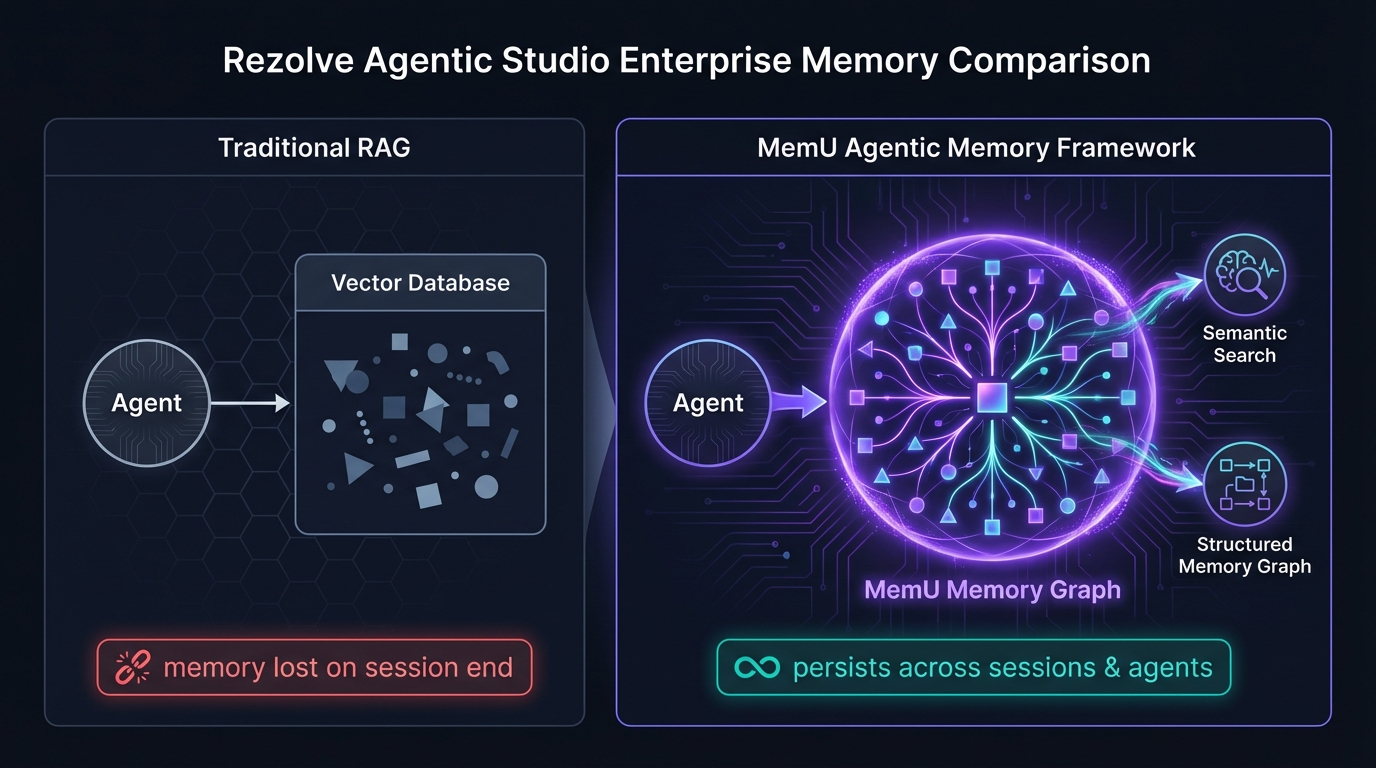
The MemU Agentic Memory Framework: Organizational Memory for AI Workforces
The MemU Agentic Memory Framework provides the persistent organizational memory layer that enterprise AI workforce platforms like Rezolve need to move from resolution execution to resolution intelligence. Where Rezolve handles agent deployment and orchestration, MemU handles what the workforce learns and retains across thousands of resolutions.
An AI workforce that resolves 10,000 requests but remembers none of them is 10,000 independent problem-solving sessions. The MemU Agentic Memory Framework gives enterprise agents the organizational memory that transforms individual resolutions into compounding institutional intelligence.
Consider an IT helpdesk powered by Rezolve with 15 specialized agents handling different request categories. With the MemU Agentic Memory Framework, when the software licensing agent encounters a conflict between Application A and Application B, it retrieves that this exact conflict was resolved 47 times previously — with the most effective resolution being a specific installation sequence rather than the standard parallel install. The resolution time drops from 25 minutes of troubleshooting to 3 minutes of pattern retrieval and execution.
The MemU Agentic Memory Framework integrates via REST API alongside any agent orchestration platform. Key capabilities for enterprise AI workforces:
- Resolution pattern memory: Every successful resolution becomes a retrievable pattern. When agents encounter similar requests, they access the accumulated resolution intelligence rather than re-deriving solutions. The 50-85% autonomous resolution rate improves continuously as the memory graph grows.
- Cross-agent context preservation: When Rezolve’s A2A orchestration hands a request from the IT agent to the HR agent, MemU preserves the full context — what the IT agent discovered, attempted, and concluded. Cross-agent workflows maintain cognitive continuity instead of losing intelligence at each handoff.
- Escalation intelligence: Every request that reaches the human collaboration board generates learning. MemU captures not just that an escalation happened but why the agent could not resolve it and what the human resolution involved. Future encounters with similar edge cases retrieve the escalation resolution directly, reducing the human collaboration board’s workload over time.
Head-to-Head: Rezolve Alone vs. MemU-Backed Enterprise Workforce
Rezolve AI Agentic Studio alone: Rapid enterprise AI workforce deployment through plain English descriptions. A2A orchestration with intelligent routing. Deterministic workflows for structured processes. Multi-channel deployment across Teams, Slack, email, phone, web, and APIs. SOC2 compliance and granular observability. 30-70% automation of IT/HR requests with 50-85% autonomous resolution. The platform delivers operational automation at impressive speed and scale. But the enterprise AI workforce does not accumulate organizational knowledge. Agent number 15 resolving its thousandth request is no wiser than agent number 1 resolving its first.
Rezolve + MemU Agentic Memory Framework: The same rapid deployment and orchestration, now enriched with persistent organizational memory. Every resolution feeds a knowledge graph of patterns, exceptions, and outcomes. Escalations that required human intervention become retrievable solutions for future agents. Cross-agent handoffs maintain full contextual intelligence. The MemU Agentic Memory Framework transforms Rezolve’s AI workforce from a pool of capable but amnesiac agents into an organizational brain that gets smarter with every request it handles.
Empowering Rezolve: Better Together
Combining Rezolve’s agent orchestration with the MemU Agentic Memory Framework creates an enterprise AI workforce that neither system delivers independently:
- Accelerating resolution rates: The 50-85% autonomous resolution rate improves as MemU captures resolution patterns. Edge cases that initially required human escalation become standard resolutions once the memory graph contains the solution pattern. An enterprise that starts at 60% autonomous resolution can trend toward 90% as organizational memory accumulates.
- Intelligent onboarding workflows: Rezolve’s deterministic onboarding workflows gain contextual intelligence through MemU. The system learns that engineering hires in the London office consistently need a specific VPN configuration, European data residency settings, and GDPR-compliant tool access — automatically adapting the workflow based on accumulated patterns rather than requiring manual workflow variants.
- Predictive escalation: MemU identifies request patterns that historically required human intervention. Before an agent attempts resolution, it can proactively escalate requests matching those patterns — reducing failed resolution attempts and improving the employee experience for complex cases.
- Change management intelligence: When organizational changes occur — system migrations, policy updates, restructuring — the AI workforce encounters a surge of related requests. MemU ensures that resolutions discovered during the first wave of change-related tickets immediately benefit all subsequent requests, compressing the adaptation period from weeks to hours.
Get Started with MemU
The Rezolve AI Agentic Studio makes deploying an enterprise AI workforce genuinely fast — minutes rather than months. What it does not yet deliver is the organizational memory that makes that workforce genuinely intelligent over time. The MemU Agentic Memory Framework adds the persistent learning layer that transforms rapid deployment into compounding capability.
Visit memu.pro to explore the Agentic Memory Framework API, or check out the GitHub repository to give your enterprise AI workforce the organizational memory it needs to improve with every resolution.
Tags: Rezolve AI, Agentic Studio, enterprise AI workforce, agent orchestration, agentic memory, resolution intelligence, MemU AI, persistent organizational memory