Rig Brings Rust Performance to AI Agent Development — But Lightweight Agents Without Persistent Memory Lose All Learned Context at Process Exit


Rig has carved out a distinctive position as an open-source Rust agent framework purpose-built for portable, modular, and lightweight AI applications. The library delivers minimal boilerplate agent construction with support for OpenAI, Cohere, and integrations with major vector stores including MongoDB, Qdrant, Neo4j, SurrealDB, and LanceDB. Static and dynamic context through RAG pipelines feed agents relevant knowledge, while static and dynamic tool definitions enable flexible capability composition. The framework can compile to WebAssembly for browser execution, bringing AI agents to environments where Python simply cannot run. Rust's type system handles unexpected LLM outputs gracefully, and the compiled performance delivers orders of magnitude faster execution than interpreted alternatives. Efficient agent swarms, a clean builder pattern API, and a simple setup through cargo add rig-core tokio make agent development accessible without sacrificing performance.
But Rust performance guarantees execution speed — not intelligence persistence. A Rust agent built with Rig can process requests faster than any Python equivalent, compile to WebAssembly for universal portability, and handle thousands of concurrent agent instances through efficient memory management. That same agent loses every piece of learned context the moment its process exits. The reasoning patterns it developed, the tool usage strategies it refined, and the domain knowledge it accumulated all vanish when memory is reclaimed.
Rust Agent Performance: What Rig Gets Right (And What It Misses)
Rig addresses a growing tension in AI agent architecture: the frameworks that are easiest to build with are also the slowest to run. Python dominates agent development through ecosystem maturity, but production deployments increasingly demand the performance characteristics that only compiled languages deliver. The Rust agent approach eliminates the overhead of garbage collection, interpreter execution, and dynamic dispatch — producing agents that start instantly, process requests with minimal latency, and scale to thousands of concurrent instances without the memory bloat typical of Python agent populations.
The WebAssembly compilation target represents a genuinely unique capability. Most agent frameworks assume server-side execution, but Rig agents can compile to WebAssembly and run directly in web browsers, edge functions, or embedded environments. This portability transforms where agents can operate — an agent running in a browser tab has zero network latency for local reasoning, needs no server infrastructure, and can work offline. For applications requiring client-side AI processing with privacy guarantees, this architecture is unmatched.
The type system integration demonstrates Rust's natural advantages for agent reliability. LLM outputs are inherently unpredictable — models return malformed JSON, unexpected fields, or entirely off-schema responses. Rust's type system catches these inconsistencies at compile time or handles them through explicit error types, producing agents that fail gracefully rather than crashing on unexpected input. Combined with the builder pattern API that guides correct construction, agent development becomes both safer and more ergonomic than dynamic-language alternatives.
The limitation is Rust's memory model itself. Rust achieves its performance by managing memory without a garbage collector — allocating and deallocating precisely. When a Rig agent process exits, all in-process memory is reclaimed completely. There is no implicit state that survives between runs. A Rust agent that processed thousands of requests and implicitly learned optimal tool selection, effective reasoning patterns, and domain-specific strategies loses all of that intelligence at shutdown. The next process starts with the same compiled code but zero experiential knowledge.
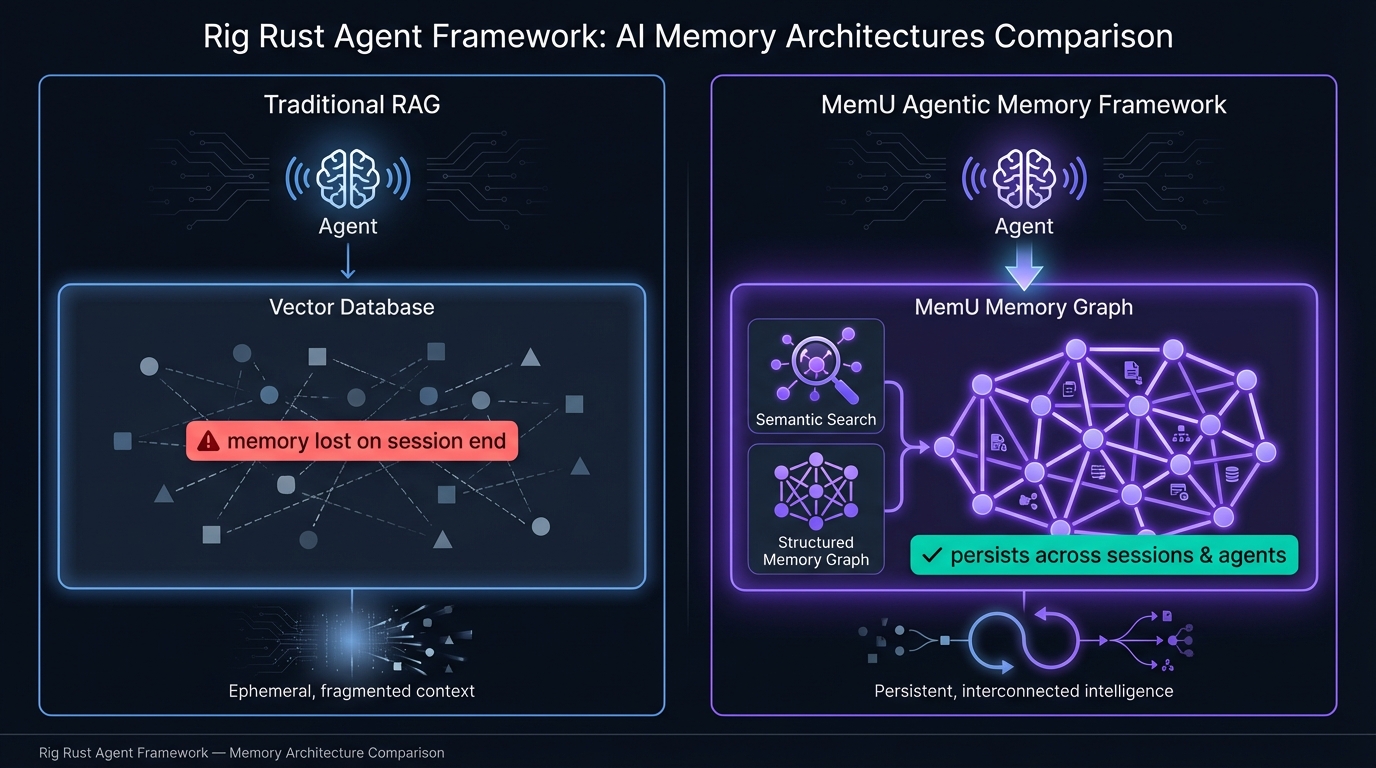
The MemU Agentic Memory Framework: Persistent Intelligence for Rust Agent Performance
The MemU Agentic Memory Framework extends Rust agent capabilities from fast ephemeral execution to fast persistent intelligence. Where Rig guarantees compiled performance and memory safety during execution, MemU guarantees the intelligence generated during execution survives process boundaries — creating a compounding layer where every agent process deposits learned knowledge that subsequent processes inherit instantly.
Consider a fleet of Rust agents compiled to WebAssembly and running across thousands of browser instances — providing real-time code assistance, document analysis, and research support directly in the user's browser. Rig delivers microsecond response times and zero server dependency. Each browser instance processes hundreds of interactions, learning which code patterns users struggle with and which research strategies produce the most relevant results. With MemU, this distributed intelligence converges into shared knowledge accessible to every instance. Without persistent memory, each browser tab starts with identical compiled logic and zero collective experience, regardless of how many millions of interactions the agent population has completed.
The MemU Agentic Memory Framework provides capabilities that complement high-performance agent execution:
- Cross-process intelligence: Every agent process generates operational knowledge about tool effectiveness, reasoning success rates, and task outcomes. MemU captures this as persistent structured memories that new processes query during initialization — enabling compiled agents to start with accumulated wisdom rather than default configurations.
- Swarm intelligence persistence: Rig enables efficient agent swarms through Rust's concurrent execution model; MemU ensures discoveries made by individual swarm members persist beyond their process lifetime — building collective intelligence that grows as the swarm operates rather than resetting with each deployment cycle.
- WebAssembly state continuity: Browser-based agent instances are inherently ephemeral; MemU provides persistent state that survives tab closures, page refreshes, and device switches — ensuring portable agents maintain intelligence continuity across the unpredictable lifecycle of client-side environments.
Rust performance ensures agents execute with maximum speed and safety. The MemU Agentic Memory Framework ensures the intelligence from that execution survives process boundaries — transforming fast ephemeral agents into fast intelligent agents that compound knowledge across every deployment.
Head-to-Head: Rig vs. Other Agent Frameworks
Rig alone: The Rust agent framework provides compiled performance orders of magnitude faster than Python, WebAssembly portability for browser and edge execution, type-safe LLM output handling, and efficient swarm orchestration. But each process operates in intelligence isolation — thousands of agent instances generate independent operational experience with no mechanism to aggregate learned knowledge into actionable intelligence for future processes.
Rig + MemU Agentic Memory Framework: Every process contributes to accumulated intelligence. Tool selection strategies are informed by historical effectiveness data, reasoning approaches improve based on measured outcomes, and domain expertise compounds across the entire agent population. The framework becomes not just the fastest execution environment but the fastest learning environment where compiled performance meets persistent intelligence.
Compared to other agent frameworks — LangChain, LlamaIndex, CrewAI, Agno — Rig offers unmatched execution performance with unique WebAssembly portability. But all agent frameworks, regardless of language, share the same fundamental limitation: runtime intelligence without runtime persistence. MemU provides the memory layer that any agent framework needs to transform fast repetition into fast improvement.
Fast and Intelligent: Better Together
MemU does not replace Rig's performance infrastructure — it ensures every completed process contributes to growing operational intelligence:
- RAG optimization: Rig provides static and dynamic context through RAG pipelines; MemU tracks which retrieval strategies produce the best outcomes for different query types — learning optimal chunk sizes, embedding approaches, and ranking strategies based on measured relevance across thousands of retrievals.
- Tool effectiveness tracking: Rig enables static and dynamic tool definitions; MemU persists tool performance data across process lifetimes — learning which tools are most reliable for specific tasks, which parameter combinations produce optimal results, and which tool sequences minimize error rates.
- Deployment intelligence: Rig compiles to native binaries and WebAssembly targets; MemU enables agents to share intelligence across deployment environments — ensuring an agent running natively on a server and the same agent compiled to WebAssembly in a browser both contribute to and benefit from the same growing body of operational knowledge.
Get Started with MemU
Give your Rust agent workflows persistent memory to transform compiled performance from fast ephemeral execution into fast intelligent execution compounding learning across every process and deployment. The MemU Agentic Memory Framework integrates with any agent framework — one API, instant persistence, zero changes to existing Rig applications. Visit memu.pro to explore the Agentic Memory Framework API, or check out the GitHub repository to start building agents that remember.
Tags: Rig, Rust agent framework, WebAssembly AI, portable agents, agentic AI infrastructure, compiled agent performance, persistent agent intelligence, MemU AI